
Why Crane Quotes Vary So Much: The 5 Key Configuration Items That Determine Price
A Procurement Guide from DONGQI CRANE for Global Industrial Buyers
You send the same Request for Quotation (RFQ) to three crane manufacturers. The specifications are identical—”10-ton overhead crane, 20-meter span, 8-meter lift height.” One supplier quotes $18,000. Another quotes $31,000. The third quotes $47,000.
For the same 10-ton capacity.
If you have ever found yourself staring at three wildly different quotes wondering whether you are being overcharged by one supplier or under-spec’d by another, you are not alone. This scenario plays out daily in procurement offices around the world, and it reveals a fundamental truth about crane purchasing: capacity tells you almost nothing about price.
At DONGQI CRANE, a Sino-New Zealand joint venture with over 40 years of manufacturing experience, we believe that informed buyers make better decisions. With our 240,000-square-meter facility in Changyuan, China—the “Cradleland of Cranes”—and products exported to 96+ countries, we have seen firsthand how intelligent procurement differs from reactive purchasing.
This guide reveals the five hidden configuration items that separate an $18,000 crane from a $47,000 crane—even when both are rated for 10 tons. Understanding these five items will transform how you evaluate quotes and ensure you pay for exactly what your operation needs, nothing more and nothing less.
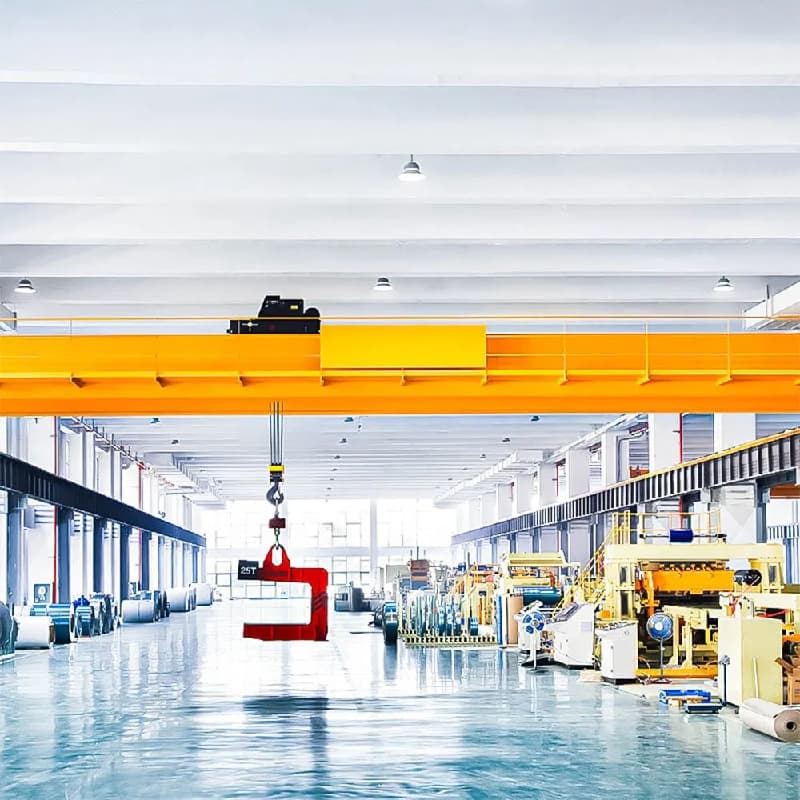
The 5 Key Configuration Items That Determine Crane Price
| # | Configuration Item | Price Impact | What It Actually Affects |
|---|---|---|---|
| 1 | Work Duty Classification (A3/M3 vs. A7/M7) | 30–100% | Structural durability, motor sizing, component quality |
| 2 | Structural Configuration (Single vs. Double Girder) | 40–80% | Load capacity, span capability, hook height, runway costs |
| 3 | Electrical Control System (Pendant vs. VFD Automation) | 15–30% | Operational precision, energy efficiency, component lifespan |
| 4 | Hoist Type and Configuration | 20–40% | Lifting speed, durability, maintenance requirements |
| 5 | Component Brand and Material Quality | 10–25% | Long-term reliability, spare parts availability, TCO |
The multiplier effect is significant: a crane that is premium on all five items can cost two to three times more than a budget configuration—even with identical capacity. Understanding the trade-offs behind each item is essential to making the right procurement decision.
Configuration Item #1: Work Duty Classification
The single biggest driver of price difference—and the most commonly overlooked
Work duty classification—expressed as A3/M3 through A8/M8 under FEM/ISO standards—defines how intensely a crane is designed to operate. It is not about how much weight you lift once; it is about how often you lift it, how fast you move it, and how many years it must survive.
Cranes with a higher duty cycle are built for tougher, more frequent operations and come with a higher price tag due to more durable components, increased motor power, and specialized design features. Light-duty cranes can use less expensive materials since the intensity of use is much lower, allowing manufacturers to use lighter and more cost-effective materials, thereby reducing production costs.
How Duty Class Affects Every Component:
| Duty Class | Typical Application | Motor & Gearbox | Structural Steel | Price Premium vs. A3/M3 |
|---|---|---|---|---|
| A3 / M3 (Light) | Maintenance bay, occasional use | Standard duty, lower torque | Lighter beam sections | Baseline |
| A5 / M5 (Medium) | General manufacturing, daily production | Reinforced gearing, better cooling | Thicker web plates | +30–50% |
| A7 / M7 (Heavy) | Steel mill, continuous operation | Heavy-duty motors, forced cooling | Box girders, fatigue-resistant design | +80–100%+ |
The work duty classification directly influences the design, strength, and capabilities of the crane. Overhead cranes with a high-duty cycle must be built from stronger, more durable materials to withstand frequent use and heavy loads—including stronger beams, heavier-duty motors, and more robust wheels, gears, and other moving parts.
Real-World Example: An overhead crane built for A7 duty cycle will typically cost more because the materials must be rated for high tensile strength and fatigue resistance. These cranes are often equipped with more advanced features such as high-duty hoists, reinforced lifting hooks, and thicker structural beams.
The Buyer’s Risk: Ordering an A3 crane for an A7 application leads to premature gearbox failure, cracked structures, and voided warranties—usually within the first year. The “savings” evaporate in repair costs and lost production.
DONGQI CRANE Approach: Our QD series double girder overhead crane is designed for A5 duty as standard, with lifting capacities from 5 to 320 tons and spans up to 35.5 meters—delivering exceptional performance for heavy-duty crane operations. For more demanding applications, we offer custom configurations up to A7/A8 duty classification, ensuring your crane is engineered precisely for your operational intensity—not over-spec’d and over-priced, nor under-spec’d and destined to fail.
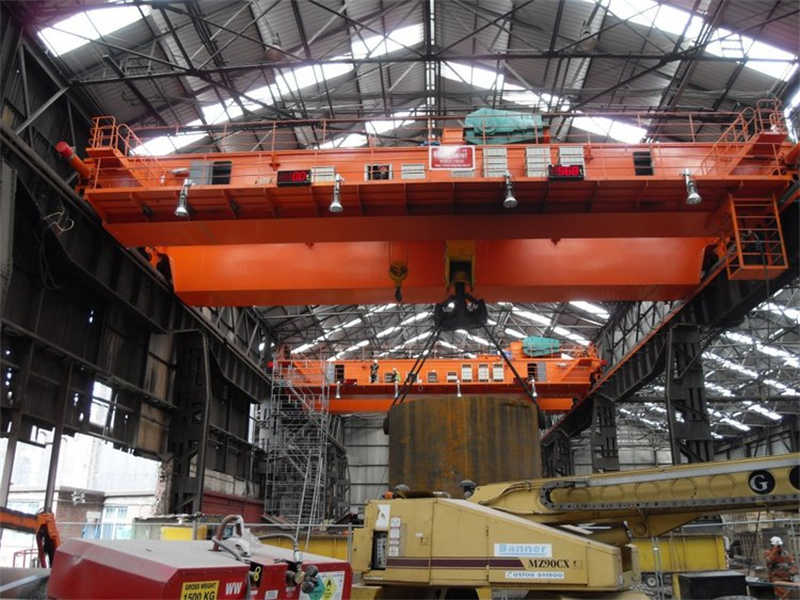
Configuration Item #2: Structural Configuration (Single Girder vs. Double Girder)
The foundation decision that sets the entire cost structure
The choice between single girder and double girder construction affects more than just the crane itself—it influences building requirements, runway costs, installation complexity, and long-term operational flexibility.
Single Girder vs. Double Girder: The Complete Cost Picture
| Factor | Single Girder | Double Girder |
|---|---|---|
| Crane Equipment Cost | Lower (baseline) | 40–80% higher |
| Runway & Building Cost | Lighter runway beams; lower building steel | Heavier runway beams; reinforced structure |
| Hook Height Advantage | Hoist hangs below girder, reducing usable lift | Hoist sits on top of girders, maximizing hook height |
| Maximum Practical Capacity | Typically up to 20 tons | 5 to 500+ tons |
| Maintenance Access | More compact, harder to service | Walkway platforms standard; easier inspection |
| Lifespan | 15–25 years | 30–50 years |
Real-World Cost Comparison: A 10-ton single girder overhead crane with a 30-foot span may cost approximately $22,000–$55,000. The same capacity in a double girder configuration with comparable specifications typically ranges from $35,000–$80,000—a premium of 40–80% depending on duty class and additional features. Span length further compounds this difference: spans over 30 meters often call for fabricated box beams, camber shaping, and bracing, boosting steel usage by 30–50% or even more.
When Single Girder Makes Sense:
- Lifting capacity up to 20 tons
- Span under 25 meters
- Light to medium duty cycle
- Existing building with limited runway capacity
- Budget-constrained projects
When Double Girder Is Worth the Premium:
- Lifting capacity above 20 tons
- Spans exceeding 25 meters
- Medium to heavy duty cycle
- Maximum hook height required (low-headroom applications)
- Long-term asset with 30+ year expected life
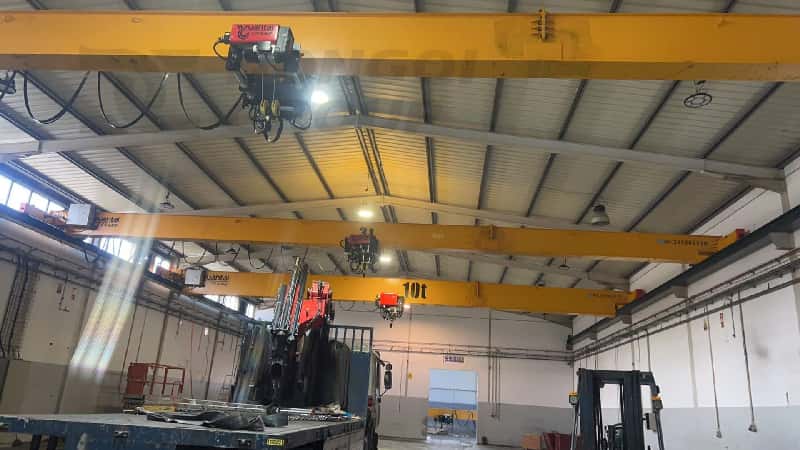
DONGQI CRANE Approach: Our HD series single girder overhead cranes provide economical solutions for 1–20 ton applications with spans up to 31.5 meters, featuring smooth operation with soft start/stop functionality for enhanced safety. For heavy industrial applications, our QD and QDX double girder series deliver capacities from 5 to over 500 tons, with fully customizable spans, lift heights, and duty classifications engineered for decades of reliable service.
Configuration Item #3: Electrical Control System
Where the difference between “functional” and “precise” lives
The electrical control system is the crane’s brain. It determines how smoothly loads accelerate and decelerate, how precisely they can be positioned, how much energy the crane consumes, and how much mechanical wear accumulates over time. This is where quotes can diverge by 15–30% for otherwise identical structural specifications.
Control System Comparison: The Price-Performance Spectrum
| Control Configuration | Relative Cost | Key Features | Best For |
|---|---|---|---|
| Pendant Control + Direct-On-Line | Baseline | Simple operation, abrupt starts/stops, lowest cost | Occasional use, non-critical positioning |
| Radio Remote + Two-Speed | +10–15% | Operator mobility, improved load control | Regular production, moderate positioning needs |
| VFD + PLC Automation | +15–30% | Smooth acceleration/deceleration, precision positioning, energy savings, extended component life | Continuous production, precise load placement, automated workflows |
Variable Frequency Drives (VFDs) represent the most significant control system upgrade. They control motor speed electronically rather than mechanically, eliminating the abrupt current surges and mechanical shocks associated with direct-on-line starting. Advanced controls like VFDs add cost but improve safety and efficiency.
The Financial Case for VFDs:
- Energy Savings: VFD-controlled cranes consume 30–40% less electricity annually compared to equivalent two-speed systems
- Mechanical Wear Reduction: Smooth acceleration eliminates the shock loading that damages gears, brakes, and wire ropes
- Productivity Gains: Precision positioning reduces load swing and shortens cycle times
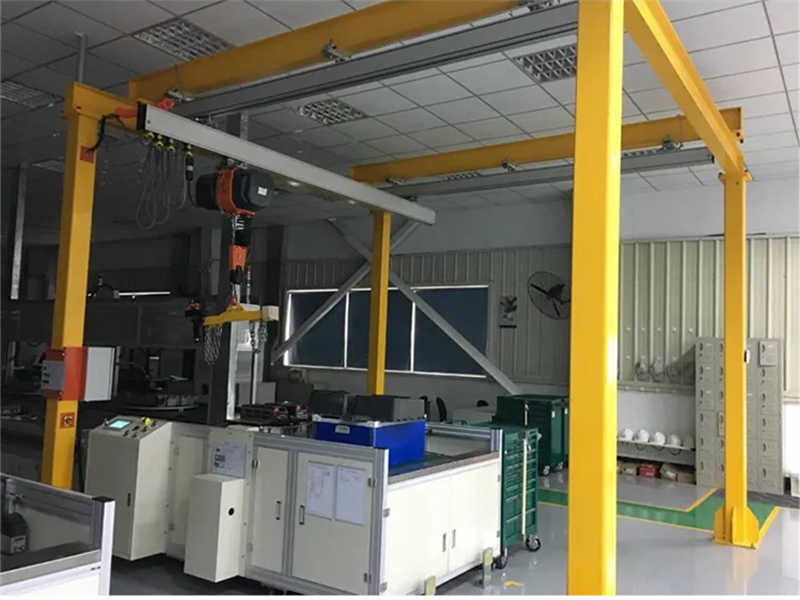
DONGQI CRANE Approach: Our cranes feature electrical systems built around premium components from Schneider Electric, with VFD options for precise speed control and energy efficiency. The QD series double girder crane includes frequency inverter control providing smooth and accurate speed adjustments for material lifting, with support for cabin, pendant, or wireless remote control operation. This modular approach allows buyers to select the control configuration that matches their operational requirements and budget—from basic pendant control for simple maintenance applications to fully automated PLC systems for production-critical installations.
Configuration Item #4: Hoist Type and Configuration
The heart of the crane—and a major cost differentiator
The hoist is the mechanism that actually lifts the load. It comprises the motor, gearbox, brake, drum, wire rope or chain, and hook assembly. Hoist selection affects initial equipment cost, ongoing maintenance expenses, and operational efficiency for the entire life of the crane.
Hoist Type Comparison: Cost and Capability
| Hoist Type | Typical Capacity | Relative Cost | Advantages | Limitations |
|---|---|---|---|---|
| Electric Chain Hoist | 0.5–10 tons | Lowest | Compact, modular, low headroom, simple maintenance | Slower lifting speeds, lower duty cycles |
| Standard Wire Rope Hoist (CD Type) | 1–32 tons | Mid-range | Fast lifting speeds, higher lift heights, economical for medium duty | Single speed only, more space required |
| Premium Wire Rope Hoist (MD/European) | 1–80+ tons | Highest | Dual speed, extended service life, high duty cycles, precise control | Higher initial investment and maintenance costs |
Wire rope hoists are typically divided into CD1 (single speed) and MD1 (dual speed) models. Wire rope hoists offer better lasting power, quicker speeds, and higher loads for hard use, while electric chain hoists provide economical, compact solutions for lighter loads and normal duty.
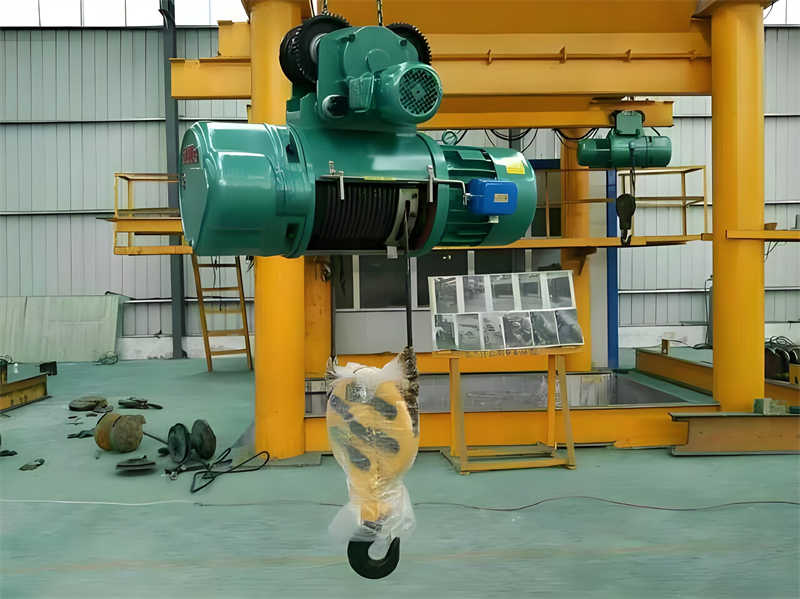
Key Hoist Features That Drive Price:
- Lifting Speed: Dual-speed or VFD-controlled hoists cost more but improve productivity and reduce load swing
- Drum Design: Larger drums with proper fleet angles extend wire rope life by 50–100%
- Brake Configuration: Dual brakes (holding + emergency) are required for certain applications and add cost
- Duty Rating: Hoists must match the crane’s overall duty classification; a heavy-duty crane with a light-duty hoist is a recipe for failure
DONGQI CRANE Approach: We offer a comprehensive range of hoist options to match every application and budget. Our standard CD/MD wire rope hoists deliver reliable performance for general manufacturing applications. For demanding environments, our European-standard hoists incorporate SEW or NORD gearmotors and premium wire rope reeving systems, delivering extended service life and reduced total cost of ownership. The winch trolley on our QD series cranes includes motor, brake, reducer, trolley frame, hook, and pulley for stable and precise operation.
Configuration Item #5: Component Brand and Material Quality
The hidden cost driver that determines long-term reliability
Two cranes can appear identical on a specification sheet but differ dramatically in what actually arrives. The difference lies in the components—the motors, gearboxes, bearings, electrical devices, and structural steel that collectively determine reliability, maintenance frequency, and service life.
Premium Components vs. Generic Alternatives: The Price-Quality Equation
| Component Category | Generic/Budget | Premium Brand | Price Difference | Why It Matters |
|---|---|---|---|---|
| Hoist Motor | Unbranded domestic | SEW-EURODRIVE, NORD, ABB | 30–50% higher | Service life, parts availability, efficiency |
| Electrical Controls | Generic contactors | Schneider Electric, Siemens | 25–40% higher | Reliability, safety compliance, global support |
| Variable Frequency Drive | Generic VFD | ABB, Siemens, Danfoss | 40–60% higher | Precise control, energy savings, motor protection |
| Structural Steel | Commercial grade Q235 | Q345B alloy | 10–20% higher | Strength-to-weight ratio, fatigue resistance |
| Wire Rope | Standard galvanized | High-performance compacted | 20–30% higher | Service life (2–3× longer), safety margin |
| Bearings | Generic | SKF, FAG, NSK | 30–50% higher | Reliability, reduced maintenance, global availability |
The Steel Quality Factor: Structural steel represents approximately 40% of total crane cost. Higher-grade steel alloys like Q345B offer superior strength-to-weight ratios, allowing lighter girder designs without compromising structural integrity. This reduces deadweight, which in turn reduces wheel loads, runway requirements, and energy consumption.
The Component Brand Factor: Premium components from established global manufacturers cost more upfront but deliver measurable long-term value:
- Global Availability: SEW, Siemens, and Schneider parts are available through local distributors worldwide, minimizing downtime
- Predictable Quality: Premium manufacturers provide documented performance data and warranty support
- Energy Efficiency: IE3/IE4 premium efficiency motors reduce electricity consumption by 5–10% annually
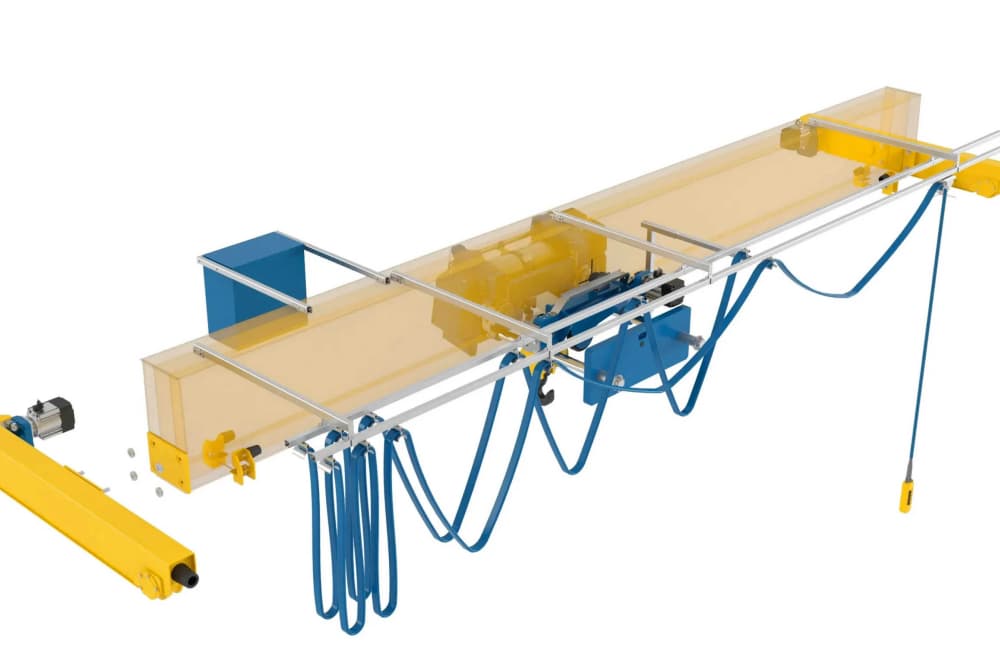
DONGQI CRANE Approach: As a Sino-New Zealand joint venture, we combine European design standards with strategic partnerships with world-leading component manufacturers. Our cranes feature SEW or NORD gearmotors, Schneider Electric control systems, and Siemens or ABB variable frequency drives as standard or optional configurations. The QD series double girder crane utilizes high-quality motors, Schneider electrics, and box-type girders fabricated from high-strength steel plates with CNC cutting for precision and flatness. We provide complete component traceability documentation with every crane shipment, ensuring you know exactly what you are purchasing.
How These Five Items Combine: The Price Multiplier Effect
The five configuration items do not operate in isolation—they compound. A premium specification across all five items can produce a price that is two to three times higher than a budget configuration for the same rated capacity.
Comparative Pricing Example: 10-Ton Overhead Crane, 20-Meter Span, 8-Meter Lift Height
| Configuration | Budget Spec | Mid-Range Spec | Premium Spec |
|---|---|---|---|
| Duty Class | A3 (Light) | A5 (Medium) | A7 (Heavy) |
| Structure | Single Girder | Single Girder | Double Girder |
| Control System | Pendant | Radio Remote + 2-Speed | VFD + PLC Automation |
| Hoist Type | CD Wire Rope | MD Wire Rope | European Premium Hoist |
| Component Brand | Generic/Domestic | Mixed | Premium Global Brands |
| Approximate Price (USD) | $15,000 – $25,000 | $25,000 – $45,000 | $50,000 – $80,000+ |
Note: Prices are equipment-only (FOB factory) estimates and do not include freight, installation, or runway preparation.
The Critical Lesson: When you receive three quotes for a “10-ton crane” ranging from $18,000 to $47,000, the difference is not arbitrary. It reflects genuine engineering and component choices that will determine how the crane performs, how long it lasts, and how much it costs to operate over its lifetime.
The total cost of ownership (TCO) extends far beyond the initial purchase price—it encompasses installation, operator training, energy consumption, maintenance, and potential downtime. One factor that many customers overlook when calculating the total cost of ownership of a crane is the equipment’s lifespan. The lifespan is directly linked to the quality of the crane and the components used in its manufacturing.
How to Compare Crane Quotes Like a Procurement Professional
Armed with an understanding of these five key configuration items, you can now evaluate quotes with precision rather than confusion.
Step 1: Create a Configuration Comparison Matrix
When you receive multiple quotes, extract the following information from each and populate a comparison table:
| Configuration Item | Supplier A | Supplier B | Supplier C |
|---|---|---|---|
| Work Duty Classification (FEM/ISO) | |||
| Structural Type (Single/Double Girder) | |||
| Control System (Pendant/Remote/VFD/PLC) | |||
| Hoist Type and Brand | |||
| Motor Brand and Efficiency Rating | |||
| Gearbox Brand | |||
| Electrical Component Brand | |||
| Steel Grade | |||
| Wire Rope Specification | |||
| Bearing Brand | |||
| Certifications Included | |||
| Warranty Period and Coverage |
Step 2: Identify What Is NOT Included
The lowest quote often omits items that others include as standard. Confirm:
- Is freight included, or is this FOB factory pricing?
- Is installation and commissioning included?
- Is load testing and certification included?
- Are operator manuals and spare parts lists provided?
- Is the runway system included in the scope?
Step 3: Calculate Total Cost of Ownership (TCO)
Use this simplified TCO estimation formula to compare quotes on a 10-year horizon:
10-Year TCO = Equipment Cost + Installation + (Annual Energy × 10) + (Annual Maintenance × 10) + Estimated Downtime Risk
A crane with premium components and higher initial cost often delivers lower 10-year TCO due to energy efficiency, reduced maintenance, and minimized downtime.
The DONGQI CRANE Difference: Transparency in Every Quote
At DONGQI CRANE, we believe that informed buyers make better partners. That is why every quotation we provide includes a complete technical specification breakdown—not just a capacity and a price.
What You Receive with Every DONGQI CRANE Quotation:
| Deliverable | Description |
|---|---|
| Detailed Technical Specification | Complete breakdown of all five configuration items discussed in this guide |
| Component Brand Schedule | Motor, gearbox, electrical, bearing, and steel specifications with brand identification |
| Duty Class Verification | Confirmation of FEM/ISO work duty classification and daily usage capability |
| Certification Package Preview | List of certifications included (CE, ISO, country-specific) |
| TCO Analysis (Upon Request) | Customized 10-year cost projection for energy, maintenance, and component replacement |
| Installation and Commissioning Options | Flexible support from turnkey installation to supervisor-only technical oversight |
With 40+ years of manufacturing excellence, a 240,000-square-meter production facility, 3,600 employees including over 70 senior engineers, and products operating in 96+ countries, DONGQI CRANE delivers lifting solutions engineered for your specific application—not off-the-shelf compromises.
Our Sino-New Zealand joint venture structure ensures European design standards are maintained throughout our manufacturing process, while our strategic location in Changyuan—China’s “Cradleland of Cranes”—provides the cost efficiencies that global buyers value.
Certifications: ISO 9001 • ISO 14001 • ISO 45001 • CE Certified
Manufacturing Capacity: 10,000+ Crane Sets Annually • 2,000+ Sets of Advanced Equipment
Conclusion: Pay for What You Need—But Know What You Are Paying For
The price of an overhead crane is not a single number. It is the sum of dozens of engineering decisions, each with cost and performance implications that extend across the crane’s 15–25 year service life.
When you understand the five key configuration items that drive crane pricing—work duty classification, structural configuration, electrical control system, hoist type, and component quality—you can:
- Compare quotes accurately, understanding exactly why prices differ
- Specify exactly what you need, avoiding both over-specification (wasted money) and under-specification (premature failure)
- Budget realistically, accounting for both initial purchase and lifetime operating costs
- Negotiate confidently, knowing which trade-offs are acceptable and which are not
The goal is not simply to find the lowest price. The goal is to find the crane that delivers the required performance, reliability, and safety at the lowest total cost of ownership over its entire service life.
Ready to receive a transparent, fully specified crane quotation?
[Contact DONGQI CRANE’s engineering team today for a complimentary consultation and detailed technical-commercial proposal tailored to your exact requirements.]
DONGQI CRANE: Your Trusted Partner for Overhead Cranes, Gantry Cranes, and Custom Lifting Solutions
240,000m² Manufacturing Facility • 3,600 Employees • 500+ Technical Specialists • 10,000+ Annual Capacity • Exports to 96+ Countries
