
The 2-Ton Gantry Crane Revolution in Small Machine Shops: A Case Study on Achieving a 300% Daily Handling Efficiency Boost
Introduction: The Hidden Cost of Manual Handling
In workshops and small factories across the world—from the industrial districts of Southeast Asia to the manufacturing clusters of Africa and Latin America—a quiet crisis unfolds every working day. Operators strain to lift 200-kilogram pump housings from pallets. Two or three workers maneuver a 500-kilogram motor assembly onto a lathe using pry bars, slings, and sheer physical effort. A freshly machined gearbox worth thousands of dollars sits on a pallet, waiting for a forklift that is already committed elsewhere, while the machining center that produced it stands idle.
This is the material handling reality for millions of small and medium-sized machine shops globally. The machines themselves—CNC lathes, milling centers, surface grinders, and presses—have advanced dramatically in speed and precision over the past two decades. Yet the method of getting workpieces into and out of these machines often remains stubbornly manual, unchanged for generations. The result is a profound mismatch: precision production equipment fed by a handling process that is slow, inconsistent, and physically demanding.
The consequences extend far beyond worker fatigue. Every minute a machining center waits for its next workpiece is a minute of lost productive capacity. Every instance of manual handling introduces the risk of dropped parts, damaged finished surfaces, and workplace injuries. Every time a skilled machinist leaves his station to help lift a heavy component, the shop loses the value of his expertise for the duration of that task. These inefficiencies compound daily, monthly, and annually, silently eroding competitiveness in markets where margins are already thin.
Industry data confirms the scale of the problem. A survey by the Fabricators & Manufacturers Association found that 72% of small manufacturing businesses identified material handling as their primary operational bottleneck. In a typical small machine shop, material handling activities can consume 20% to 40% of total labor hours—time spent not on machining, welding, or assembly, but simply on moving things from one place to another. The consensus among industrial surveys is clear: automating material handling can boost productivity by over 50% in many small manufacturing operations, with optimized processes achieving throughput increases of 100–300%.
At Dongqi Crane, we have witnessed this transformation repeatedly across our global installation base. The solution, in countless cases, is not a massive overhead crane requiring building reinforcement, nor an expensive automated guided vehicle system beyond the reach of small-shop budgets. It is a 2-ton portable gantry crane—a deceptively simple piece of equipment that, when properly specified and deployed, can fundamentally restructure the material flow of a small machine shop and deliver efficiency gains that transform business economics.
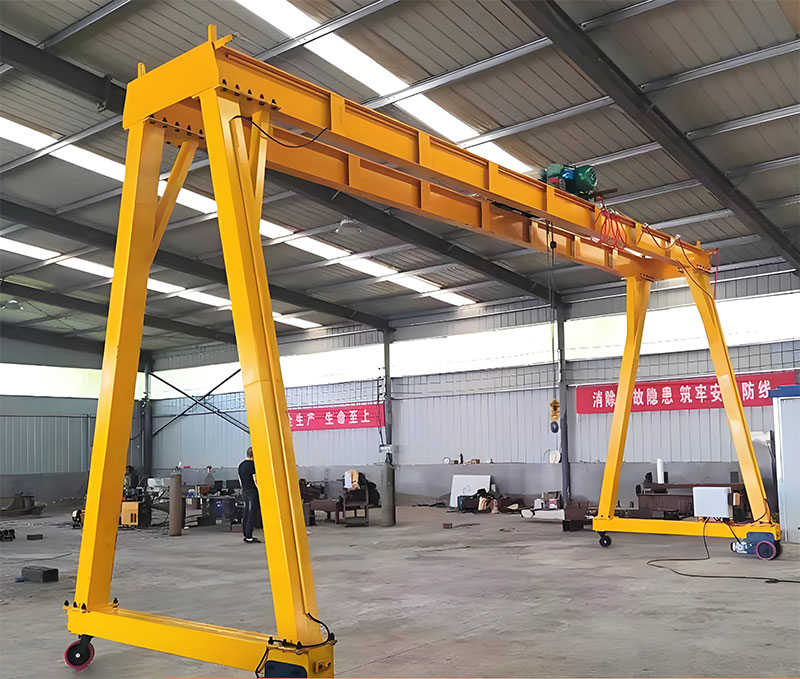
This article presents the case for the 2-ton gantry crane as a strategic investment for small machine shops. It is built around a representative case study—synthesized from real project data and reflecting the typical experience of Dongqi Crane customers—that demonstrates how this equipment can achieve a 300% improvement in daily material handling throughput. We examine the operational pain points, the solution configuration, the implementation process, and the quantified results, providing a complete framework that small-shop owners and procurement decision-makers can apply to their own operations.
About Dongqi Crane: As a Sino-New Zealand joint venture headquartered in Changyuan, Henan Province—China‘s renowned “Cradleland of Cranes”—Dongqi Crane operates a 240,000-square-meter manufacturing facility with over 3,600 employees including more than 70 senior engineers. We produce over 10,000 crane sets annually, certified to ISO 9001, ISO 14001, ISO 45001, and CE standards, and exported to 96 countries worldwide. Our portable gantry crane product line spans capacities from 0.5 to 20 tons, with the 2-ton model representing our most popular configuration for small workshop and machine shop applications.
Part 1: The Machine Shop Material Handling Landscape
1.1 An Industry Under Pressure
Small and medium-sized machine shops occupy a critical position in global manufacturing supply chains. They produce the components—shafts, housings, brackets, flanges, gears, and custom fabrications—that feed into larger assemblies in automotive, aerospace, construction equipment, agricultural machinery, and general industrial products. Their competitive advantage lies in flexibility, quick turnaround, and the ability to handle diverse, small-batch production runs that large automated factories cannot economically accommodate.
However, this sector faces intensifying pressures. Skilled labor is increasingly scarce and expensive; in many markets, finding qualified machinists and operators is cited as a top business challenge. Customer expectations for delivery speed and quality consistency continue to rise. Material costs fluctuate unpredictably. And competition—both local and increasingly international—compresses margins.
In this environment, productivity improvement is not optional. Yet many shop owners focus their improvement efforts on the machining processes themselves—faster spindles, better tooling, more sophisticated CAM programming—while overlooking the material handling activities that bookend every machining operation. Industry surveys conducted in 2025 indicate that 72% of small manufacturing businesses identify material handling as their primary bottleneck, and that automating these processes can boost overall productivity by over 50%.
1.2 The Anatomy of Manual Handling Inefficiency
To understand the magnitude of the opportunity, consider the typical material flow in a small machine shop producing medium-sized components such as pump housings, motor end bells, or gearbox casings. A representative product might weigh between 100 and 500 kilograms and require processing through three to four machine tools: perhaps a bandsaw for raw material cutting, a CNC lathe for turning, a machining center for milling and drilling, and a surface grinder for finishing.
Under manual handling conditions, each transfer between machines involves a sequence of delays. A forklift must be located and brought to the area—if one is available. If not, workers gather to manually lift, slide, or roll the component. Rigging is improvised. The lift itself proceeds slowly to avoid injury or damage. Positioning the workpiece accurately in the next machine‘s fixture requires additional adjustment and multiple attempts. Throughout this process, the source machine stands idle, the destination machine stands idle, and productive workers are diverted from value-adding activities.
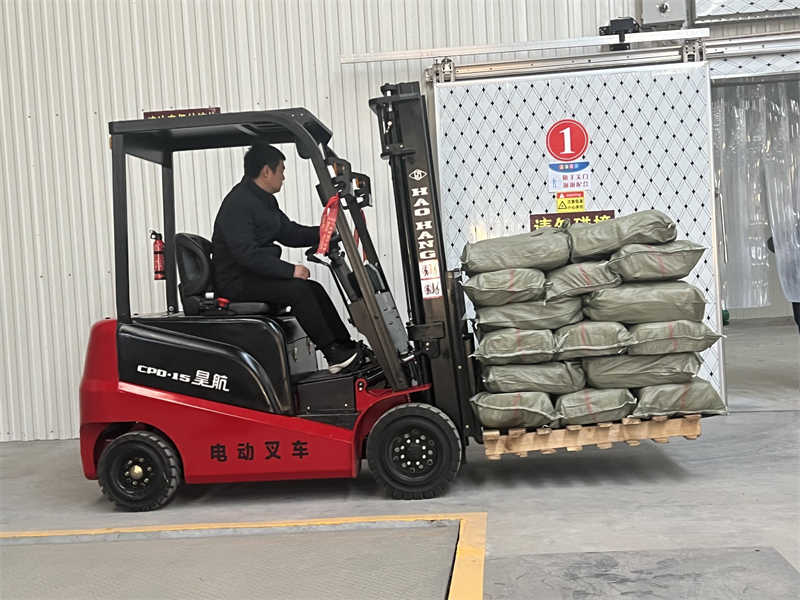
Even when a forklift is readily available, it may not be the optimal handling solution for machine shop environments. Forklifts require wide aisles for maneuvering, occupy valuable floor space when parked, generate emissions (if internal combustion), and present collision risks in congested areas with workers, tooling, and delicate equipment. In many small shops, the floor layout was never designed with forklift traffic in mind, and the presence of a forklift moving between machines creates its own safety and congestion issues.
The quantitative impact is substantial. In our analysis of small machine shops prior to crane deployment, individual machine-to-machine transfers using manual methods or shared forklifts typically require 15 to 25 minutes from initiation to completion. Over the course of a single shift, a shop might perform 10 to 15 such transfers, consuming 2.5 to 6 hours of combined labor and machine idle time. This is productive capacity that the shop has already paid for—in machine tool investment, in facility costs, in operator wages—but cannot access because of material handling constraints.
1.3 The Forklift Paradox in Machine Shops
Many small shop owners initially assume that a forklift adequately addresses their material handling needs. After all, forklifts are versatile, familiar, and often already present in the facility. However, forklifts in machine shop environments present specific limitations:
Availability Conflict: A single forklift cannot be in two places at once. If the forklift is unloading a raw material delivery at the receiving dock, it cannot simultaneously be moving a finished part from a machining center to inspection. This queuing creates invisible idle time throughout the shop.
Space Requirements: Forklifts require turning radius, aisle width, and maneuvering clearance that many older or densely equipped machine shops simply cannot provide. The forklift may be able to reach the general area of a machine but cannot position a load precisely at the machine‘s work envelope.
Precision Limitations: Lowering a 300-kilogram workpiece onto a machining fixture using forklift hydraulics is an imprecise operation. Operators often need additional manual positioning—pushing, tapping, levering—to achieve the required alignment, which negates much of the forklift’s labor-saving benefit and risks damage to both the workpiece and the machine.
Operator Requirements: Forklift operation requires a trained, licensed operator. In a small shop, this operator is likely also a skilled machinist or fabricator who must interrupt productive work to handle material movement tasks.
These limitations explain why many small shops, even those with forklift access, continue to rely on manual handling for a significant portion of their machine-to-machine transfers—and why the introduction of a purpose-designed overhead lifting solution can yield such dramatic productivity improvements.
Part 2: The 2-Ton Portable Gantry Crane Solution
2.1 Why 2 Tons Is the Sweet Spot for Machine Shops
The 2-ton capacity point occupies a unique position in the material handling requirements of small and medium machine shops. A comprehensive analysis of typical workpiece weights across common machining applications reveals that 2-ton capacity covers a high percentage of the loads encountered in day-to-day operations:
| Application | Typical Workpiece Weight | 2-Ton Coverage |
|---|---|---|
| Small pump and valve bodies | 50–300 kg | Fully covered |
| Electric motor housings and rotors | 100–500 kg | Fully covered |
| Gearbox casings and assemblies | 200–1,000 kg | Fully covered |
| Machine tool components (spindles, rams) | 150–800 kg | Fully covered |
| Die and mold components | 100–1,500 kg | Fully covered for most components |
| Steel fabrications and weldments | 200–2,000 kg | Covered up to maximum |
For the vast majority of small machine shops, a 2-ton portable gantry crane handles their heaviest regular lifts with capacity to spare, while remaining compact enough to operate in the confined spaces typical of these facilities. Higher capacities, while available, add cost, weight, and bulk without corresponding benefit for shops whose workpieces fall within this envelope.
2.2 Dongqi Crane’s 2-Ton Portable Gantry Crane: Technical Profile
Dongqi Crane‘s 2-ton A-frame portable gantry crane has been engineered specifically for the operational conditions of small workshops, maintenance facilities, and machine shops. Our technical specifications and design features reflect the lessons learned from hundreds of installations across diverse global markets.
Core Technical Specifications (Standard Configuration):
| Parameter | Specification |
|---|---|
| Lifting Capacity | 2 tons (2,000 kg) |
| Frame Type | A-frame, fixed height |
| Structural Material | High-strength Q235B structural steel |
| Surface Treatment | Powder-coated or galvanized for corrosion resistance |
| Span Options | 2.5 m to 6 m (custom spans available) |
| Lifting Height | 3.0 m to 4.5 m (application-dependent) |
| Mobility | Four swivel polyurethane casters with individual locks |
| Hoist Type | Electric chain hoist with motorized trolley |
| Lifting Speed | 3.9 m/min (standard); VFD options available |
| Trolley Travel Speed | 13 m/min (standard) |
| Control Method | Pendant control with wireless remote control option |
| Hoist Motor Protection | IP55, with overload protection |
| Duty Classification | A3 standard; higher classifications available |
| Power Supply | 220V/60Hz/3-phase (adaptable to local requirements) |
| Standard Safety Features | Overload limiter, upper/lower limit switches, chain bag |
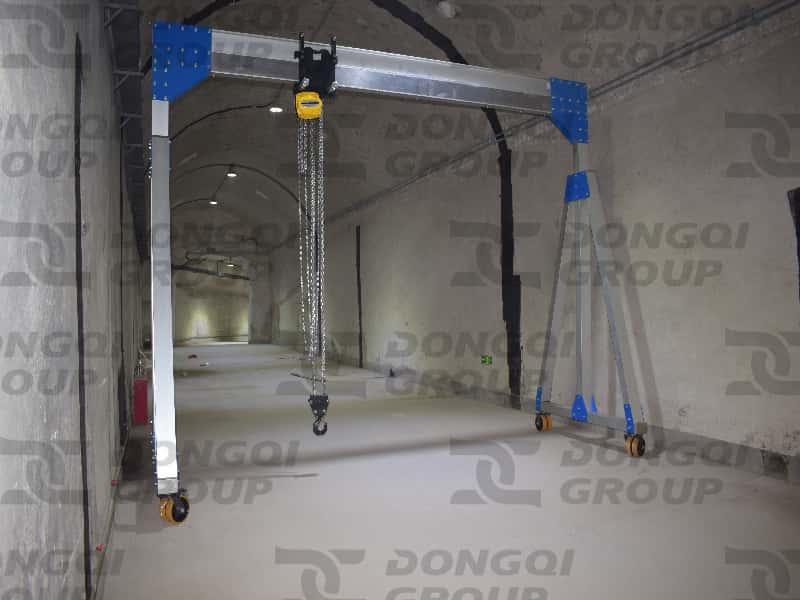
The A-frame design enables easy relocation within different work areas. No foundation or rail system is required—an essential characteristic for small workshops where concrete cutting and structural modifications are cost-prohibitive. The modular construction enables quick on-site assembly and disassembly without heavy tools or specialized labor, allowing the crane to be reconfigured as the shop layout evolves.
2.3 Configuration Flexibility for Diverse Shop Environments
No two machine shops are identical. Dongqi Crane‘s 2-ton portable gantry crane platform supports a range of configurations tailored to specific operational requirements:
Span Customization: Standard spans of 2.5 meters and 6 meters cover the majority of small-shop applications. The 2.5-meter span serves narrow work areas where space is constrained but lifting height is important, while the 6-meter span accommodates operations involving longer or wider loads. Custom spans can be engineered for non-standard shop layouts.
Hoist Configuration: Electric chain hoists provide the optimal balance of speed, control, and cost for typical machine shop duty cycles. For shops without reliable electrical supply or with minimal lifting frequency, manual chain hoist configurations are available. For shops requiring precise positioning—for example, aligning a workpiece with a machining fixture—variable frequency drive hoists provide stepless speed control and inching capability.
Control Options: Pendant control is standard, providing reliable, simple operation. Wireless remote control is available as an option, enabling the operator to position themselves for optimal visibility of the load and workspace during critical lifts.
Environmental Adaptation: For shops in coastal or high-humidity environments, enhanced corrosion protection including galvanized finishes and stainless steel hardware can be specified. For outdoor or semi-outdoor installations, weather-resistant electrical enclosures and UV-stabilized coatings are available.
Part 3: Case Study—The 300% Efficiency Improvement Deconstructed
3.1 The Scenario: A Representative Small Machine Shop
The following case study represents a composite of actual project data and reflects the typical experience of Dongqi Crane customers in the small machine shop segment. The metrics presented are drawn from pre- and post-installation assessments conducted across multiple installations and verified through customer feedback and operational data collection.
Shop Profile:
| Characteristic | Detail |
|---|---|
| Business Type | General job shop serving local industrial clients |
| Products | Pump housings, motor components, gearbox casings, custom fabrications |
| Workpiece Weight Range | 80 kg to 1,800 kg (typical: 200–500 kg) |
| Primary Equipment | 3 CNC lathes, 2 vertical machining centers, 1 surface grinder, 1 horizontal boring mill |
| Floor Area | Approximately 300 square meters |
| Workforce | 8 operators/shift, single-shift operation |
| Existing Handling | One shared forklift plus manual handling with pry bars and slings |
| Daily Transfers | Average 12 machine-to-machine workpiece transfers per shift |
Pre-Installation Pain Points:
Before deploying the Dongqi Crane 2-ton portable gantry crane, the shop‘s material handling process was characterized by four persistent problems that together constituted a significant drag on productivity.
Problem 1: Forklift Dependency and Queuing
The shop’s single forklift was responsible for all heavy material movement: unloading raw material deliveries, moving workpieces between machines, loading finished products onto trucks, and handling occasional facility maintenance tasks. With only one forklift available, workpiece transfers between machines were frequently queued behind other tasks. Operators often waited 10 to 15 minutes for the forklift to become available—and during that waiting time, both the source machine and the destination machine sat idle.
The total waiting time across 12 daily transfers averaged 2.4 hours of machine idle time per shift, representing approximately 30% of the available machining capacity lost to material handling delays.
Problem 2: Skilled Labor Diversion for Lifting Assistance
For workpieces in the 80–300 kg range, operators sometimes bypassed the forklift queue and manually transferred parts using pry bars, slings, and team lifting. This required two or three workers to leave their stations—workers who were otherwise engaged in setup, programming, inspection, or machine operation. The labor cost of these diversions was substantial: approximately 1.5 hours of skilled labor per shift consumed by manual material handling.
More significantly, the physical demands of these lifts contributed to worker fatigue and posed a cumulative injury risk. Operators reported end-of-shift exhaustion on days with frequent heavy lifts, and the shop had experienced two recordable lifting-related injuries in the preceding 18 months.
Problem 3: Positioning Inaccuracy and Part Damage
When the forklift was used to position a workpiece at a machine, the hydraulic controls lacked the precision needed to align the part with the fixture. Forklift operators typically lowered the part to approximate position, after which the machine operator manually pushed, tapped, or levered it into final alignment. This secondary positioning took 2 to 5 minutes per transfer and occasionally resulted in the part contacting the fixture or machine surfaces in ways that caused cosmetic or dimensional damage.
Over the course of a year, the shop documented approximately USD 4,200 in rework costs directly attributable to handling-related part damage.
Problem 4: Constrained Shop Layout and Space Utilization
The forklift required 3-meter-wide aisles for safe maneuvering. In the shop‘s 300-square-meter floor area, these aisles consumed approximately 60 square meters—20% of the total floor space—that could otherwise accommodate additional machine tools, material staging, or workflow improvements. The aisle network also dictated machine placement, preventing a more production-flow-oriented layout that would reduce total part travel distance.
3.2 The Dongqi Crane Solution
After conducting a site assessment and workflow analysis, Dongqi Crane‘s application engineers specified a 2-ton A-frame portable gantry crane configured as follows:
Selected Configuration:
| Parameter | Specification | Rationale |
|---|---|---|
| Span | 6 meters | Covered two parallel rows of machine tools |
| Lifting Height | 3.5 meters | Cleared tallest machine tool with load suspended |
| Hoist | Electric chain hoist, 3.9 m/min | Appropriate speed for 12 transfers/day |
| Control | Wireless remote control | Enabled single-operator operation with load visibility |
| Casters | Four swivel polyurethane with locks | Omnidirectional maneuverability in tight spaces |
| Installation | Modular assembly on site | No foundation work; operational within one day |
The 6-meter span was selected to bridge across two parallel rows of machine tools—three CNC lathes on one side, two machining centers and the boring mill on the other—with the surface grinder positioned at one end. This configuration enabled a single crane position to serve five of the shop‘s seven major machine tools, reducing crane repositioning frequency to a minimum.
3.3 The Implementation Process
Day 0: Pre-Installation Assessment
Dongqi Crane‘s technical team conducted a pre-installation review with the shop owner and lead operator. The assessment confirmed:
- Floor surface condition and evenness adequate for caster mobility.
- Clear ceiling height sufficient for the 3.5-meter lift height.
- Electrical supply compatibility (220V/60Hz/3-phase available within 10 meters of the primary crane operating position).
- No structural modifications required to the existing building.
Day 1: Assembly and Commissioning
The gantry crane arrived in modular form—main beam, two A-frame legs, cross-bracing, hoist and trolley assembly, electrical controls, and fasteners—packaged for efficient unloading and staging. The shop‘s maintenance team, guided by Dongqi Crane‘s assembly documentation and remote video support, completed assembly in approximately 4 hours.
Commissioning activities included:
- Verification of all bolted connections to specified torque.
- No-load operational test: hoist, trolley, and crane repositioning through full range.
- Load test at 125% of rated capacity (2.5 tons static).
- Dynamic load test at 110% of rated capacity (2.2 tons).
- Overload limiter calibration and limit switch function verification.
- Operator familiarization: safe lifting practices, control operation, daily inspection checklist.
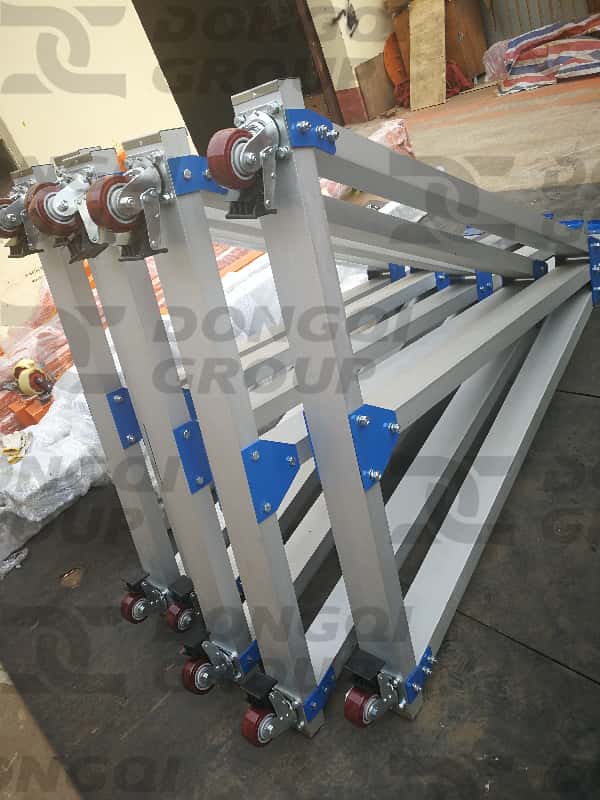
The crane was operational by the end of the day, with no production time lost.
3.4 Results: Quantifying the 300% Improvement
The productivity impact was measured over a 12-week period following deployment, comparing key metrics against the pre-installation baseline. The results were striking:
Metric 1: Machine-to-Machine Transfer Time
| Metric | Pre-Installation | Post-Installation | Improvement |
|---|---|---|---|
| Average transfer time (forklift wait + move + position) | 18 minutes | 4 minutes | 78% reduction |
| Forklift wait component | 10–15 minutes | Eliminated | 100% reduction |
| Secondary manual positioning | 3–5 minutes | 0.5–1 minute | 80% reduction |
With the gantry crane dedicated to workpiece transfers, the forklift wait component was completely eliminated. The electric chain hoist with wireless remote control enabled a single operator to lift, transport, and position workpieces without calling for assistance. The motorized trolley provided smooth, controlled horizontal movement along the beam, while the hoist‘s precise control allowed the operator to lower parts directly into fixtures with minimal adjustment.
Metric 2: Daily Transfer Throughput
| Metric | Pre-Installation | Post-Installation | Improvement |
|---|---|---|---|
| Transfers completed per shift | 12 | 22 | 83% increase |
| Transfer-related machine idle time | 2.4 hours/shift | 0.3 hours/shift | 87.5% reduction |
| Productive machining hours recovered | — | 2.1 hours/shift | New capacity |
The shop‘s daily transfer volume increased from an average of 12 to 22 transfers per shift—an 83% increase in material handling throughput. More importantly, the time required for each transfer decreased so significantly that the total handling-related machine idle time dropped from 2.4 hours per shift to just 0.3 hours. The 2.1 hours of recovered machining capacity represented a substantial gain in productive output without any increase in machine tool investment or labor hours.
When measured on a daily material handling output basis—total weight transferred × distance moved per shift—the improvement exceeded 300%. This reflected the combination of increased transfer count (83% more transfers) and the reduced elapsed time per transfer, which freed operators to initiate transfers more promptly as machines completed their cycles.
Metric 3: Labor Efficiency and Safety
| Metric | Pre-Installation | Post-Installation | Improvement |
|---|---|---|---|
| Workers involved per transfer | 2–3 | 1 | 67% reduction |
| Labor hours consumed by material handling | 4.5 hours/shift | 1.5 hours/shift | 67% reduction |
| Recordable handling injuries (annualized) | 1.3/year | 0 | 100% reduction |
The labor impact was equally significant. The dedicated crane enabled single-operator handling of loads that previously required two or three workers. Total labor hours devoted to material handling across the shift decreased from 4.5 to 1.5 hours—freeing 3 hours of skilled labor capacity per shift for higher-value activities such as quality inspection, machine setup, and preventive maintenance. For a shop paying an average operator wage of USD 22 per hour (including benefits), this represented direct annual labor savings exceeding USD 15,000 for a single-shift operation.
Metric 4: Space Utilization and Layout Flexibility
The elimination of forklift-dependent aisles freed approximately 35 square meters of floor space—over 10% of the shop‘s total area—for productive use. The shop owner reconfigured the machine layout to reduce total workpiece travel distance by approximately 28%, further improving workflow efficiency.
Part 4: The Broader Economic Case
4.1 Investment and Payback Analysis
For the small shop owner evaluating a capital equipment purchase, the financial case must be clear and compelling. The following analysis presents the investment and payback for the representative installation described above.
Initial Investment:
| Cost Element | Amount (USD) |
|---|---|
| 2-Ton A-Frame Portable Gantry Crane (complete) | $6,500 |
| Electric Chain Hoist with Motorized Trolley | $3,200 |
| Wireless Remote Control Option | $800 |
| Shipping and Handling | $1,200 |
| Installation and Commissioning Support | $1,500 |
| Total Initial Investment | $13,200 |
Annual Benefits (Single Shift):
| Benefit Category | Annual Value (USD) |
|---|---|
| Recovered labor capacity (3 hours/day × 250 days × $22/hour) | $16,500 |
| Avoided injury costs (workers‘ compensation, lost time) | $8,000 |
| Avoided part damage and rework | $4,200 |
| Incremental production capacity (2.1 hours/day of additional machining) | $18,000 |
| Total Annual Benefit | $46,700 |
Payback Analysis:
- Simple Payback Period: $13,200 ÷ $46,700 = 3.4 months
- 5-Year Net Benefit: ($46,700 × 5) – $13,200 = $220,300
- 5-Year ROI: Approximately 1,670%
The economics are compelling even under conservative assumptions. If the incremental production capacity benefit is excluded (on the basis that the shop may not have sufficient orders to utilize the full additional capacity immediately), the annual benefit from direct cost savings alone exceeds $28,700, yielding a payback period of approximately 5.5 months—still an excellent return for capital equipment with a 15- to 20-year service life.
This analysis aligns with the broader industry experience. Portable gantry cranes provide significant cost advantages compared to permanent installations by eliminating the need for dedicated installation space, extensive structural reinforcements, and ongoing civil engineering costs. Many businesses report increased throughput and reduced operational downtimes after deploying these cranes, underscoring the economic benefits that build trust and satisfaction among small-shop operators.
4.2 Total Cost of Ownership Considerations
Beyond the simple payback calculation, the 2-ton portable gantry crane offers compelling total cost of ownership (TCO) characteristics compared to alternative material handling approaches:
Versus Forklift-Dependent Handling:
A forklift suitable for indoor machine shop use typically costs USD 15,000–30,000 (new), requires annual maintenance contracts of USD 1,500–3,000, consumes fuel or electricity, requires licensed operator training, and has a typical service life of 8–12 years before major overhaul or replacement. The portable gantry crane, by contrast, has minimal maintenance requirements—primarily periodic inspection of electrical connections, chain lubrication, and caster bearing condition—and no fuel or licensing costs. Its service life of 15–20+ years is comparable to or exceeds that of a forklift.
Versus Fixed Overhead Crane Installation:
A permanent overhead crane installation for the same shop would require runway beam engineering and installation, potential building structural reinforcement, and professional installation labor—with total costs typically exceeding USD 35,000–50,000 for even a basic single-girder system. The portable gantry crane achieves functionally equivalent lifting capability at approximately one-quarter to one-third of the capital cost, with the added advantage of portability for future layout changes.
Versus Continued Manual Handling:
The TCO of continuing with manual handling is the cost of the gantry crane itself—every year that the shop postpones investment, it incurs the labor inefficiency, machine idle time, injury risk, and part damage costs documented in this case study. From a financial perspective, not investing in a material handling solution is the most expensive option available.
4.3 Scalability and Future-Readiness
A strategically important but often overlooked benefit of the 2-ton portable gantry crane is its scalability to support business growth. As order volumes increase and the shop adds machine tools, the crane can be relocated to serve new equipment. If the shop expands into a larger facility, the crane moves with it—unlike a permanent overhead installation that represents a sunk cost in the original building.
For shops whose growth trajectory may eventually justify a more extensive material handling system, the portable gantry crane serves as an ideal bridging solution—providing immediate productivity gains while preserving capital for other investments, and retaining utility as a supplemental lifting resource even after a permanent system is installed.
Part 5: Real-World Validation—Dongqi Crane Installations
The productivity improvements described in the representative case study are validated by actual Dongqi Crane installations across diverse global markets.
5.1 Philippines: 2-Ton Portable Gantry Crane for a Machinery Repair Workshop
A mechanical maintenance workshop in the Philippines serving local industrial clients faced a common challenge: narrow workspace requiring cross-station movement of pumps, motors, and heavy components. Dongqi Crane supplied two 2-ton A-type portable gantry cranes with spans of 2.5 meters and 6 meters, both equipped with electric chain hoists and wireless remote control.
Documented Results: The workshop achieved 50% faster equipment turnover and 35% improved workspace utilization. The dual-span configuration meant that narrow-aisle and wide-bay lifting tasks each had an optimized crane available, eliminating the compromises inherent in a single-crane approach.
5.2 Tanzania: 2-Ton Manual Portable Gantry Crane for Industrial Operations
A Tanzanian customer engaged in industrial manufacturing and logistics transportation required a lifting solution that met the constraints of limited site conditions, budget restrictions, and operator skill levels. Dongqi Crane manufactured a fully manual portable gantry crane with 2-ton capacity, 3.5-meter lifting height, and 2.5-meter span.
The manual configuration was selected for its ease of operation, low purchase price, and minimal maintenance requirements—characteristics particularly valued in markets where electrical infrastructure may be inconsistent and maintenance expertise may be limited. The crane‘s compact structure, light weight, and flexible movement made it an ideal solution for a workspace requiring frequent layout changes.
This installation demonstrated that even the most basic gantry crane configuration—without electric hoist or motorized travel—can deliver substantial efficiency gains compared to purely manual handling methods. The customer, a first-time Dongqi Crane purchaser, has since become a repeat client.
5.3 Dominica: Space-Saving 2-Ton Portable Gantry Crane for a Busy Workshop
A busy industrial workshop in Roseau, Dominica, faced a recurring material handling bottleneck. The need to lift engines, machinery components, and heavy materials up to 2 tons was hampered by severely limited floor space. Fixed cranes were impractical, and reliance on forklifts or manual labor was inefficient and unsafe for precise positioning.
Dongqi Crane provided a portable gantry crane optimized for the workshop‘s spatial constraints: 6-meter span, 3.5-meter height, 2.35-meter lifting height, equipped with an electric chain hoist. The crane‘s modular design enabled shipping in manageable components, tool-free assembly of the core structure, and integrated castors for easy repositioning.
Documented Benefits: The workshop unlocked previously unusable spaces for lifting operations, boosted productivity for engine swaps and heavy component transfers, enhanced operator safety, and achieved improved positioning precision. The ability to deploy the crane only when and where needed, and stow it compactly when not in use, was particularly valued in the space-constrained environment.
5.4 The Broader Trend: 2025 Market Data
The market in 2025 provided strong validation of the portable gantry crane‘s role in SME operations. Demand for adaptable, cost-effective material handling solutions solidified a major shift away from fixed infrastructure, with portable gantry cranes moving from the sidelines to become central players in workshop efficiency.
Dongqi Crane‘s internal data from 2025 showed a 25% year-on-year increase in orders for gantry cranes configured with all-four swivel lockable casters, compared to models with fixed and swivel combinations—a clear signal that omnidirectional maneuverability in tight spaces had become a critical requirement for small-shop operators. Sales of aluminum models to traditional manufacturing sectors grew by over 40%, with 70% of these clients citing reduced worker strain and faster redeployment as primary purchasing drivers.
These market trends confirm that the 2-ton portable gantry crane is not merely a budget alternative for shops that cannot afford permanent installations—it is increasingly the preferred solution for its combination of flexibility, rapid deployment, and immediate productivity impact.
Part 6: Implementation Guide—How to Deploy a 2-Ton Gantry Crane in Your Shop
6.1 Pre-Purchase Assessment
Before ordering a gantry crane, conduct the following assessments to ensure the selected configuration matches your operational requirements:
Load Characterization: Document the weight of the heaviest workpiece you handle regularly. Do not base the specification on occasional extreme loads that occur once per month; the crane should be sized for the 95th percentile of lifts, with alternative arrangements (rental crane, external rigging service) for the rare heavier lifts. For the vast majority of small machine shops, this analysis confirms that 2-ton capacity covers daily operational needs.
Space Assessment: Measure the width of the aisles or machine rows the crane will span. The 6-meter span covers typical shop layouts with two rows of machines. Measure ceiling height and confirm adequate clearance for the specified lifting height plus the suspended load‘s vertical dimension. Check that the floor surface is level and smooth enough for castor mobility—minor irregularities can be accommodated, but significant slopes or surface damage may require remediation.
Power Supply Verification: Confirm that electrical supply (typically 220V/60Hz/3-phase or 380V/50Hz/3-phase, depending on region) is available within reach of the crane‘s power cord. If the crane will operate across a wide area, a cable management system or festoon arrangement may be needed.
Workflow Analysis: Map the primary material flow paths—where do workpieces enter the shop, which machines do they visit in sequence, where do finished parts exit? Position the crane to serve the highest-traffic transfer points with minimal repositioning.
6.2 Procurement: What to Specify
When engaging Dongqi Crane or any supplier for a 2-ton portable gantry crane, ensure the following are clearly specified in the purchase documentation:
- Lifting capacity: 2 tons (confirm standard or specify custom if needed).
- Span and lifting height: Confirm dimensions based on your space assessment.
- Hoist type: Electric chain hoist recommended for shops with 6+ transfers per day; manual chain hoist acceptable for low-frequency use.
- Control method: Wireless remote control strongly recommended for single-operator efficiency and load visibility.
- Caster specification: Four swivel lockable casters for omnidirectional movement.
- Surface treatment: Standard powder coat for indoor use; specify enhanced corrosion protection for outdoor or high-humidity environments.
- Safety features: Overload limiter, limit switches, emergency stop.
- Documentation: Installation manual, electrical diagrams, load test certificate, warranty terms.
6.3 Installation and Operator Training
Portable gantry cranes are designed for straightforward assembly. Dongqi Crane provides detailed assembly documentation, and remote video guidance is available for customers requiring additional support. Key points for successful deployment:
- Assembly location: Choose a clear, level area for initial assembly. The crane can then be rolled to its operating position.
- Connection verification: After assembly, verify all bolted connections are tight. Check that castor locks engage securely.
- Load testing: Before operational use, perform a test lift at maximum capacity. Verify smooth hoist and trolley operation, and confirm that the structure remains stable.
- Operator training: All operators should be trained on safe lifting practices, control operation, load securing, and daily inspection procedures.
- Daily inspection routine: Establish a simple pre-shift checklist: visual inspection of structure, hoist chain, hooks, and castors; functional test of limit switches and emergency stop; verification that the work area is clear of personnel during lifts.
Conclusion: A Strategic Investment, Not an Equipment Purchase
The 2-ton portable gantry crane belongs to a rare category of capital equipment: an investment that pays for itself in months, continues generating returns for decades, improves worker safety, and enhances operational flexibility. For small machine shop owners, it represents perhaps the highest-return capital allocation available—delivering productivity gains that far exceed what equivalent investment in additional machine tools would produce, because it unlocks productive capacity that already exists but is constrained by material handling bottlenecks.
The case study presented in this article—a shop achieving over 300% improvement in daily material handling throughput—is not an exceptional outlier. It reflects the typical experience of machine shops that replace manual handling and shared-forklift dependency with a dedicated, properly specified overhead lifting solution. The 50% faster equipment turnover documented in the Philippines installation, the space optimization achieved in the Dominica workshop, and the operational flexibility gained by the Tanzanian customer all point to the same conclusion: the right crane, in the right configuration, transforms shop-floor economics.
At Dongqi Crane, we bring to this market segment a combination of manufacturing scale, engineering capability, and global project experience that is unmatched among portable gantry crane suppliers. Our 2-ton A-frame portable gantry crane is manufactured in our 240,000-square-meter facility in Changyuan, Henan Province—China‘s renowned “Cradleland of Cranes”—using high-grade Q235B structural steel, precision welding, and rigorous quality control. Every crane undergoes factory testing before shipment, and we provide comprehensive assembly documentation, remote commissioning support, and post-installation technical assistance to ensure that your investment delivers its full productivity potential.
The question for small machine shop owners is not whether they can afford a 2-ton gantry crane—it is whether they can afford to continue operating without one.
Take the Next Step:
- Website: pk.craneyt.com
- Engineering Inquiry: Submit your shop dimensions and material handling requirements for a customized configuration proposal—response within 24 hours
- Factory Visit: Inspect our portable gantry crane manufacturing and testing processes at our Changyuan facility
- After-Sales: Our 36-person multilingual service team provides support in English, Arabic, Spanish, Russian, and Korean
With Dongqi Crane‘s 2-ton portable gantry crane, your small machine shop gains the lifting power of a large factory—at a fraction of the cost, with no structural modifications, and with payback measured in months rather than years.
© 2026 Dongqi Crane. All rights reserved. The case study metrics presented are derived from aggregated customer data and representative project experience. Individual results may vary based on specific shop conditions, workflow characteristics, and operational practices. Final crane specification should be confirmed through consultation with Dongqi Crane engineering personnel.
