
Overhead Cranes from 15 Tons to 50 Tons and Above: How Does Dongqi Build the Power Core of the Workshop?
1 Overhead Cranes: The Backbone of Modern Industry
In modern industrial production, heavy-duty overhead cranes have become indispensable core equipment, serving as the “power core” of workshops. These behemoths span the upper space of workshops, undertaking the handling, precise positioning, and assembly of various heavy materials, greatly improving production efficiency and operational safety. Especially heavy-duty overhead cranes with lifting capacities of 15 tons to 50 tons and above play a vital role in fields such as steel metallurgy, heavy machinery manufacturing, power station construction, shipbuilding, and large-scale warehousing and logistics.
As an important component of industrial infrastructure, the technical level of heavy-duty overhead cranes directly relates to the level and competitiveness of a country’s industrial development. With the deepening implementation of the “Made in China 2025” strategy and the global manufacturing industry’s transition towards intelligence and green transformation, the market demand for high-performance, high-reliability, and intelligent heavy-duty lifting equipment is growing. In this context, domestic leading crane manufacturers such as Henan Dongqi Machinery Co., Ltd. (Dongqi Machinery) are providing powerful material handling solutions for industrial enterprises at home and abroad through continuous technological innovation and service optimization, helping enterprises enhance their core competitiveness.

2 Dongqi Company Profile and Technical Advantages
Since its establishment in 1984, Henan Dongqi Machinery Co., Ltd. (Dongqi Machinery) has grown into a Sino-foreign joint venture focusing on the research and development and manufacturing of high-end lifting equipment. The company has been deeply involved in the field of heavy-duty overhead cranes for many years, gradually forming a complete product system and technical accumulation, and becoming one of the well-known brands in the industry. Dongqi’s main products include various European-style overhead cranes, gantry cranes, European-style electric hoists, etc. Among them, overhead cranes from 15 tons to 50 tons and above are its core product series, widely used in various industrial fields.
Dongqi always adheres to the R&D philosophy of “technology first, quality-based” and regards technological innovation as the core driving force for enterprise development. The company focuses on core technology research and development and has accumulated rich experience and obtained multiple patents in crane structural design, drive systems, control technology, and other aspects. Through the technical path of introduction, digestion, absorption, and re-innovation, Dongqi has successfully overcome many technical problems in the high-speed operation stability, precise positioning, intelligent control, and other aspects of heavy-duty overhead cranes, and product performance has reached the domestic leading level.
3 Product Series of Overhead Cranes from 15 Tons to 50 Tons and Above
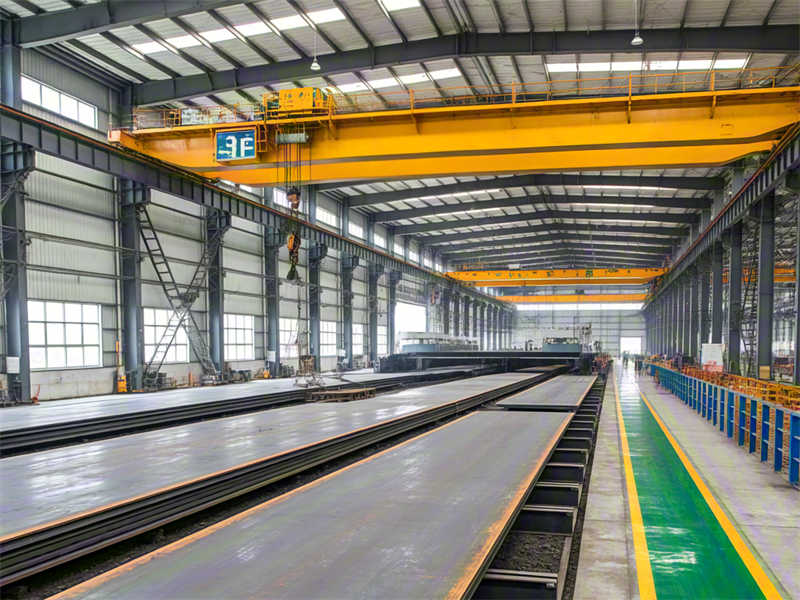
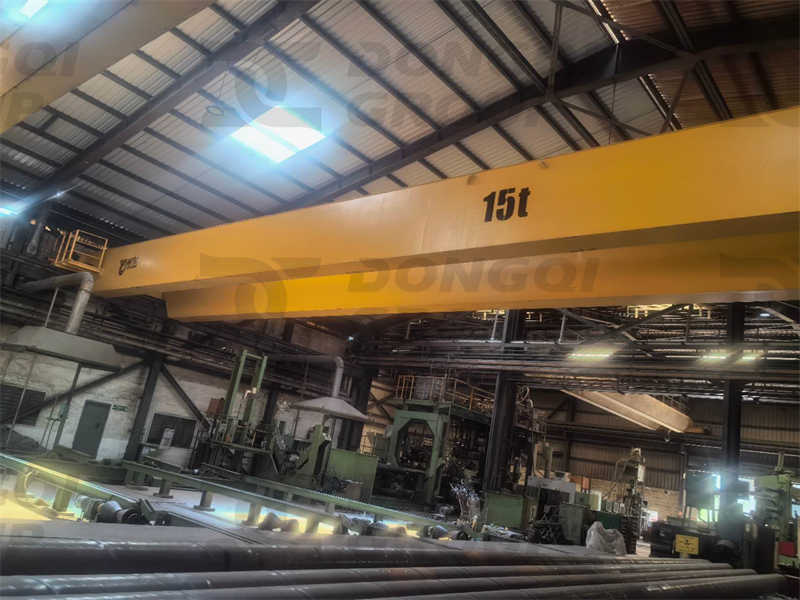
Dongqi’s heavy-duty overhead crane product line covers multiple levels from 15 tons, 16 tons, 20 tons, 32 tons, 50 tons and above, forming a complete product system. These cranes adopt a double-girder bridge structure, with the metal structure in the form of double-girder box shape, which has the characteristics of stable structure, strong carrying capacity, and smooth operation. According to different usage scenarios and functional requirements, Dongqi’s heavy-duty overhead cranes can be divided into three major series: universal, special-purpose, and intelligent.
3.1 Universal Overhead Cranes
Universal overhead cranes are Dongqi’s basic product series, adopting standardized design, with high versatility and economy. This series of cranes is mainly composed of a bridge frame, trolley traveling mechanism, crab traveling mechanism, hoisting mechanism, and electrical control system. Among them, the hoisting mechanism includes core components such as motor, brake, reducer, drum, and pulley block. The motor drives the drum to rotate through the reducer, so that the wire rope is wound up or down, thereby realizing the lifting or lowering of heavy objects.
The duty grade of universal overhead cranes covers A5 to A7, with a wide applicable span range (up to 42 meters and above), which can meet the heavy object handling needs of most industrial environments. According to user needs, this series of cranes can be equipped with a variety of slings, such as hooks, grabs, electromagnetic suckers, etc., to realize the handling operations of materials of different forms.
3.2 Special-purpose Overhead Cranes
Aiming at the special needs of specific industrial scenarios, Dongqi has developed a variety of special-purpose overhead cranes, including metallurgical cranes, casting cranes, clamp cranes, ingot stripping cranes, charging cranes, and forging cranes. These special cranes add special devices and functions adapted to specific process requirements on the basis of ordinary overhead cranes.
Taking forging cranes as an example, they are mainly used in the large forging production process, where metal billets are pressed by forging presses to cause plastic deformation. Dongqi’s forging cranes adopt double-girder double-rail single crab or three-girder four-rail double crab structural forms, equipped with special turning machines to realize the hoisting and turning of workpieces. This kind of crane is also equipped with a buffer device to avoid damage to the mechanism or structural parts due to impact loads.
3.3 Intelligent Overhead Cranes
With the advent of the Industry 4.0 era, Dongqi actively promotes product intelligent upgrading and has developed an intelligent overhead crane series. These cranes adopt automation control technology, which can realize automatic operation, precise positioning, anti-sway control, automatic loading and unloading, and other functions, significantly improving operational efficiency and safety.
Intelligent overhead cranes are equipped with a variety of sensors and intelligent control systems, which can monitor equipment status and working parameters in real-time, realizing predictive maintenance and fault diagnosis. In addition, these cranes can also interact with the enterprise’s production management system (MES, ERP, etc.) to realize intelligent management of production logistics. The automated overhead crane market size is expected to increase from USD 2.1 billion in 2023 to USD 3.5 billion in 2031, with a compound annual growth rate of 7.00% during this period.
4 Technical Characteristics and Innovative Design
Dongqi’s heavy-duty overhead cranes incorporate multiple technological innovations in the design and manufacturing process, ensuring outstanding performance in terms of safety, reliability, and efficiency. These technical features enable Dongqi cranes to operate stably in harsh industrial environments and meet users’ stringent requirements for heavy-duty handling.
4.1 Structural Design Innovation
Dongqi’s heavy-duty overhead cranes adopt a box girder structure as the basic form of the main girder, consisting of upper and lower flange plates and two vertical web plates. This structure has the characteristics of simple structure, convenient manufacturing, and suitability for mass production, but it is subject to large forces. To optimize the force performance, Dongqi has also developed partial轨 box girders and partial轨 double轨 box section main girders, which arrange the crab tracks above the main web plate, omit the stiffening plate, and reduce the dead weight, but the manufacturing is relatively complicated.
For large span needs, Dongqi’s heavy-duty overhead cranes adopt computer optimized design to structurally optimize the main girder and end girder parts, achieving a balance between high performance and low weight. This optimized design brings significant returns in terms of strength and cost effectiveness, enabling the crane span to reach 42 meters or even larger.
4.2 Drive and Running System
Dongqi’s heavy-duty overhead crane operating mechanism adopts two methods: centralized drive or separate drive. The centralized drive uses one motor to drive the active wheels on both sides through the transmission shaft; the separate drive is that each active wheel on both sides is driven by one motor. For small and medium-sized cranes, Dongqi often combines the brake, motor, and reducer into a “three-in-one” drive device. This integrated design facilitates installation and adjustment and improves the reliability of the equipment.
The crane usually adopts four active and driven wheels. When the lifting capacity is large, the wheel pressure is reduced by increasing the number of wheels. When the number of wheels exceeds four, Dongqi adopts a balanced articulated frame device to evenly distribute the load of the crane on each wheel. This design can effectively disperse pressure and prolong the service life of tracks and wheels.
4.3 Electrical Control System
Dongqi’s heavy-duty overhead crane electrical control system adopts a modular design, which can be flexibly configured according to user needs. Standard configurations include functions such as frequency conversion control, anti-sway control, and precise positioning to ensure smooth crane operation and accurate positioning. For intelligent cranes, they are also equipped with functions such as remote monitoring, fault diagnosis, and data management to realize intelligent management of equipment.
The control system provides a variety of operation methods, including cab operation, ground remote control, and remote monitoring. The remote control system adopts security coding technology to prevent signal interference and misoperation and ensure operational safety. In addition, the system also has multiple safety protection functions, such as overload protection, limit protection, emergency stop, etc., to minimize the risk of accidents.
Table: Main Technical Parameters of Dongqi Heavy-duty Overhead Cranes
| Parameter Type | 15-ton Class | 20-ton Class | 32-ton Class | 50-ton Class |
|---|---|---|---|---|
| Lifting Capacity | 15t | 20t | 32t | 50t |
| Span Range | 10.5m~31.5m | 10.5m~31.5m | 13.5m~31.5m | 13.5m~31.5m |
| Lifting Height | 6m~30m | 6m~30m | 6m~30m | 6m~30m |
| Duty Grade | A5~A7 | A5~A7 | A5~A7 | A5~A7 |
| Lifting Speed | Customized according to needs | Customized according to needs | Customized according to needs | Customized according to needs |
| Trolley Traveling Speed | 20~60m/min | 20~60m/min | 20~60m/min | 20~60m/min |
5 Customized Solutions: Meeting Diversified Needs
Dongqi understands that the demands for lifting equipment vary significantly across industries and users. Therefore, we offer comprehensive customization services, tailoring the most appropriate lifting solutions to each user’s specific working conditions and requirements. This customized approach encompasses not only variations in lifting capacity but also individual design aspects such as span, lifting height, working level, and control methods.
Dongqi’s customized design process typically includes stages such as demand analysis, scheme design, detailed design, manufacturing and installation, debugging, and acceptance. During the demand analysis stage, technical personnel will conduct in-depth research on the user’s site to gain a detailed understanding of key information, such as working conditions, frequency of use, and material characteristics, providing an accurate basis for design. During the scheme design phase, Dongqi offers multiple technical solutions for users to choose from, providing professional advice on technical feasibility, cost-effectiveness, and ease of use.
For example, for high-temperature working environments such as metallurgy and foundry, Dongqi recommends specialized metallurgical cranes equipped with specialized design and safety features, such as thermal insulation and dual braking systems. For forging workshops that require frequent workpiece turnover, we recommend a forging crane equipped with a dedicated turnover machine to facilitate workpiece hoisting and turnover. Furthermore, Dongqi can also provide low-headroom, high-utilization designs tailored to the workshop’s existing layout and space constraints, maximizing space utilization.
6 Intelligent Control System and Automation Functions
With the continuous improvement of industrial automation, Dongqi vigorously develops intelligent control systems, adding a series of automation functions to its heavy-duty overhead cranes, significantly improving equipment performance and user experience.
6.1 Precise Positioning and Anti-Sway Control
Dongqi’s heavy-duty overhead cranes adopt frequency conversion control technology to achieve smooth stepless speed regulation during the starting and braking process, avoiding the impact and shaking problems common in traditional cranes. Through technologies such as encoder positioning and laser ranging, the system can detect the position of the crane and the trolley in real time accurately, achieving precise positioning, with positioning accuracy up to ±1mm or above.
Aiming at the problem of sling swinging, Dongqi has developed an Anti-Sway Control System, which actively suppresses load swing through algorithms, keeping the sling stable during operation and stopping. This function is particularly suitable for operating scenarios that require high positioning accuracy, such as precision assembly and large component docking, and can significantly improve work efficiency and safety.
6.2 Remote Monitoring and Predictive Maintenance
Dongqi’s intelligent heavy-duty overhead cranes are equipped with a remote monitoring system that can collect equipment operating data in real time, including key parameters such as lifting capacity, operating speed, motor temperature, and brake status. These data are transmitted to the central control room through industrial Ethernet or wireless network, facilitating management personnel to grasp the equipment status in real time.
The system also has functions of fault diagnosis and predictive maintenance. Through the analysis of historical data, it predicts potential faults and issues warnings in time, prompting maintenance personnel to carry out repairs and avoid unexpected downtime. In addition, the system can automatically generate operating reports and maintenance plans, helping users achieve the transition from scheduled maintenance to condition-based maintenance, thereby reducing maintenance costs and extending equipment life.
6.3 Automated Operation Functions
Dongqi’s intelligent cranes support a variety of automated operation functions, such as automatic addressing, path planning, automatic obstacle avoidance, etc., which can achieve semi-automatic or fully automatic operation. Users only need to set the start and end positions, and the system can automatically calculate the optimal operating path and complete the material handling task. These automated functions not only reduce the labor intensity of operators but also reduce the requirements for operating skills, while improving the consistency and reliability of operations.
7 Safety and Reliability Assurance Measures
As heavy-duty equipment, safety and reliability are key indicators of overhead cranes. Dongqi has invested a lot of R&D resources in this field, ensuring the safe and reliable operation of cranes through multiple measures.
7.1 Structural Safety Design
The metal structure of Dongqi’s heavy-duty overhead cranes uses finite element analysis technology for strength and stiffness calculations to ensure the safety of the structure under various working conditions. Main welds are inspected by non-destructive testing methods such as ultrasonic testing to ensure welding quality. For cranes with a lifting capacity of more than 50 tons, double trolley design is usually adopted. The lifting capacity ratio of the main and auxiliary hoisting mechanisms is about 1:4, which not only meets the needs of heavy object handling but also takes into account the efficiency of light load and high-speed operation.
7.2 Safety Protection Devices
Dongqi’s heavy-duty overhead cranes are equipped with multiple safety protection devices, including overload protection, limit protection, anti-collision devices, etc. The overload protection device can monitor the lifting capacity in real time. When the load exceeds the rated value, it automatically stops the lifting operation to prevent structural damage. Limit protection devices include lifting height limiters, operating stroke limiters, etc., to prevent the mechanism from exceeding the allowable range and causing accidents.
For workshops where multiple cranes operate on the same track, Dongqi can provide an anti-collision system. Through infrared, laser, or radio ranging technology, it monitors the relative position and distance between cranes in real time. When the distance is less than the safety value, it automatically slows down or stops to prevent collision accidents.
7.3 Reliability and Durability Measures
To improve the reliability and durability of the equipment, Dongqi adopts high-quality brand products in the selection of key components, such as motors and electrical control equipment from internationally renowned brands such as Siemens and ABB, to ensure the reliability of basic components. At the same time, according to the usage characteristics of cranes, special designs are made for key components, such as the use of hardened tooth surface reducers and high-pressure disc brakes, to extend their service life.
Dongqi also pays special attention to anti-corrosion treatment, adopting corresponding anti-corrosion coatings and processes according to different use environments. For high temperature, high humidity, or corrosive environments, special treatments such as hot-dip galvanizing and stainless steel materials can be used to extend the structural life and reduce maintenance requirements.
8 Practical Application Cases and Value Embodiment
Dongqi’s heavy-duty overhead cranes have been widely used in various industrial fields, creating significant economic and social benefits for users. The following are several typical application cases:
In the iron and steel metallurgy industry, a large iron and steel enterprise uses a 50-ton metallurgical crane provided by Dongqi for the handling and pouring of molten steel packs. The crane adopts a double-girder double-rail structure. The main hoisting mechanism is equipped with a double braking system and safety monitoring devices to ensure the safety and reliability of the molten steel handling process. The auxiliary hoisting mechanism is used for auxiliary operations to improve work efficiency. After applying this crane, the enterprise realized the mechanization of molten steel handling and pouring operations, reduced manual participation, improved operational safety, and significantly increased production efficiency.
In the heavy machinery manufacturing industry, a heavy machinery factory uses Dongqi’s 32-ton double-girder overhead crane for the handling and assembly of large workpieces. The crane is equipped with an intelligent anti-sway system and a precise positioning system, which can achieve precise docking and assembly of workpieces, greatly improving assembly accuracy and efficiency. In addition, the crane can also be integrated with the workshop’s MES system to realize real-time monitoring and management of production logistics information, providing basic support for the enterprise’s digital factory construction.
In the shipbuilding industry, a shipyard uses multiple 20-ton and 32-ton overhead cranes from Dongqi to form a crane group for the handling and assembly of hull segments. These cranes adopt a coordinated control system, which can realize the synchronous operation of multiple cranes, easily handling large hull segments. According to data released by the National Oceanic and Atmospheric Administration in 2023, ship construction volume increased by 15% compared with 2020, and China’s shipbuilding industry completed the delivery of 38 million deadweight tons of ships, an increase of 12% over 2022. Dongqi cranes have provided strong equipment support for this growth in the shipbuilding industry.
9 Future Development Trends and Prospects
With the continuous progress of industrial technology, heavy-duty overhead cranes are rapidly developing towards intelligence, greenization, and servitization. Dongqi actively tracks industry development trends and continuously promotes product technological innovation and upgrading.
Intelligence is an important direction for crane development. Dongqi will further develop intelligent crane systems based on the Internet of Things, big data, and artificial intelligence to realize self-perception, self-decision-making, and self-execution of equipment status. Through deep learning algorithms, the system can continuously optimize operating parameters and improve operating efficiency and economy. In addition, Dongqi also explores the application of digital twin technology in the crane field, optimizing equipment design and operation and maintenance strategies through virtual simulation.
Green environmental protection is another important development trend. Dongqi is committed to developing energy-saving and environmentally friendly cranes, adopting high-efficiency motors and energy feedback technology to reduce energy consumption. At the same time, optimize the structural design, reduce material usage, and improve the recyclability of materials. For cranes used outdoors, the use of renewable energy such as wind and solar energy will also be considered to further reduce environmental impact.
Servitization transformation is also an important strategy for Dongqi’s future development. The company is transforming from a simple equipment supplier to a solutions provider and service provider, offering full lifecycle services from design and manufacturing to installation, maintenance, and retrofitting. Through remote monitoring and predictive maintenance technologies, Dongqi can provide users with more accurate and efficient after-sales service, reduce equipment downtime, and improve equipment utilization.
10 Conclusion
As the “power core” of the workshop logistics system, the technical level of heavy-duty overhead cranes from 15 tons to 50 tons and above directly relates to the production capacity and competitiveness of industrial enterprises. Through continuous technological innovation and product optimization, Dongqi provides users with high-performance and high-reliability heavy-duty lifting solutions, helping enterprises improve material handling efficiency and safety.
From structural design to intelligent control, from standardized products to customized solutions, Dongqi always adheres to user needs and continuously improves product performance and service quality. With the advent of the Industry 4.0 era, Dongqi will continue to deepen its intelligent and green transformation, providing more advanced lifting equipment and better services to industrial users around the world, becoming the builder and guardian of the core strength of the workshop.
In the future, Dongqi will closely follow the development trend of global manufacturing, strengthen cooperation with universities and research institutes, continuously promote technological innovation, and provide strong support for the industrial development of China and even the world.
