
Why Standard Overhead Cranes Fail in Metallurgical Plants and What You Need Instead
Summary: Operating an overhead crane in a metallurgical workshop is one of the most demanding industrial applications. This article explains the unique challenges of high-temperature environments and why standard cranes are a safety and financial risk, paving the way for the specialized engineering required in a true metallurgical crane.
Introduction: The Extreme Environment of a Metallurgical Workshop
Metallurgical plants, encompassing steel mills, foundries, smelters, and forging shops, are the bedrock of modern industry. However, the very processes that transform raw metal into usable products—melting, casting, heat-treating—create an environment that is exceptionally hostile to machinery. Standard electric overhead cranes, designed for general manufacturing and warehousing, are not built to withstand these conditions. Deploying them in a high-temperature job-shop is a recipe for frequent breakdowns, serious safety hazards, and ultimately, lost productivity and revenue.
At Dongqi Crane, we specialize in engineering double girder EOT (Electric Overhead Travel) cranes that are not just placed in these environments, but are specifically designed to thrive in them. This article details the critical challenges and why a specialized solution is not just an option, but a necessity.
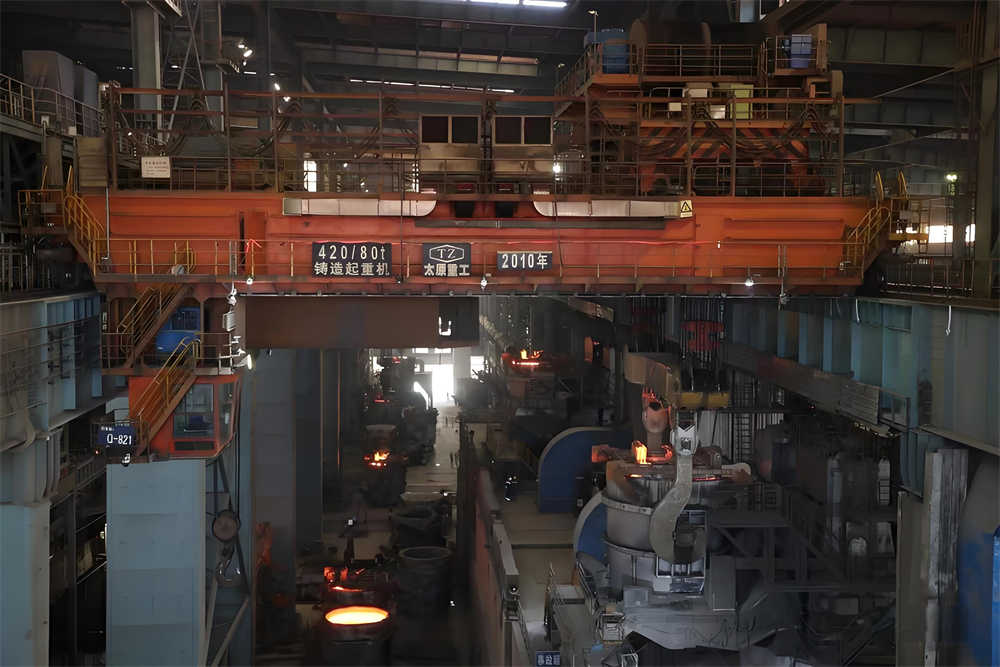
The Triple Threat: Dissecting the Challenges of High-Temperature Job-Shops
1. Intense and Radiant Heat
The most obvious challenge is extreme heat. Unlike ambient heat, metallurgical cranes must operate near molten metal baths, freshly cast ingots, or heat-treatment furnaces, facing direct radiant heat often exceeding 180°F (82°C) and sometimes reaching much higher levels.
- Impact on Standard Cranes: The structural steel of the crane’s double girder and end trucks can be weakened under prolonged heat exposure. Repeated thermal expansion and contraction can lead to metal fatigue, warping, and misalignment of the rails and the crane itself, compromising structural integrity.
- The Critical Component Failure: The hoist unit and the wire rope are particularly vulnerable. Standard wire ropes can lose their lubricants and tensile strength, becoming brittle and prone to sudden failure. Grease in bearings and gears can melt away, leading to rapid wear and seizure.
2. Abrasive and Corrosive Contaminants
These environments are filled with airborne abrasive dust (e.g., silica sand from casting molds, coal dust from forging) and corrosive agents (e.g., moisture, chemical fumes from quenching processes).
- Impact on Standard Cranes: These contaminants infiltrate electrical panels, motors, and gearboxes. Abrasive dust acts like sandpaper on moving parts, accelerating wear on wheels, brakes, and open gears. Corrosive elements attack electrical connections, leading to short circuits, component corrosion, and erratic control system behavior.
3. Demanding Duty Cycles and Heavy Loads
Operations in these shops are often continuous and intense. Cranes are required to perform frequent lifts, transport critical loads with precision, and handle heavy or abrasive materials like ladles of molten metal or large castings.
- Impact on Standard Cranes: Motors and electrical systems on standard cranes are rated for moderate duty cycles. Under constant heavy use, they are prone to overheating and burning out. Control systems lacking precision can lead to dangerous load sway, a significant risk when moving valuable or hazardous materials.
The High Cost of Compromise: Risks of Using a Standard Crane
Choosing a standard crane for a high-temperature application is a false economy. The risks include:
- Catastrophic Failure: The most severe risk is the failure of a critical component like the wire rope or brake while handling a ladle of molten metal. The potential for injury, loss of life, and massive property damage is immense.
- Excessive Downtime: Frequent breakdowns halt production lines. In a continuous process like steelmaking, downtime costs tens of thousands of dollars per hour.
- Sky-High Maintenance Costs: The constant battle against heat and contamination means replacing parts like wire ropes, motors, and electrical contacts far more often than in a normal environment, leading to unsustainable maintenance expenses.
- Shortened Equipment Life: A standard crane that might last 20-25 years in a normal warehouse may be rendered unusable in just a few years in a metallurgical setting.
The Foundation of a Proper Solution: Engineering for Extremes
Understanding these challenges is the first step. The next is engineering a crane that addresses each one systematically. A true Metallurgical Double Girder Electric Overhead Crane is not a modified standard product; it is a purpose-built machine from the ground up.
This begins with a design philosophy that prioritizes:
- Heat Management: Shielding components from radiant heat.
- Component Protection: Sealing and isolating critical parts from contaminants.
- Robust Construction: Using materials and designs that guarantee reliability under the most strenuous duty cycles.
Conclusion: Invest in Purpose-Built Reliability and Safety
The demanding conditions of a metallurgical workshop leave no room for compromise. Using a standard overhead crane presents an unacceptable level of operational, financial, and safety risk.
The only prudent choice is a crane specifically designed for the job. Dongqi Crane’s Metallurgical Double Girder EOT Cranes are engineered with these extreme conditions as the baseline, ensuring maximum uptime, safety, and long-term return on investment.
Ready to specify the right crane for your demanding application? Contact Dongqi Crane today to speak with our engineering team and request a custom quotation for a crane built to withstand your environment’s specific challenges.
