
Why Replace Jib Cranes with Single Girder Overhead Cranes?
Introduction
In industrial material handling operations, choosing the right lifting equipment is crucial for optimizing productivity and safety. At Dongqi Crane, we manufacture both jib cranes and single girder overhead cranes, each serving distinct purposes in workshop environments. While jib cranes have long been a staple for localized lifting tasks, many facilities are now transitioning to single girder overhead cranes to meet growing production demands.
This guide provides an objective comparison of both crane types, helping you determine which solution best fits your operational requirements. We’ll examine key differences in functionality, cost considerations, and ideal applications for each system.
Key Differences Between Jib Cranes and Single Girder Overhead Cranes
Coverage and Mobility
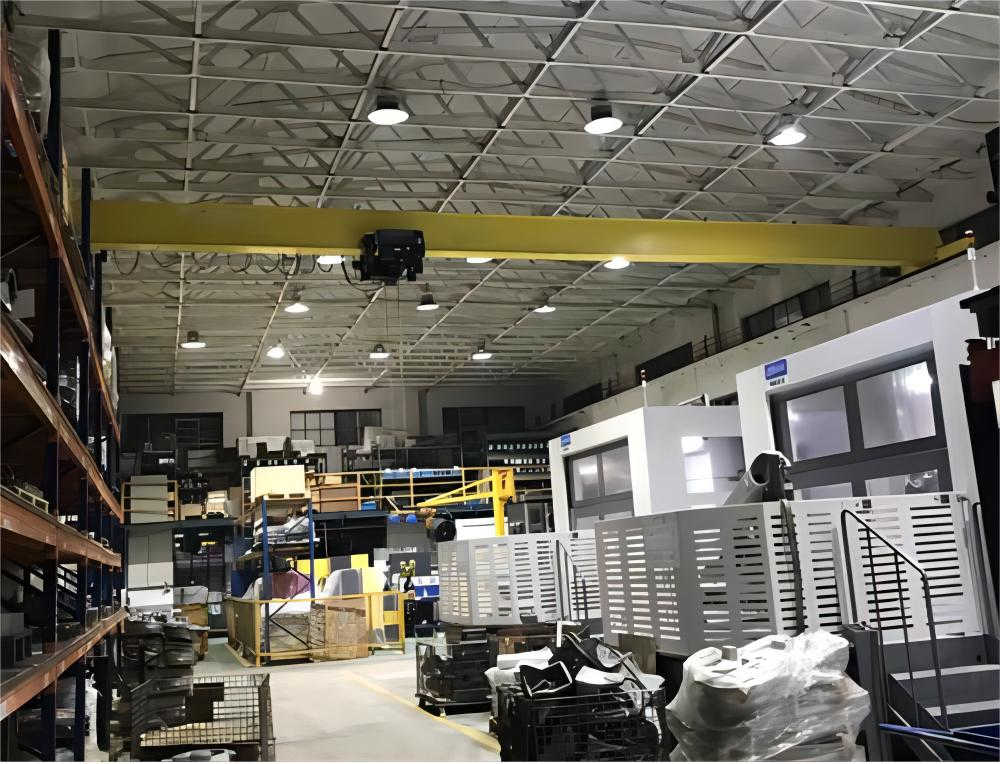
Jib cranes feature a fixed rotation arc (typically 180°-360°) with limited reach determined by their boom length. This design creates dead zones in your workspace that often require manual load repositioning. In contrast, single girder overhead cranes travel along runway beams, providing complete coverage of your facility length with no blind spots. The trolley and hoist can position loads with millimeter precision anywhere within the crane’s span.
Load Capacity
Standard jib cranes typically handle loads up to 10 tons, with some heavy-duty models reaching higher capacities. Single girder overhead cranes offer significantly greater capacity options, with standard models ranging from 1-20 tons and custom configurations available for loads up to 50+ tons. This makes overhead cranes ideal for heavy industrial applications where jib cranes would be inadequate.
Space Efficiency
Jib cranes require floor space for their mounting columns and clearance for boom rotation, which can interfere with workflow in crowded facilities. Single girder overhead cranes mount to ceiling structures, completely freeing up your floor space. Their compact girder designs minimize intrusion into your workspace while maximizing available headroom.
Automation and Control
While jib cranes typically offer basic motorized rotation at best, modern single girder overhead cranes feature advanced control options including variable frequency drives for smooth acceleration/deceleration, wireless remote operation, and even IoT-enabled monitoring systems. These capabilities enable precision handling and integration with automated production processes.
When to Choose a Jib Crane
Jib cranes remain the preferred choice for certain applications where their specific advantages shine:
Small Workshop Applications
In compact work areas with limited lifting needs, jib cranes provide an economical solution. Their simple design makes them ideal for maintenance bays, small assembly stations, or loading docks where only occasional lifting is required.
Fixed Position Lifting
For repetitive lifting tasks at a single workstation – such as machine loading or parts positioning – a jib crane offers sufficient functionality without the complexity of an overhead system.
Budget-Conscious Operations
With lower initial costs and minimal installation requirements, jib cranes present an accessible entry point for businesses with limited capital expenditure budgets.
Temporary or Mobile Needs
Freestanding jib cranes can be relocated relatively easily, making them suitable for temporary work sites or facilities with changing layouts.

When to Upgrade to a Single Girder Overhead Crane
Several operational factors may indicate it’s time to transition from jib cranes to a more capable overhead system:
High-Volume Material Handling
Single girder overhead cranes dramatically improve throughput with cycle times 3-5x faster than jib cranes. Their ability to move loads directly to any point in the facility eliminates the repositioning delays inherent to jib crane operation.
Heavy Load Requirements
When your lifting needs exceed 10 tons or involve oversized loads, overhead cranes provide the structural capacity and stability that jib cranes cannot match.
Full Facility Coverage Needs
Unlike jib cranes that serve limited work zones, overhead systems can transport materials across entire production areas, between work cells, or from receiving to storage.
Automation Integration
Modern overhead cranes readily integrate with automated production systems through programmable controls, position sensing, and data communication capabilities.
Long-Term Cost Efficiency
While requiring greater initial investment, overhead cranes typically deliver a complete return on investment within 12-24 months through labor savings, reduced product damage, and lower maintenance costs.
Cost and ROI Comparison
A detailed financial analysis reveals why many facilities ultimately transition to overhead crane systems:
| Factor | Jib Crane | Single Girder Overhead Crane |
|---|---|---|
| Initial Cost | $15,000-$50,000 | $30,000-$150,000 |
| Installation | Simple, often DIY | Requires professional installation |
| Load Capacity | ≤10 tons (typically) | 1-50+ tons |
| Coverage Area | Limited work zone | Full facility |
| Labor Requirements | 1-2 operators | Often just 1 operator |
| Daily Lift Capacity | 50-100 lifts | 200-300+ lifts |
| Maintenance Costs | Moderate (exposed mechanisms) | Low (sealed components) |
| Service Life | 10-15 years | 25+ years |
| Energy Efficiency | Standard | High (regenerative drives available) |
A typical manufacturing facility replacing multiple jib cranes with an overhead system often achieves:
- 50-70% reduction in labor costs
- 30-50% improvement in material handling throughput
- 25-40% decrease in maintenance expenses
- Complete ROI within 12-24 months
Dongqi Crane Solutions for Every Need
At Dongqi Crane, we offer complete lifting solutions tailored to your specific requirements:
Jib Crane Options
- Wall-mounted and freestanding designs
- Capacities from 0.5-20 tons
- Manual rotation or motorized options
- Stainless steel models for harsh environments
Single Girder Overhead Cranes
- Span capabilities up to 35 meters
- Capacities from 1-50+ tons
- Standard and explosion-proof configurations
- Smart crane technology packages
Our engineering team can help you:
- Evaluate your current material handling processes
- Identify bottlenecks and safety concerns
- Recommend optimized crane solutions
- Provide detailed ROI projections
Conclusion and Recommendation
The choice between jib cranes and single girder overhead cranes ultimately depends on your specific operational requirements:
- Choose jib cranes for:
✓ Small-scale, localized lifting
✓ Budget-limited projects
✓ Temporary or flexible installations
✓ Light-duty applications (<10 tons) - Upgrade to single girder overhead cranes for:
✓ High-volume material handling
✓ Heavy load requirements
✓ Full facility coverage needs
✓ Automated production integration
✓ Long-term cost efficiency
At Dongqi Crane, we’re committed to helping you select the ideal lifting solution. Our experts can evaluate your facility layout, workflow patterns, and growth projections to recommend the most cost-effective crane system for your operation.
Contact Dongqi Crane today for a free consultation and facility assessment. Let us help you optimize your material handling processes with the right crane solution for your needs and budget.
