
What Is Bridge Speed on an Overhead Crane, and Why Does It Matter?
Introduction: The Pulse of Your Material Handling System
In the world of industrial material handling, the overhead crane stands as a pivotal workhorse, integral to the flow of operations in manufacturing plants, warehouses, shipyards, and steel mills. While specifications like lifting capacity, span, and lifting height often capture immediate attention, one critical parameter frequently remains in the background, despite being the very pulse that dictates operational rhythm: bridge speed.
At Dongqi Crane, with decades of engineering excellence and a global footprint in crane manufacturing, we have consistently observed that a deep understanding of bridge speed is a hallmark of a well-designed, efficient, and safe lifting system. This comprehensive guide delves beyond the basic definition, exploring the multifaceted role of bridge speed, its profound implications on your operation, and how to optimize it for your specific needs.
What Is Bridge Speed on an Overhead Crane? Defining the Core Metric
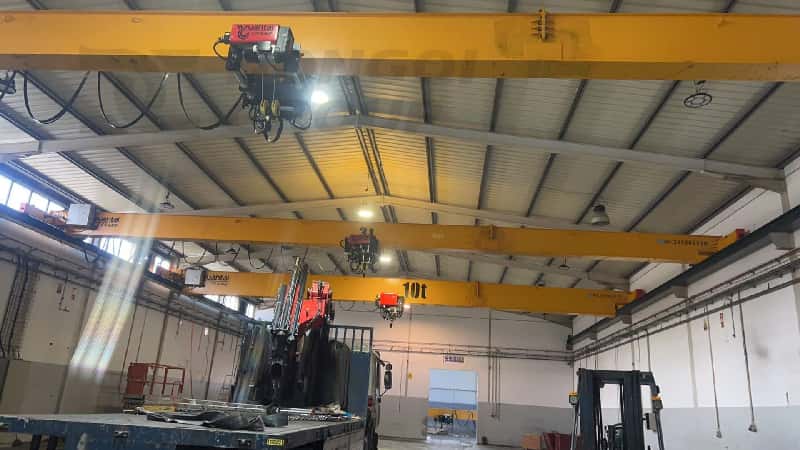
The bridge of an overhead crane is the primary horizontal beam (or set of beams) that forms the main traveling structure, moving perpendicularly along the runway rails installed on the building’s support columns or framework. The bridge speed, therefore, is the travel velocity at which this entire assembly—comprising the bridge girders, the trolley (which moves across the bridge), and the hoist—transits the length of the bay or building.
It is quantified in distance per unit of time, most commonly feet per minute (ft/min or FPM) or meters per minute (m/min). This speed is distinct from and operates independently of:
- Hoist Speed: The vertical speed of lifting and lowering the load.
- Trolley Speed: The transverse speed of the hoist assembly moving across the bridge girder(s).
Think of the crane system as a coordinate plane: the bridge speed controls movement along the X-axis (the building’s length), the trolley speed controls movement along the Y-axis (the building’s width), and the hoist speed controls the Z-axis (height). The synergy of these three axes determines overall cycle time and operational fluidity.
Why Bridge Speed Matters in Crane Design: The Cornerstone of Operational Efficiency
Bridge speed is not merely a number on a spec sheet; it is a fundamental driver of your system’s productivity and total cost of ownership. Its significance in crane design stems from its direct impact on:
- Cycle Time Optimization: The primary goal of most material handling is to move a load from Point A to Point B as quickly and safely as possible. The time taken for the bridge to traverse the bay often constitutes a major portion of the total cycle time. An optimally specified bridge speed minimizes this travel time without compromising control, directly boosting throughput.
- System Harmony and Balance: A crane is an integrated system. An excessively high bridge speed paired with a slow hoist speed creates a bottleneck—the crane arrives at its destination quickly but then waits for the load to be lifted or lowered. Engineers at Dongqi Crane meticulously balance all three motion speeds to ensure they complement each other, creating a seamless and efficient workflow.
- Process Integration: In automated or semi-automated systems, such as those serving CNC machine tools or assembly lines, the crane’s bridge speed must be synchronized with the pace of the surrounding processes. A mismatched speed can disrupt the entire production cadence.

How Bridge Speed Impacts Safety and Reliability: The Non-Negotiable Priorities
Compromising on the correct bridge speed specification is a direct gamble with safety and equipment longevity. The consequences are tangible:
- Load Sway and Pendulum Effect: Newton’s laws are unforgiving. Rapid acceleration or deceleration of the bridge imparts kinetic energy to the suspended load, causing it to swing. This sway complicates precise positioning, poses a danger to personnel and equipment below, and places undue stress on the crane structure and slings. Controlling sway often forces the operator to slow down, negating any theoretical speed advantage.
- Precision Positioning Challenges: Tasks requiring spot-on placement—such as setting a mold into a press, aligning a generator rotor, or stacking delicate goods—become exceedingly difficult with high bridge speeds. The “creep” or “inching” capability becomes critical, which is often a function of the drive control system.
- Increased Dynamic Loads on Structure: The forces acting on the crane and runway are not static. They are multiplied by dynamic factors during start-up and braking. Higher speeds require more forceful acceleration/deceleration, subjecting the entire system (drive wheels, gearboxes, runway beams, and building supports) to greater stress, accelerating fatigue and potential failure.
- Operator Fatigue and Error: Controlling a fast-moving, swaying load is mentally and physically demanding. Operator fatigue sets in faster, leading to judgment errors, “over-correcting” joystick inputs, and increased accident risk. A crane with a well-matched, controllable speed reduces cognitive load and enhances safe operation.

What Factors Determine the Right Bridge Speed? A Detailed Selection Matrix
Selecting the optimal bridge speed is a multidimensional decision. At Dongqi Crane, our consultation process involves a thorough analysis of these key factors:
- Duty Cycle and Service Class (CMAA/ISO Standards): Is the crane used for occasional, light service (Class A) or for intensive, 24/7 heavy-duty operation (Class E/F)? Higher duty cycles demand more robust drive systems to sustain performance at a given speed.
- Load Characteristics:
- Weight: Moving 5 tons versus 200 tons involves vastly different inertia.
- Nature: Is the load rigid (a steel coil), flexible (cable reels), or fluid (a ladle with molten metal)? Some loads are inherently more unstable.
- Dimension: A long, bulky load (like a beam) has a higher center of gravity and is more prone to swinging.
- Operational Environment and Distance:
- Bay Length: A 200-foot bay may justify a higher speed than a 50-foot bay to reduce transit time.
- Obstructions: The presence of other equipment, columns, or frequent cross-traffic may necessitate lower speeds for safety.
- Frequency of Moves: Short, frequent moves may benefit from moderate speeds with excellent controllability over sheer velocity.
- Precision Requirements: The need for millimeter-level precision (e.g., in aerospace assembly) dictates lower base speeds and sophisticated control systems.
- Control Method and Operator Skill: Will the crane be operated via pendant, cabin, or radio remote? Is the operator highly experienced? More intuitive controls and skilled operators can safely manage higher effective speeds.
Typical Bridge Speed Ranges by Application: A Practical Reference
While every application is unique, the following ranges provide a industry-standard baseline:
- Precision & Laboratory Applications (0.5 – 20 Tons): 20 – 60 FPM. Emphasis is on smooth, vibration-free, and ultra-precise movement for sensitive tasks.
- General Manufacturing, Maintenance Shops, Warehouses (5 – 50 Tons): 60 – 160 FPM. This is the most common range, offering a balance between efficiency and control for varied, daily tasks.
- Heavy Fabrication, Steel Service Centers, Scrap Yards (20 – 100+ Tons): 160 – 300+ FPM. Here, loads are heavy but standardized, and cranes often travel long distances in open bays. Robust structures and advanced drives are essential.
- Specialized High-Speed Cranes (e.g., Paper Mill Roll Handling, Certain Automated Systems): 400 – 600+ FPM. These are engineered for specific, optimized processes where cycle time is paramount. They feature custom-designed drives, specialized braking systems, and often automated controls.
The Role of Variable Frequency Drives (VFDs) in Bridge Speed Control: The Game Changer
The advent of Variable Frequency Drive (VFD) technology has revolutionized bridge motion control. Replacing traditional contactor-based (AC across-the-line) starting, VFDs offer:
- Soft Start & Stop: The motor’s voltage and frequency are ramped up and down smoothly. This eliminates the “jerk” at startup, drastically reducing load swing and mechanical shock on the drive train.
- Full Range Speed Control: Operators have infinite speed control from zero to maximum, enabling both fast travel and precise slow-speed positioning without switching motors or gears.
- Enhanced Motor Protection: VFDs provide controlled acceleration/deceleration currents, reducing thermal stress on motors and extending their life.
- Energy Efficiency: By controlling the motor’s input power based on demand, VFDs can significantly reduce energy consumption, especially in applications with frequent starts and stops.
- Programmable Features: Features like S-curve acceleration, skip frequencies (to avoid mechanical resonance), and preset speeds can be programmed into the VFD for optimized performance.
For any crane where control, precision, and longevity are valued, specifying a VFD for the bridge drive is, in Dongqi Crane’s expert opinion, a critical investment.
Does Higher Bridge Speed Increase Crane Cost? Understanding the Cost Drivers
Yes, specifying a higher bridge speed invariably increases the initial capital cost, and for sound engineering reasons:
- Drive Motor Power: To achieve higher speeds with the same load, more powerful motors are required to overcome inertia and friction.
- Gearbox & Drive Assembly: The gearbox ratio must be designed for the target speed. Higher output speeds or torques require larger, more robust, and often more precise gearing.
- Braking System: Stopping a faster-moving mass requires brakes with higher torque capacity and thermal dissipation to handle the increased kinetic energy.
- Structural Reinforcements: The bridge girders and end trucks must be designed to withstand the higher dynamic forces and moments induced during high-speed travel and braking, potentially leading to heavier sections.
- Advanced Control Systems: As mentioned, achieving safe high-speed operation almost mandates VFDs and potentially more sophisticated programmable logic controller (PLC) systems.
- Runway Implications: The crane’s runway may also need to be strengthened to handle the increased horizontal forces transmitted through the wheels.
The key is justification through productivity analysis. A 20% increase in bridge speed that reduces cycle time by 15% on a crane running 20 cycles per hour can yield a compelling return on investment (ROI).
Can You Adjust Bridge Speed After Installation? The Retrofit Reality
While some limited adjustment is possible post-installation, significant changes are often impractical or cost-prohibitive:
- Minor Adjustments: With a VFD-controlled system, the maximum speed setting can sometimes be increased or decreased within the motor’s capability band. However, this is constrained by the mechanical design (gearbox ratio, wheel size).
- Major Changes: To substantially increase speed, you may need to replace the drive motors, gearboxes, and possibly the brake wheels. This is a complex retrofit that requires engineering review, as the original structural design may not have accounted for the new dynamic forces. It is almost always more economical and reliable to specify the correct speed requirements upfront during the initial design and procurement phase with a knowledgeable partner like Dongqi Crane.
How Does Bridge Speed Vary by Industry? Sector-Specific Requirements
- Aerospace: Low to moderate speeds (20-80 FPM) for handling high-value, delicate composite structures and engines. Precision and absolute smoothness are paramount.
- Automotive & Stamping: Moderate to high speeds (100-250 FPM) for moving dies, sheet metal coils, and sub-assemblies over long production lines to meet just-in-time schedules.
- Power Generation (Turbine Halls): Very low speeds (10-40 FPM) for the excruciatingly precise placement of multi-hundred-ton turbines, generators, and rotors.
- Shipping & Ports (Gantry Cranes): Highly variable. While large container gantries move quickly, the bridge speed of an indoor workshop crane handling engine blocks would be moderate, prioritizing control.
- Warehousing & Logistics (Stacker Cranes): High and tightly controlled speeds (200-400+ FPM) for automated storage/retrieval systems, where speed and positional accuracy are optimized by software.
Common Misunderstandings About Bridge Speed: Dispelling the Myths
- Myth 1: “The Top Speed on the Brochure is What We’ll Get Daily.”
- Reality: The maximum speed is a design capability. The effective, usable speed is often lower due to the need to control sway, navigate a congested bay, or position accurately. Controllability is more valuable than pure top speed.
- Myth 2: “We Should Specify the Fastest Speed We Can Afford.”
- Reality: This leads to overspending on capability you cannot safely use and potentially undermines safety and control. The goal is to specify the optimal speed for your specific workflow.
- Myth 3: “Bridge Speed is Only an Electrical/Control Issue.”
- Reality: It is a mechanical-electrical-structural triad. The speed influences the motor size (electrical), the gearbox design (mechanical), and the girder stiffness (structural). All must be engineered in concert.
- Myth 4: “A Standard Speed is Fine for Our Application.”
- Reality: While standard options exist, overlooking a detailed speed analysis can lock you into years of suboptimal productivity. Customization is key to value.
Final Thoughts: Integrating Bridge Speed into Your Holistic Crane Strategy
Bridge speed is far more than a line item; it is a vital parameter that interlinks with every aspect of your crane’s design, performance, and safety. Ignoring it during the specification phase can lead to a crane that is either a sluggish bottleneck or a dangerous, uncontrollable asset.
At Dongqi Crane, we don’t just sell cranes; we engineer integrated material handling solutions. Our process begins with a deep dive into your operational data, spatial constraints, and productivity goals. We then model the interaction of bridge, trolley, and hoist speeds to propose a system harmonized for maximum safe throughput.
Investing time in correctly defining your bridge speed requirements is an investment in the long-term efficiency, safety, and profitability of your operations.
FAQs About Bridge Speed on Overhead Cranes
Q: How is bridge speed typically measured and verified?
A: During commissioning, technicians use manual timing over a measured distance or laser speed measurement tools to verify the crane meets the specified speed under no-load and full-load conditions.
Q: What’s the relationship between bridge speed and motor RPM?
A: Bridge Speed (FPM) = (Motor RPM / Gearbox Ratio) * (Wheel Diameter * π) / (12 in/ft). Changes to any of these components affect the final speed.
Q: Does weather or temperature affect bridge speed in outdoor cranes?
A: Indirectly, yes. Extreme cold can thicken grease, increasing resistance. High winds can create additional drag and safety concerns, often requiring operators to reduce speed. Outdoor crane designs account for these factors.
Q: Can different bridge speeds be set for different operators or load weights?
A: Yes. Modern control systems, especially those with VFDs and PLCs, can allow for password-protected speed limit settings or automatically derate speed based on load cell readings for very heavy loads.
Learn More About Overhead Cranes and Proper Overhead Crane Maintenance
Specifying the correct bridge speed is the first step. Ensuring it is maintained throughout the crane’s life is the next. Proper overhead crane maintenance—including regular inspection of drive motors, gearbox lubrication, wheel flange alignment, and brake adjustment—is essential to preserving the designed performance and safety of your crane’s travel motions.
Dongqi Crane provides end-to-end support: from initial consultation and custom engineering to manufacturing, installation, and a comprehensive suite of after-sales maintenance and inspection services. Let our experts help you design a crane system where every specification, especially bridge speed, is optimized for your success.
Contact Dongqi Crane today for a detailed consultation and to request a custom crane design proposal tailored to your unique operational rhythm.
