
The Global Influence and Development Prospects of Chinese Bridge Cranes: A Case Study of Dongqi Crane
Driven by the wave of global industrialization and a new round of infrastructure construction, bridge cranes, as the “aerial backbone” of modern industrial production, are experiencing accelerated market demand and technological iteration. According to industry reports, the global bridge crane market sales reached $6.266 billion in 2025 and are expected to maintain steady growth in the coming years. In this global competition, Chinese bridge crane manufacturers represented by Dongqi Crane are leveraging their unique competitive advantages to gradually transform from market participants to shapers of the landscape, exerting a profound impact on industrial development worldwide and indicating future directions for the industry.
I. Assistance and Impact of Chinese Bridge Cranes on Global Industrial Development
The assistance provided by Chinese-made bridge cranes to countries around the world is primarily manifested in three areas: filling the global infrastructure construction capacity gap, offering cost-effective industrialization solutions, and promoting the stability and upgrading of global supply chains.
1. Empowering Global Infrastructure Construction and Industrialization Processes
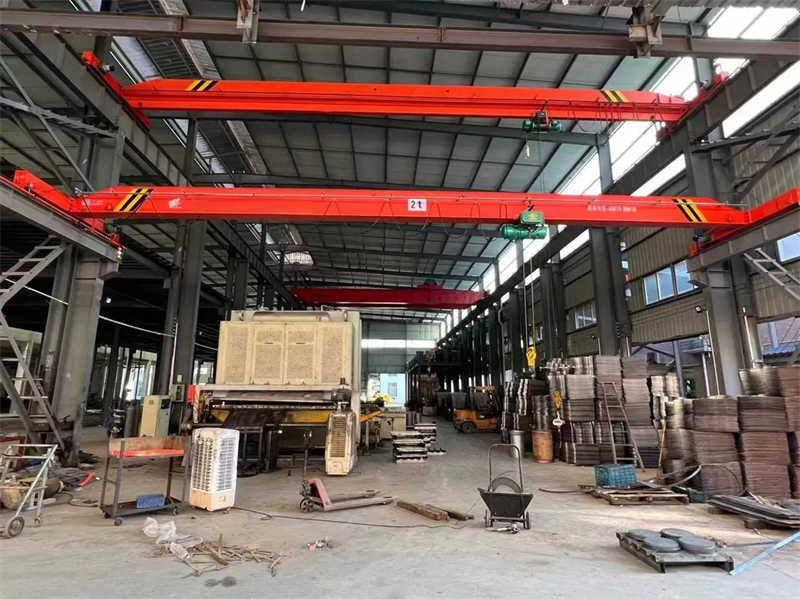
For many developing countries and emerging economies, advancing industrialization and improving ports, logistics hubs, and heavy manufacturing facilities are crucial for economic development. Chinese bridge cranes, with their exceptional cost-performance ratio and strong adaptability, have become vital tools for these nations to achieve leapfrog development. Taking Dongqi Crane as an example, its product line covers lifting requirements from 10 tons to 800 tons and can provide highly customized solutions applicable to manufacturing, logistics centers, ports, and even specialized environments like nuclear power and mining. This “one-stop” problem-solving capability enables countries with limited resources to quickly establish or upgrade their core industrial material handling systems at more controllable costs, directly enhancing the efficiency and scale of their local manufacturing sectors.
2. Providing Cost-Effective and Highly Customized Solutions
Compared to traditional European high-end brands, a core advantage of Chinese manufacturers lies in offering more competitive prices and flexible customization services while ensuring quality that meets international standards (such as ISO and CE certification). This lowers the threshold for global small and medium-sized enterprises to undertake automation upgrades and equipment renewal. For instance, addressing the common challenge of insufficient load-bearing capacity in existing factory structures, Chinese manufacturers can not only provide standard bridge cranes but also, like Dongqi Crane, offer professional engineering technical support. This includes customizing multi-wheel structures to distribute wheel load or recommending European-style designs to reduce deadweight, thereby meeting customer lifting needs without costly factory modifications. This deep service model, oriented toward solving practical customer problems, significantly expands the application scenarios for bridge cranes.
3. Building Stable and Efficient Global Service Networks
Leading Chinese crane manufacturers have established mature global sales and service networks. Dongqi Crane’s products have been exported to 96 countries worldwide, with a commitment to providing 24/7 rapid after-sales response and technical support. This extensive and timely service coverage ensures stable equipment operation anywhere in the world, reducing significant losses for customers caused by equipment downtime. This is not only a commercial guarantee but also a reflection of the upgrade of “Made in China” from “product export” to “service and solution export,” enhancing global customers’ reliance on and trust in the Chinese supply chain.
II. Comparative Analysis of Development Differences Between Chinese and Foreign Bridge Cranes
There are significant differences in the development paths and competitive advantages between China and traditional industrial powers in Europe and America in the bridge crane sector, mainly reflected in three aspects: technology evolution paths, market drivers, and industrial ecosystem structures.
1. Technology Evolution Path: From Catching Up to Parallel Leadership
European and American enterprises (such as Finland’s Konecranes, Germany’s Demag, etc.) have long been deeply entrenched in the high-end market, with profound accumulation in core components (such as wire rope hoists, drive systems) and long-term reliability of ultra-heavy-duty, high-precision, and special-environment (e.g., explosion-proof, nuclear power) cranes. Their technological development focuses more on ultimate performance, safety standards, and seamless integration with highly automated production lines.
In contrast, the technological rise of Chinese enterprises follows a more composite path. Initially, through absorption, introduction, and scaled manufacturing, they quickly captured the mid-range market. Currently, Chinese manufacturers are achieving technological breakthroughs via two pathways: First, application innovation targeting specific market needs, such as promoting low headroom single-girder cranes for space-constrained sites or developing customized solutions for diverse factory layouts. Second, actively integrating new-generation information technologies like the Internet of Things and artificial intelligence. Data shows that remote operation and smart sensor integration have become clear industry trends, with Chinese enterprises demonstrating unique advantages in the promotion speed and cost control of intelligent, digital solutions.
2. Market and Industrial Ecosystem Structure
From a market structure perspective, the global market exhibits characteristics of “high-end dominance, mid-range concentration.” In 2025, the top six manufacturers held a significant market share, with Konecranes accounting for about 16%. Although Chinese companies like Henan Weihua and Henan Mine have entered the ranks of global major manufacturers, overall, they still remain in a catching-up position in terms of brand premium and competition for top-tier complex projects.
However, China possesses the world’s most complete and rapidly responsive crane manufacturing industrial cluster. Upstream supply chains for materials like steel, motors, and reducers are ample, midstream manufacturing enterprises show obvious agglomeration effects (especially in Jiangsu, Shandong, Henan, etc.), and downstream application markets are vast with diverse demands. This industrial cluster advantage endows Chinese enterprises with unparalleled cost control capabilities, rapid delivery capabilities, and the ability to meet fragmented, personalized needs—a challenge for Western manufacturers with high specialization but relatively independent systems.
3. Competition Focus and Service Models
The competition focus for European and American manufacturers lies in providing whole-lifecycle value, including top-tier technical consulting, long-term maintenance agreements, and energy efficiency solutions (e.g., energy regeneration drives). The competitive strategy of Chinese manufacturers is more flexible and diverse: while consolidating the “high cost-performance” foundation, leading enterprises are vigorously building full-process service systems from professional consulting and custom design to rapid installation and round-the-clock after-sales support, aiming to enhance customer stickiness and brand value.
III. Predictions for Future Development Trends in the World Market
Looking ahead to 2026 and beyond, the development of Chinese bridge cranes in the global market will exhibit the following three major trends:
1. Continued Enhancement of Market Position, Advancing Toward the High-End Value Chain
The global bridge crane market is projected to continue growing by 2032. As one of the world’s largest production and consumption markets, China’s market share is expected to further expand. As Chinese manufacturers achieve breakthroughs in technological accumulation in intelligent, heavy-duty, and special cranes, they will gradually erode the high-end market share dominated by European and American brands. Export-oriented enterprises represented by Dongqi Crane, with their adherence to international standards and global service networks, will become pioneers in the high-end transformation of “Made in China.”
2. Technology-Driven Industry Transformation, with Intelligence and Green Development as Core Arenas
The core of future competition will be technological integration and innovation capability. Intelligence is a definitive direction, with increasing demand for smart cranes featuring remote monitoring, predictive maintenance, automatic anti-sway, and precise positioning. Green development will also become an important standard, where energy-efficient motors, lightweight designs, and energy recovery systems will transition from unnecessary costs to key competitive advantages. If Chinese manufacturers sustain investment in these two arenas, they will have the opportunity to redefine market rules.
3. Deepening Solution Orientation to Address Complex Global Challenges
Future competition will transcend single equipment, shifting toward providing complete material handling solutions covering planning, installation, operation, maintenance, and upgrades. Simultaneously, global supply chain restructuring, changes in regional trade policies (such as tariff barriers), and fluctuations in raw material prices pose higher requirements for manufacturers’ global operational capabilities and risk resilience. Chinese manufacturers capable of offering stable supply chains, flexible financial solutions (e.g., financing leases), and localized in-depth services will be more likely to gain the long-term favor of global customers.
In summary, the Chinese bridge crane industry, epitomized by Dongqi Crane, is playing an increasingly significant role on the global stage with its strong manufacturing foundation, flexible market strategies, and accelerated technological innovation. It not only provides solid assistance for the industrialization processes of countries worldwide but also, through competition and cooperation with Western counterparts, drives the entire industry toward a smarter, more efficient, and more sustainable future. From “manufacturing” to “intelligent manufacturing,” from “product export” to “standard and solution export,” the global journey of Chinese bridge cranes is a vivid snapshot of the rise of China’s high-end equipment manufacturing industry.
