
The Definitive Guide to Manual Hoisting: An In-Depth Analysis of Hand Chain Hoists vs. Lever Hoists
Introduction: The Critical Role of Manual Hoists in Modern Industry
In the intricate ecosystem of industrial material handling, the ability to move heavy loads safely, precisely, and efficiently remains a cornerstone of productivity and safety. While powered hoists and cranes dominate high-volume operations, the manual hoist retains an indispensable role. It is the epitome of controlled power, combining human oversight with mechanical advantage for tasks that demand finesse, reliability in remote locations, or cost-effective simplicity. For riggers, maintenance crews, and workshop operators, the manual hoist is not just a tool but a trusted partner in executing critical lifts and placements.
However, navigating the selection process reveals a landscape of diverse options. Among these, two champions stand out: the Hand Chain Hoist and the Lever Hoist. To the untrained eye, both accomplish the same goal—lifting a load. Yet, their design philosophies, operational mechanics, and ideal applications diverge significantly. Choosing incorrectly can lead to inefficiency, increased operator fatigue, potential safety risks, and unnecessary equipment wear.
This comprehensive guide, presented with the engineering expertise of Dongqi Crane, delves beyond basic comparisons. We will dissect the anatomy, physics, and practical realities of each hoist type. Our goal is to transform you from an informed researcher into a confident decision-maker, equipped with the knowledge to select the perfect manual hoisting solution for your specific challenges, ensuring every lift is executed with optimal safety and performance.
Chapter 1: The Hand Chain Hoist – The Vertical Lift Specialist
1.1 What Is a Hand Chain Hoist?
A hand chain hoist, traditionally known as a chain block or differential hoist, is a manually operated device designed for pure vertical lifting in a suspended configuration. Its operation is elegantly simple: the operator pulls down on an endless hand chain, which rotates a set of precision-machined gears. This gear train reduces the input force required, translating into a powerful mechanical advantage. The load chain, directly connected to this gear system, is drawn into the hoist body, lifting the attached load with smooth, controlled motion.
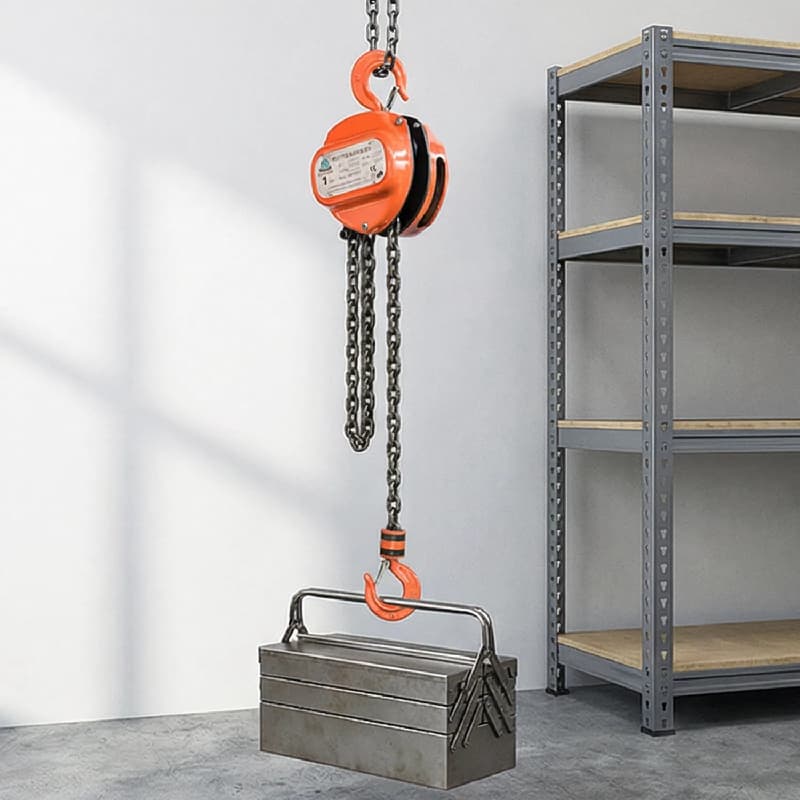
Key components include:
- Load Hook (Upper & Lower): Forged steel hooks with safety latches for secure attachment to the support point and the load.
- Gear Train: Enclosed in a robust housing, typically utilizing spur or planetary gears for high efficiency and durability.
- Load Chain: High-tensile, alloy steel chain (e.g., Grade 80 or 100) designed to bear the full load.
- Hand Chain: A smaller, lighter chain made for comfortable pulling, forming a continuous loop.
- Braking System: An automatic, load-sensitive mechanical brake that engages the moment hand chain tension is released, preventing accidental lowering.
1.2 The Profound Benefits and Advantages
Hand chain hoists are not merely tools; they are systems engineered for specific excellence.
- Superior Lifting Efficiency and Ergonomics: For repetitive vertical lifting over a fixed point, no manual tool is more efficient. The natural downward pulling motion allows an operator to use their body weight effectively, reducing fatigue compared to other manual methods. The gear ratios are optimized for this single motion.
- Unmatched Precision in Load Control: The direct correlation between hand chain movement and load chain movement allows for micrometer-fine positioning. Operators can “inch” a load into place with exceptional accuracy, which is critical for aligning machinery, setting delicate components, or working in tight tolerances.
- Legendary Durability and Minimalist Maintenance: Their design is a testament to simplicity. With few moving parts sealed in a protective housing, hand chain hoists are incredibly resilient to harsh environments—dust, moderate moisture, and temperature variations. Maintenance often involves only periodic cleaning, lubrication, and load chain inspection.
- Economic Advantages: Lower initial investment, combined with minimal maintenance and long service life (often decades), results in a remarkably low total cost of ownership. They are a “set-and-forget” component of a workstation.
- Safety by Design: The automatic brake is fail-safe. It holds the load securely without relying on the operator’s continuous force. Many models also feature a dual braking system for added redundancy.
1.3 Ideal Applications: Where the Hand Chain Hoist Reigns Supreme
- Dedicated Workstation Lifting: Permanently installed on a monorail, jib crane, or gantry crane in workshops, manufacturing cells, and assembly lines.
- Maintenance Bays: For hoisting engines, heavy components, or machinery during repair and servicing.
- Warehousing and Storage: Lifting and positioning heavy items onto shelves or pallets.
- Low-Headroom Applications: Specific designs are optimized for situations where vertical clearance is severely limited.
Chapter 2: The Lever Hoist – The Versatile Portable Powerhouse
2.1 What Is a Lever Hoist?
A lever hoist, also called a ratchet hoist or come-along, is the Swiss Army knife of manual hoisting. It is a compact, portable device operated by manually oscillating a lever handle back and forth. This action engages a ratchet and pawl mechanism, which incrementally draws in or releases the load chain. This fundamental design grants it a unique capability: multi-directional operation.
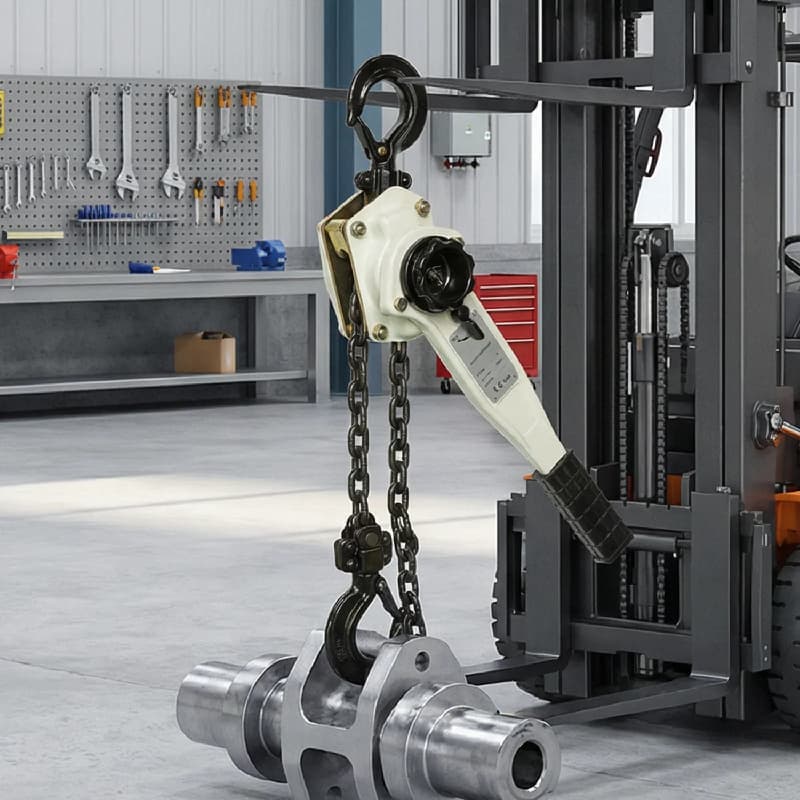
Key components include:
- Lever Handle: The operating mechanism, incorporating the ratchet direction control.
- Ratchet and Pawl System: The heart of the hoist, converting the lever’s reciprocating motion into linear chain movement.
- Load Chain: Similar to hand chain hoists, made of high-grade alloy steel.
- Hooks: Typically equipped with two hooks (top and bottom), both swiveling for alignment.
- Braking System: Also utilizes a ratchet-and-pawl system for holding, where the load itself keeps the pawl engaged against the ratchet gear.
2.2 The Core Benefits and Operational Strengths
The lever hoist’s value proposition is rooted in adaptability and problem-solving.
- Unparalleled Versatility and Portability: Its compact, self-contained design means it can be taken anywhere—up a tower, into a trench, or onto a rooftop. It is the ultimate tool for field service and mobile operations.
- Multi-Directional Force Application: This is its defining feature. A lever hoist can lift, pull, drag, and tension. It does not require a perfectly vertical orientation. You can use it to pull a pipeline section into alignment, tension a guy-wire, drag a fallen tree, or lift a load where the anchor point is not directly above.
- Operation in Confined and Complex Spaces: The short stroke of the lever handle requires only inches of operating space, unlike the continuous pull needed for a hand chain. It can operate in incredibly tight quarters where swinging a hand chain would be impossible.
- Precise Control in All Orientations: The ratchet mechanism allows for very controlled, click-by-click movement, whether you are lifting or applying horizontal tension. This control is vital in rigging and assembly work.
- Independent of Continuous Overhead Support: While it can be used for overhead lifting, it can also be anchored to walls, floors, or other structures, vastly expanding its utility.
2.3 Where are Lever Hoists Used?
- Construction and Erection: Lifting steel beams, positioning prefabricated sections, and tensioning structures.
- Rigging and Hauling: As a “come-along” for moving equipment, positioning heavy machinery on skids, or recovering vehicles.
- Maintenance and Repair: Ideal for in-situ work on conveyors, agricultural equipment, or marine engines where overhead cranes are unavailable.
- Utilities and Telecom: For pulling cable, tensioning lines, and handling equipment on poles or in underground vaults.
- Emergency and Recovery Services: A staple in fire/rescue and disaster recovery kits for its ability to create lifting/pulling points anywhere.
Chapter 3: The Critical Decision Matrix – How to Choose with Confidence
Selecting between a hand chain and lever hoist is not about which is “better,” but which is optimized for your specific task. Use this detailed decision framework.
| Decision Factor | Hand Chain Hoist | Lever Hoist | Rationale and Implications |
|---|---|---|---|
| Primary Function | Dedicated Vertical Lifting | Multi-Purpose: Lift, Pull, Drag, Tension | If >90% of your work is straight vertical lifting under a fixed point, the hand chain’s efficiency wins. If your tasks are varied and directional, the lever hoist is mandatory. |
| Mounting & Setup | Requires a fixed, rated overhead support point (hook, trolley). | Extremely flexible. Can be anchored overhead, horizontally, or even below the load. | The hand chain hoist is part of a fixed installation. The lever hoist is a field tool for creating solutions where infrastructure is lacking. |
| Operational Space | Needs clear vertical space below the hoist for the operator to pull the hand chain (typically >1 meter). | Can operate in extremely confined spaces; needs only enough room to swing the lever handle (often <30 cm). | A critical factor in repair pits, inside machinery, or crowded construction sites. Space constraints often dictate the choice. |
| Portability & Frequency of Move | Low. Designed for stationary or semi-stationary use on a trolley. | High. Lightweight, carried in a tool bag or vehicle. Meant to be moved constantly. | Consider how often the hoist needs to travel. A lever hoist moved 10 times a day is being used as designed; a hand chain hoist moved that often is being misapplied and will wear prematurely. |
| Operator Ergonomics & Fatigue | Excellent for high-volume vertical cycles. Uses natural body motion. | Can be more fatiguing for pure, high-volume lifting due to the repetitive lever motion. Superior for low-cycle, positioning, and tensioning work. | For an 8-hour shift of loading/unloading a truck under a gantry, the hand chain hoist is far less taxing. For a series of 10-minute tensioning jobs around a site, the lever hoist causes less fatigue. |
| Load Control & Precision | Exceptionally smooth and precise for vertical positioning. | Precise, but incremental (ratchet clicks). Excellent for controlled tensioning and positioning in any direction. | Both offer fine control, but the “feel” is different. The hand chain offers a fluid motion; the lever offers measured, step-by-step advancement. |
| Typical Duty Cycle | Higher. Built for more frequent use in a controlled environment. | Lower to Medium. Designed for intermittent, often demanding, field use. | Match the tool to the intensity of use. Using a lever hoist for hundreds of lifts per day in a factory will lead to rapid wear and operator strain. |
The Ultimate Question Set for Your Team:
- What is the primary motion? (Straight up vs. pull/drag/tilt)
- Where will the hoist live? (Fixed workstation vs. service truck)
- What are the spatial constraints? (Wide-open bay vs. inside a turbine housing)
- How often will it be used and moved? (50 lifts/day at one station vs. 5 lifts/week at various sites)
- Who is the operator and what is their skill level? (Trained technician in a bay vs. a versatile rigger in the field)
Answering these will point decisively toward the correct technology.
Chapter 4: The Imperative of Standards and Safety
Regardless of choice, compliance with rigorous international standards is non-negotiable for safety and liability. Both hoist types are governed by stringent regulations.
- ASME B30 Series (USA):
- ASME B30.16: “Overhead Hoists (Underhung).” This is the primary standard for hand chain hoists, covering design, construction, installation, inspection, testing, maintenance, and operation.
- ASME B30.21: “Manually Lever Operated Hoists.” This standard is specific to lever hoists, addressing their unique safety considerations, such as anchorages and multi-directional use.
- ISO Standards (International):
- ISO 9001: Quality Management Systems, ensuring manufacturing consistency.
- Specific product standards (e.g., related to hooks, chains, and load testing) ensure performance and safety benchmarks are met globally.
- CE Marking / EU Machinery Directive 2006/42/EC: Mandatory for sale in the European Economic Area, indicating conformity with essential health, safety, and environmental protection requirements.
Universal Safety Practices:
- Never Exceed the Rated Capacity (WLL – Working Load Limit).
- Inspect Before Every Use: This includes hooks, chain, brakes, and labels for damage or wear.
- Ensure Proper Anchorage: The support must be capable of holding the load plus the force of the hoist.
- Use Correct Rigging Techniques: Employ slings, shackles, and other rigging hardware appropriately.
- Keep Personnel Clear of the Load Path.
- Follow a Formal Periodic Inspection Schedule as mandated by standards and operational conditions.
Chapter 5: Partnering with Dongqi Crane for Your Hoisting Success
Selecting the right hoist is the first step. Sourcing it from a partner who provides the right product, the right knowledge, and the right support completes the cycle of value and safety.
Why Choose Dongqi Crane for Your Manual Hoist Needs?
- Curated Product Portfolio: We offer a comprehensive range of both hand chain hoists and lever hoists from world-renowned manufacturers and our own rigorously tested brands. Our selection includes various capacities (from 0.5T to 50T+), lift heights, and specialized models (e.g., low-headroom, high-frequency duty, corrosion-resistant).
- Application Engineering Expertise: We don’t just sell products; we solve lifting challenges. Our technical team can analyze your specific application—considering load, environment, frequency, and space—to provide a data-driven recommendation, ensuring you invest in the optimal tool.
- Uncompromising Commitment to Standards: Every hoist we supply is accompanied by clear documentation of its compliance with relevant ASME, ISO, or CE standards. We ensure traceability and provide the certificates required for your safety audits and compliance records.
- Total Solution Support:
- Pre-Sale Consultation: In-depth needs analysis and specification support.
- Competitive & Transparent Pricing: High value without hidden costs.
- Logistics & Delivery: Reliable global and domestic shipping to get equipment to your site.
- After-Sales Service: Access to inspection guidelines, maintenance manuals, spare parts, and technical support to maximize the service life of your equipment.
- A Partner for Your Growth: As your operations evolve, Dongqi Crane is your partner for more complex systems. We provide everything from standalone hoists to complete overhead crane systems, gantries, and electrification solutions.
Conclusion: Empowering Your Lift, Ensuring Your Safety
The choice between a hand chain hoist and a lever hoist is a fundamental decision that impacts daily operations, safety culture, and long-term productivity. The hand chain hoist stands as the undisputed master of the vertical lift—efficient, precise, and durable in its dedicated role. The lever hoist is the versatile champion of the field—adaptable, portable, and capable of solving a hundred different pulling and positioning problems.
By understanding their core principles, advantages, and ideal applications as outlined in this guide, you are now equipped to make an intelligent, cost-effective, and—most importantly—safe choice.
Don’t let the complexity of choice hinder your operations. Contact the lifting experts at Dongqi Crane today. Let us help you analyze your requirements, navigate the specifications, and provide you with the perfect manual hoist solution that your team can rely on, lift after lift.
