
Boosting Production Efficiency: The Application of Dongqi Light Crane on Assembly Lines
1 KBK Crane Overview: The Ideal Solution for Modern Assembly Lines
The KBK crane (abbreviation for the German “Kombiniert Kran,” meaning “Combined Crane”) is a flexible beam lifting system with a typical maximum lifting capacity of 2 tons. Originating in Europe, this crane design employs a modular concept, allowing for the flexible combination of standard components to create material handling solutions tailored to different workspace and task requirements. The basic working principle of the KBK system involves suspending tracks from the workshop structure, enabling an electric or manual hoist to move along the track, achieving precise positioning and efficient handling of materials.
Core components of the KBK crane include:
- KBK Track: The load-bearing foundation of the system, made from high-strength cold-rolled profiles to ensure stable operation.
- Suspension System: Connects the track to the building structure, allowing for horizontal and vertical adjustment.
- Trolley: Equipped with wear-resistant nylon wheels for smooth and effortless movement.
- Electric Hoist: The core lifting mechanism, featuring a compact design and smooth operation.
- Connectors and Safety Devices: Ensure system integrity and operational safety.
This modular design makes the KBK crane a highly flexible material handling solution, particularly suitable for modern assembly lines that require frequent layout adjustments. Compared to traditional cranes, the KBK system is characterized by its light weight and easy installation, placing lower demands on the building structure and effectively reducing initial investment costs.
2 Core Value of KBK Cranes in Enhancing Assembly Line Efficiency
In modern manufacturing, assembly line efficiency directly impacts a company’s production capacity and competitive advantage. KBK cranes significantly enhance assembly line production efficiency in the following ways:
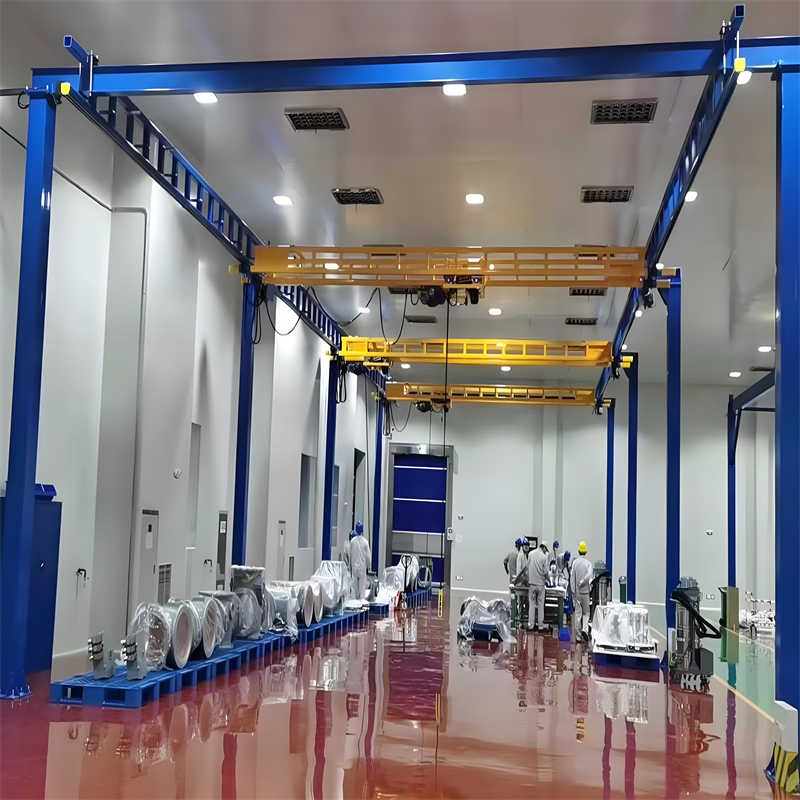
2.1 Optimizing Material Flow Efficiency
The KBK crane system enables point-to-point material transport, minimizing handling paths. Through various combinations of straight tracks, curved tracks, switches, and turntables, a continuous material flow can be established, seamlessly connecting various workstations. This integrated material supply avoids the multiple transfers and waiting times associated with traditional handling methods, making the assembly process more coherent and smooth. Practical application data shows that a well-designed KBK track layout can reduce material handling time by over 30%.
2.2 Improving Space Utilization
The KBK crane system utilizes a top-suspended installation method, occupying no floor space and making full use of the workshop’s three-dimensional volume. For expensive industrial buildings, this characteristic means more production equipment or workstations can be arranged within the same footprint. Furthermore, the KBK system can be flexibly designed to follow the specific spatial conditions of the workshop, even utilizing inclined tracks and variable-span tracks where traditional cranes are difficult to operate, achieving efficient use of irregular spaces.
2.3 Precise Positioning and Ergonomic Operation
KBK cranes are equipped with precise control systems capable of millimeter-level positioning accuracy, which is crucial for assembly tasks requiring fine alignment. Operators can easily place heavy objects accurately into predetermined positions, significantly reducing adjustment and alignment time. Excellent ergonomic design ensures minimal operating force, greatly reducing operator labor intensity. A typical example is in automotive assembly lines, where workers use KBK cranes to effortlessly lift engine assemblies precisely into the vehicle body, a task that would require multiple people and more time using traditional methods.
Table: Performance Comparison of KBK Cranes vs. Traditional Material Handling Methods on Assembly Lines
| Indicator | KBK Crane | Traditional Crane | Manual Handling |
|---|---|---|---|
| Positioning Accuracy | High (millimeter level) | Average | Low |
| Space Occupation | Only overhead space | Overhead + partial floor space | Floor aisles |
| Labor Intensity | Low | Medium | High |
| Flexibility | High (reconfigurable) | Low | Medium |
| Initial Investment | Medium | High | Low |
2.4 Reducing Comprehensive Operating Costs
The low maintenance requirements and high reliability of KBK cranes reduce long-term operating costs for businesses. The system’s modular design allows for quick replacement of faulty modules, minimizing downtime. Additionally, by reducing reliance on physical labor, companies can lower potential costs associated with injury risks. Practical case studies indicate that after introducing KBK cranes, handling-related injuries on assembly lines can be reduced by over 60%.
3 Typical Application Scenarios of KBK Cranes in Assembly Lines
The flexibility and adaptability of KBK cranes allow them to play a vital role in various assembly environments. Here are some typical application scenarios:
3.1 Automotive Manufacturing Assembly Lines
In the automotive industry, KBK cranes are widely used for critical processes such as engine lifting, chassis assembly, and body component positioning. During vehicle assembly, large, heavy, and high-value components require smooth, precise movement and positioning, which the KBK system can provide. Particularly in emerging fields like new energy vehicle battery pack assembly, KBK cranes can safely handle heavy, irregularly shaped battery modules, ensuring assembly accuracy and operational safety.
3.2 Electronics and Appliance Assembly
Assembly lines in the electronics industry often need to handle precision components and meet anti-static requirements. KBK cranes can be equipped with specialized lifting attachments and anti-static devices to meet these specific needs. In high-end manufacturing sectors like LCD panel and semiconductor production, specialized cleanroom-type KBK cranes are available, which generate minimal particles to maintain cleanroom standards. Electronics assembly often involves high-mix, low-volume production models, and the flexibility of the KBK system perfectly adapts to this frequent line-change requirement.
3.3 Warehouse Logistics Assembly Areas
In the final assembly and packaging areas of warehousing and logistics centers, KBK cranes can efficiently perform tasks such as product sorting, assembly, and loading preparation. Logistics companies typically need to respond quickly to order changes, and the adjustable nature of the KBK system allows it to be reconfigured as business needs evolve. For businesses that require final assembly of large goods (e.g., furniture, fitness equipment), KBK cranes can significantly improve operational efficiency and quality.
3.4 Machinery Equipment Manufacturing Workshops
Machinery equipment manufacturing involves components of various specifications and complex assembly processes. KBK cranes can adapt to various lifting needs, from small parts to large sub-assemblies. Their precise positioning capability is particularly valuable for the precision assembly of machinery equipment. Furthermore, KBK telescopic beam cranes can avoid obstacles like columns, walls, or pipes, obtaining a larger working range, which is especially useful in equipment-intensive machining workshops.
4 Product Features and Service Advantages of Dongqi Cranes’ KBK Products
As a professional lifting equipment supplier, Dongqi Crane holds significant advantages in the field of KBK cranes, offering comprehensive solutions to customers:
4.1 Customized Design Capability
Dongqi Crane understands that assembly lines vary across industries and companies, hence it provides deeply customized KBK solutions. The company’s technical team conducts on-site inspections of customer workshop conditions, analyzes material flow, and studies operational characteristics before designing the most suitable crane system. Whether it’s single-girder suspension, double-girder suspension, or telescopic beam configurations, Dongqi can optimize the combination based on specific customer needs. For example, for scenarios requiring obstacle crossing, Dongqi can provide telescopic beam solutions with cantilever lengths up to 2500mm.
4.2 Comprehensive Quality Assurance
Dongqi Crane’s KBK products are manufactured using high-strength cold-rolled profiles, ensuring the track system possesses excellent strength, stiffness, and lightweight characteristics. All core components undergo strict quality control, including:
- Track Profiles: High strength and precise dimensions ensure smooth operation.
- Trolleys: Wear-resistant nylon wheels and precision bearings ensure easy operation.
- Safety Devices: Comprehensive safety configurations like overload protection and limit switches.
- Electrical Components: Reliable electrical equipment complying with international standards.
Dongqi Crane also provides comprehensive inspection services and a one-year warranty commitment, ensuring customers have no worries.
4.3 Professional Technical Support and Service
Dongqi Crane has established a professional technical service team offering full-process services from initial consultation and solution design to installation & commissioning and after-sales maintenance. The company focuses on long-term cooperative relationships with customers, conducting regular follow-ups to understand equipment operation status and providing timely maintenance advice. For customers needing to expand or modify existing KBK systems, Dongqi’s technical team can quickly provide optimization solutions, maximizing the use of existing equipment and reducing modification costs.
5 Practical Application Case References
The following are typical successful application cases of KBK cranes in assembly lines across different industries, for reference by potential users:
5.1 Case 1: Automotive Components Assembly Line (Germany)
A German automotive parts manufacturer introduced Dongqi’s KBK double-girder crane system during the construction of a new product line. The project challenge was how to achieve high-precision assembly of heavy components within a limited space. The solution involved a customized KBK track layout combining straight and curved tracks, covering multiple assembly stations. Implementation results showed a 25% increase in assembly efficiency, a 15% reduction in product defect rate, and a significant decrease in worker labor intensity.
5.2 Case 2: CNC Machine Tool Assembly Workshop (China)
A Chinese CNC machine tool manufacturer selected Dongqi’s KBK flexible modular crane for the renovation of an old workshop. Special requirements included handling machine tool components of different sizes and adapting to the existing workshop structure. The solution’s feature combined single and double-girder configurations, using designs with different load capacities in different areas. Effectiveness evaluation indicated a 40% reduction in material handling time, a 30% improvement in space utilization, and zero handling-related accidents achieved.
5.3 Case 3: Aerospace Component Assembly (USA)
An US aerospace component supplier deployed Dongqi’s cleanroom-type KBK crane in a precision assembly area. Key requirements included a dust-free environment, high-precision positioning, and strict safety standards. Technical highlights included anti-static design and millimeter-level control accuracy, coupled with special cleanroom materials. Value creation was reflected in achieving industry-leading assembly precision, increasing product qualification rate to 99.8%, and meeting the strict compliance requirements of the aerospace industry.
