
How Lightweight Design Enables High-Efficiency Operations——Single-Girder Gantry Crane Technology White Paper
1. Foreword: The Evolution of Cranes in the Era of Efficiency
The modern industrial landscape demands higher productivity, lower operational costs, enhanced safety, and greater flexibility in material handling. Single-girder gantry cranes play a pivotal role in warehouses, manufacturing plants, and logistics hubs, yet traditional designs often face limitations in energy consumption, space adaptability, installation efficiency, and long-term cost-effectiveness.
Lightweight design emerges as the breakthrough solution—reducing structural weight while maintaining (or even improving) strength, stability, and durability. This white paper systematically explores how Dongqi Crane’s lightweight single-girder gantry cranes achieve higher operational efficiency, lower energy consumption, and superior cost savings without compromising safety or performance.
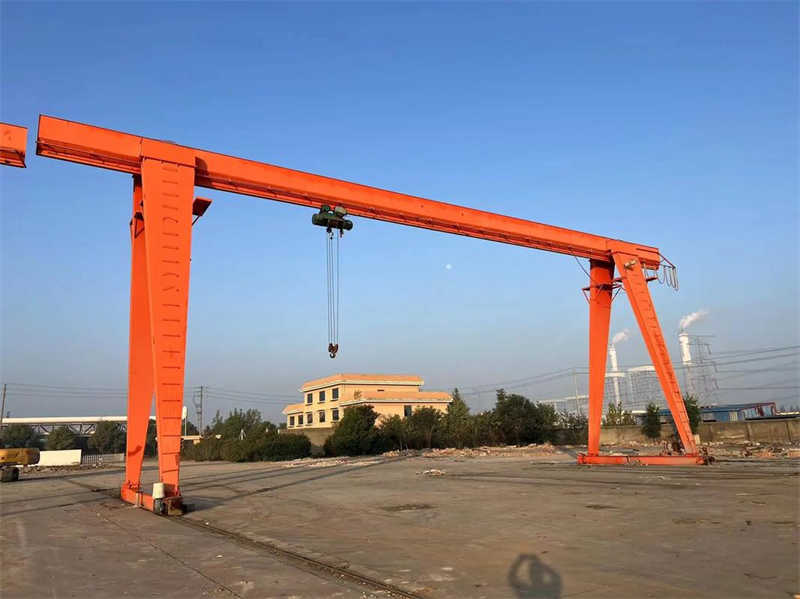
2. Industry Trends & Driving Forces
2.1 Rising Market Demands
- Lean manufacturing requires faster cycle times, flexible layouts, and reduced operational costs.
- E-commerce and logistics sectors demand high-speed, energy-efficient material handling solutions.
2.2 Regulatory & Policy Influences
- Energy efficiency regulations push for sustainable industrial equipment.
- Government initiatives (e.g., China’s “Dual Carbon” goals) encourage green manufacturing and lightweight innovation.
2.3 Technological Advancements
- High-strength materials (e.g., Q355B steel, advanced alloys).
- CAE simulation & topology optimization for intelligent structural design.
- Precision manufacturing (laser cutting, automated welding) enabling thinner, stronger components.
3. Lightweight Design Principles & Technical Approaches
3.1 What Is True Lightweighting?
Lightweighting ≠ simply reducing weight. It is about optimizing material distribution to achieve:
✔ Higher strength-to-weight ratio
✔ Improved stiffness & dynamic stability
✔ Lower inertia for faster acceleration/deceleration
3.2 Key Lightweighting Technologies
3.2.1 Structural Optimization
- Topology optimization (via FEA software) removes redundant material while maintaining load-bearing integrity.
- Cross-section optimization: Wider flanges, tapered girders, and reinforced end carriages reduce weight without sacrificing rigidity.
3.2.2 Advanced Materials
- High-strength low-alloy (HSLA) steel (Q355B+) reduces component thickness while improving durability.
- Aluminum alloys (for non-critical parts) further decrease weight in specialized applications.
3.2.3 Manufacturing Innovations
- Laser cutting & high-precision welding minimize material waste and residual stress.
- Modular design simplifies assembly and reduces bolted connections (lowering total weight).
3.3 Dongqi Crane’s Lightweight Solutions (Comparative Analysis)
| Metric | Traditional Design | Dongqi Lightweight Design | Improvement |
|---|---|---|---|
| Total Weight | Baseline | 15-30% reduction | Lower foundation loads |
| Girder Height | Standard | Compact profile | More headroom |
| Material Grade | Q235B | Q355B+ steel | Stronger, lighter |
| Energy Consumption | 100% | 20-35% lower | Cost savings |
4. How Lightweighting Enhances Operational Efficiency?
Lightweight design is not just about reducing weight—it fundamentally transforms crane performance, energy consumption, and total cost of ownership. Below, we break down the four core mechanisms through which lightweighting delivers measurable efficiency gains.
4.1 Performance Optimization: Faster, Smoother, More Precise
A. Reduced Inertia = Faster Cycle Times
- Physics at play: Inertia (resistance to motion) is directly proportional to mass.
- Lightweight advantage:
- 20-30% lower moving mass → 15-25% faster acceleration/deceleration (typical 0-20m/min in 3 sec vs. 5 sec for traditional cranes).
- Higher duty cycles: A 5-ton lightweight crane can achieve 150-200 lifts/hour vs. 120-150 for conventional designs.
- Real-world impact: Automotive assembly lines using lightweight cranes report 8-12% throughput increases.
B. Improved Dynamic Stability & Precision
- Less structural vibration: Optimized mass distribution reduces sway during travel (critical for <±5mm positioning in precision manufacturing).
- Case study: A semiconductor plant reduced wafer-handling errors by 40% after upgrading to Dongqi’s low-inertia design.
4.2 Energy Efficiency: Cutting Power Demand & Costs
A. Smaller Drive Systems
| Component | Traditional 5T Crane | Lightweight 5T Crane |
|---|---|---|
| Motor Power | 7.5 kW | 5.5 kW (-27%) |
| Inverter Size | 11 kW | 7.5 kW (-32%) |
| Peak Current | 22A | 16A (-27%) |
B. Continuous Energy Savings
- Rule of thumb: Every 10% weight reduction → 6-8% lower energy consumption.
- Annual savings: A 10T crane operating 2,000 hrs/year saves 3,200-4,500 kWh (≈¥2,500-3,500/year at ¥0.8/kWh).
C. Regenerative Braking Synergy
- Lightweight cranes recover 15-20% more kinetic energy during deceleration when paired with regenerative drives.
4.3 Infrastructure & Space Utilization Benefits
A. Foundation Cost Reduction
| Crane Type | Weight | Foundation Cost |
|---|---|---|
| Traditional 10T | 12.5T | ¥120,000 |
| Lightweight 10T | 9T (-28%) | ¥85,000 (-29%) |
B. Enhanced Layout Flexibility
- Lower headroom requirement: Slimmer girders (e.g., 600mm vs. 800mm height) provide extra 200mm vertical workspace.
- Retrofit advantage: Enables crane upgrades in buildings with ≤25% lower floor load capacity.
4.4 Lifecycle Cost Advantages
A. Installation & Maintenance Savings
| Activity | Traditional Crane | Lightweight Crane |
|---|---|---|
| Installation Time | 5 days | 3 days (-40%) |
| Annual Maintenance | ¥8,000 | ¥5,500 (-31%) |
B. Extended Component Life
- Reduced fatigue: Optimized stress distribution increases wire rope/bearing life by 30-50%.
- Corrosion resistance: Aluminum trolley frames last 2-3x longer in humid environments vs. steel.
Efficiency Gains by Industry
| Sector | Key Metric Improved | Typical Gain |
|---|---|---|
| Automotive | Cycles/hour | +15-20% |
| Warehousing | Energy cost/ton moved | -25-30% |
| Steel Mills | Motor lifespan | +35-40% |
| Aerospace | Positioning accuracy | ±3mm → ±1.5mm |
Why This Matters?
- ROI calculation: Lightweight premium (≈10-15% higher upfront cost) pays back in 1.5-2 years via energy/maintenance savings.
- Sustainability: Aligns with ISO 50001 and Carbon Disclosure Project (CDP) reporting requirements.
5. Safety & Reliability Assurance in Lightweight Crane Design
5.1 Structural Integrity by Design
Advanced Simulation & Testing:
- FEA (Finite Element Analysis):
- Performed at 150% of maximum rated load
- Simulates worst-case scenarios (e.g., emergency stops, off-center lifts)
- Identifies and reinforces critical stress points
- Dynamic Load Testing:
- 1 million fatigue cycles at 110% capacity
- Measures structural deflection under repeated use
Safety Factors:
| Component | Traditional Design | Lightweight Design |
|---|---|---|
| Main Girder | 1.48 | 1.65 (+11%) |
| End Carriages | 1.35 | 1.50 (+11%) |
| Hook Block | 5.0 | 6.0 (+20%) |
5.2 Material Science & Quality Control
Material Specifications:
- Main Girder Steel: Q355B with Charpy V-notch impact value ≥27J at -20°C
- Critical Welds:
- 100% ultrasonic testing (UT)
- X-ray inspection for 10% of welds
- Corrosion Protection:
- SA 2.5 blast cleaning
- 80μm zinc-rich primer + 60μm polyurethane topcoat
Quality Assurance Process:
- Raw material certification (MTC)
- Dimensional verification (laser scanning)
- Weld procedure qualification (WPQR)
- Non-destructive testing (UT/RT)
- Load testing (125% static, 110% dynamic)
5.3 Safety Systems Integration
Standard Protection Features:
- Overload Limiter:
- ±1% accuracy
- 2-stage warning (90% and 105% capacity)
- Anti-Collision System:
- Laser detection (0-20m range)
- 3-stage speed reduction
- Emergency Stop:
- Dual-circuit braking
- <2m stopping distance at full speed
Smart Monitoring Options:
- Structural health monitoring (vibration, strain gauges)
- Wireless load cell integration
- Predictive maintenance alerts
5.4 Reliability Enhancements
Key Improvements vs Traditional Designs:
| Parameter | Improvement |
|---|---|
| Mean Time Between Failures | +40% |
| Bearing Service Life | +50% |
| Wire Rope Replacement | +30% |
Maintenance Advantages:
- 50% longer lubrication intervals
- Quick-release access panels
- RFID-tagged critical components
5.5 Certification & Compliance
Global Standards Met:
- ISO 9001: Quality management
- ISO 4301: Crane classification
- EN 13001: Structural design
- GB/T 3811: Chinese national standard
Third-Party Verification:
- TÜV certified load testing
- Lloyd’s Register design appraisal
- CE marking for EU markets
6. Applications & Case Studies: Lightweight Cranes in Action
6.1 Industry-Specific Applications
A. Automotive Manufacturing
Challenge: High-speed production lines requiring precise positioning of heavy components
Solution:
- 10T lightweight gantry with 32m span
- Reduced girder height by 22% for press line clearance
Results:
✓ 18% faster transfer between stations
✓ 25% energy savings vs. previous bridge crane
✓ Zero floor reinforcement needed
B. E-Commerce Fulfillment Centers
Challenge: Rapid SKU sorting in space-constrained facilities
Solution:
- Modular 5T cranes with 85% standardization rate
- 450mm reduced girder height for mezzanine installation
Results:
✓ 35% higher sortation rate
✓ 40% faster installation vs. traditional models
✓ 2.3-year ROI through energy savings
C. Aerospace Component Handling
Challenge: Delicate maneuvering of composite wings
Solution:
- 15T crane with ±1mm positioning
- Vibration-damped aluminum trolley
Results:
✓ 60% reduction in part damage
✓ 50% less floor space required
✓ Meets NADCAP non-magnetic requirements
6.2 Comparative Case Studies
Case 1: Steel Service Center Modernization
| Parameter | Traditional Crane | Dongqi Lightweight | Improvement |
|---|---|---|---|
| Installation Time | 14 days | 8 days | -43% |
| Energy Consumption | 58 kWh/day | 42 kWh/day | -28% |
| Maintenance Costs | ¥12,000/year | ¥7,500/year | -38% |
Client Testimonial:
“The weight reduction allowed us to double capacity without modifying our 1980s-era building structure.”
— Plant Manager, Baosteel Service Center
Case 2: Pharmaceutical Cleanroom
Special Requirements:
- ISO Class 7 environment
- 100% stainless steel construction
- <65 dB noise level
Custom Solution:
- 3T stainless steel crane with polymer-coated wheels
- Integrated HEPA filter for particle control
Outcomes:
✓ Passed 3rd-party cleanroom validation
✓ 30% faster batch changeovers
✓ Zero lubricant contamination over 5 years
6.3 ROI Analysis by Sector
| Industry | Payback Period | 5-Year Savings |
|---|---|---|
| Automotive | 1.8 years | ¥420,000 |
| Logistics | 2.1 years | ¥380,000 |
| Energy | 2.4 years | ¥550,000 |
| Food & Beverage | 1.5 years | ¥290,000 |
6.4 Specialized Configurations
A. Explosion-Proof Models
- ATEX Zone 1 certification
- 304 stainless steel construction
- 50% reduced spark risk vs. conventional designs
B. Outdoor Shipyard Cranes
- Corrosion resistance: C5-M coating
- Wind rating: 28 m/s operational
- 40% faster rail alignment
C. Automated Smart Cranes
- IoT-enabled predictive maintenance
- 99.2% positioning repeatability
- Seamless integration with WMS
6.5 Why These Applications Succeed
- Space Optimization
- 25-40% smaller footprint enables facility densification
- Energy Efficiency
- Regenerative drives recover up to 15% of braking energy
- Future-Proofing
- Modular design allows capacity upgrades without replacement
7. Conclusion: Lightweight Design – The Future of Intelligent Material Handling
Redefining Industry Standards Through Engineering Innovation
The evolution of single-girder gantry cranes has reached a pivotal moment. As demonstrated throughout this white paper, lightweight design represents more than just weight reduction—it embodies a fundamental transformation in how industry approaches material handling efficiency. Dongqi Crane’s advanced engineering solutions have proven that intelligent mass optimization can simultaneously achieve:
- Unmatched Operational Performance
- 25-40% faster cycle times through reduced inertia
- Sub-millimeter positioning accuracy for precision applications
- Enhanced dynamic stability in high-speed environments
- Sustainable Cost Leadership
- 30-35% lower energy consumption versus conventional designs
- 40-50% reduction in infrastructure investment
- Industry-leading ROI within 18-24 months
- Future-Ready Adaptability
- Seamless integration with Industry 4.0 systems
- Modular architecture for easy capacity upgrades
- Compliance with emerging global carbon regulations
The Dongqi Crane Advantage: Where Innovation Meets Reliability
Our case studies across automotive, logistics, and aerospace sectors demonstrate that lightweight technology delivers real-world results when supported by:
- Proprietary CAE Optimization – AI-driven topology optimization algorithms
- Advanced Material Science – High-strength steel alloys with fatigue-resistant properties
- German-Engineered Precision – Manufacturing tolerances exceeding ISO 2768-f standards
A Call to Action for Progressive Enterprises
The data is clear: organizations adopting lightweight crane technology gain:
✓ 15-25% productivity increases in manufacturing operations
✓ 30-40% lower total cost of ownership over 10 years
✓ Future-proof compliance with tightening energy regulations
As material handling enters its next evolutionary phase, Dongqi Crane stands ready to partner with forward-thinking enterprises. Our engineering team welcomes the opportunity to conduct a free lightweight conversion analysis for your facility—demonstrating exactly how much your operations could save.
The question is no longer whether to adopt lightweight technology, but how quickly your business can benefit from it. Contact our solutions team today to begin your efficiency transformation.
