
Metro Depot Low Headroom Double Girder Overhead Crane Design: Maximizing Efficiency in Confined Spaces
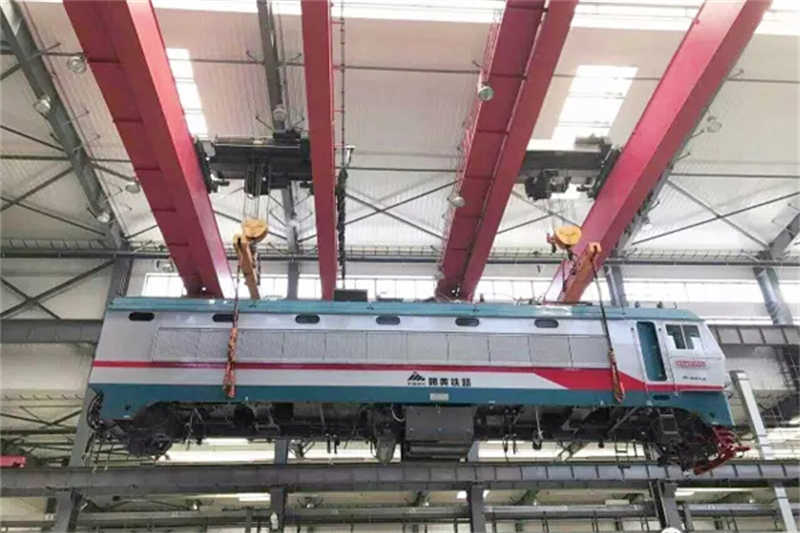
Metro maintenance depots present unique material handling challenges: extreme height restrictions (often below 5 meters), dense infrastructure (piping, ventilation, and electrical conduits), and precision operations for heavy components like train bogies (weighing 5-10 tons) and car bodies. Conventional overhead cranes struggle here, sacrificing hook height for structural bulk. Dongqi Crane’s specialized low headroom double girder cranes overcome these constraints through integrated innovations in structural design, lifting mechanisms, and control systems—ensuring optimal performance in the world’s most space-critical rail environments.
1 Structural Design Innovations for Extreme Space Optimization
Girder Configuration and Material Science
Unlike standard double girder cranes where height is dominated by the trolley and hoist assembly, Dongqi’s design uses rolled steel box girders with integrated T-section rails. This eliminates the need for top-mounted crane rails, reducing the crane’s built height by 18–25%. The girders incorporate high-strength steel (Q345B/ASME SA516 Grade 70), enabling thinner web plates without compromising rigidity. For spans exceeding 25m, a “fish-belly” profile counters deflection under load, maintaining precision alignment in depot tracks .
Revolutionary Trolley Lightweighting
Traditional trolleys house motors, gearboxes, and drums—adding bulk and weight. Dongqi adopts a distributed power system:
- Lifting motors and gearboxes are mounted laterally on fixed “power platforms” between girders, not on the trolley
- Trolley movement is driven by wire-rope traction from a separate drum, eliminating onboard drive motors
- Trolley frame weight drops by 40–50%, enabling a 450–600mm reduction in headroom versus conventional designs
Modular End Truck and Runway Integration
Four-corner drive end trucks with flanged wheel assemblies ensure even load distribution on depot rails. Crucially, Dongqi designs runway beams with embedded leveling pads—compensating for depot floor irregularities and preventing rail misalignment, a key cause of wheel wear and derailment .
2 Lifting Mechanism Breakthroughs
Ultra-Compact Drum and Rope Guidance
In metro depots, hook height is paramount. Dongqi’s solution uses:
- Bi-planar drum placement: Drums oriented perpendicular to girder direction, mounted between girders, with grooves aligned to minimize rope splay
- Split-sheave assemblies: Sheave sets integrated into trolley side plates, not below them, saving 150–300mm
- Even-numbered reeving (6:1 or 8:1): Avoids reverse bends, extending rope life 30% versus odd reeving systems
Low-Profile Hook and Auxiliary Lifting
Standard hooks add unusable height. Dongqi’s “flat-top” hook blocks with integrated sheaves sit flush against the trolley underside. For multi-point lifts (e.g., train car bodies), modular spreader beams attach via ISO locks, enabling tool-free reconfiguration for varied center-of-gravity loads .
3 Safety and Control Systems for High-Risk Environments
Multi-Layered Safety Architecture
Metro depots demand failsafe operation:
- Primary safety: Redundant brakes (dual calipers on drum + motor-mounted disc)
- Collision avoidance: LiDAR-based zone scanning creates dynamic “keep-out” volumes around obstacles
- Mechanical end stops: Ultimate travel limits engage if software limits fail
- Load security: Anti-sway algorithms stabilize loads during traverse; weight metering blocks overloads
Operator-Centric Control
- RFID-enabled pendants: Authenticate operators and recall pre-sets (e.g., bogie lift height profiles)
- Augmented reality (AR) headsets: Overlay lift paths onto real-world depot views
- Predictive analytics: Monitor motor temps, brake wear, and rope integrity, triggering maintenance alerts
4 Environmental Adaptability and Serviceability
Corrosion and Contaminant Defense
Depot environments feature humidity, metal dust, and chemical exposure. Critical components feature:
- IP66-rated enclosures for motors and controls
- Hot-dip galvanizing (ISO 1461) on structural parts
- Stainless-steel bearings and self-lubricating bushings in sheaves
- Cable reels with sealed slip rings to prevent debris ingress
Maintenance Optimization
- Power platform access: Walkways with foldable grating allow tool-free component access
- Modular sub-assemblies: Drum units, gearboxes, and controllers swap in <4 hours
- Data-driven servicing: Vibration sensors on bearings predict failures; QR codes on parts link to repair guides
5 Proven Applications in Global Metro Systems
Case 1: Shenzhen Metro Depot (China)
- Challenge: 4.8m ceiling clearance; 32-ton bogie lifts
- Solution: 6x Dongqi 40-ton double girder cranes with 1020mm headroom
- Outcome: Enabled triple-level maintenance lines (pit, floor, mezzanine); 22% faster train turnaround
Case 2: Hamburg S-Bahn Depot (Germany)
- Challenge: Historic building (1920s) with 5.2m height limit; vibration restrictions
- Solution: Cranes with noise-damped drives (<75 dBA) and seismic load monitoring
- Outcome: Zero structural modifications; preserved heritage architecture
Case 3: Singapore MRT Wheel Lathe Workshop
- Challenge: Precision positioning (±2mm) for wheel set transfers
- Solution: Cranes with encoder-feedback trolleys and automated docking at lathes
- Outcome: 45% reduction in wheel machining cycle time
6 Why Dongqi Crane Leads in Metro Depot Solutions
Design Validation
- FEM 1.001 analysis: Simulates dynamic loads during emergency stops
- Prototype testing: 200% static load / 125% dynamic load tests at ISO-certified labs
- Modular scalability: Same components used in 10-ton to 80-ton cranes—sparing depot inventory
Total Cost of Ownership Advantages
- Energy recovery: Hoist motors feed braking energy back into depot grid (saves 8–12% power)
- Rope longevity: Patented sheave linings extend wire rope life to 7+ years
- Remote diagnostics: Dongqi’s SmartCare platform cuts downtime 30% via predictive fixes
Metro depots symbolize the ultimate challenge in overhead lifting: maximum capability in minimum space. Dongqi Crane’s low headroom double girder designs conquer this through architectural rethinking—distributed power, ultra-dense mechanics, and intelligent control. The results transcend mere compliance: depots gain usable height for multi-level servicing, avoid costly building modifications, and achieve unprecedented lift precision. In an industry where every centimeter equates to operational flexibility or constraint, Dongqi delivers not just cranes, but strategic vertical space reclamation.
