
KBK vs. Single-Girder Overhead Cranes: How to Make the Right Choice for Your Assembly Line
Confused between KBK and Single-Girder Overhead Cranes? This definitive guide from Dongqi Crane breaks down the differences, applications, and cost factors to help you select the perfect lifting solution for your assembly line.
Introduction: The Heart of Efficient Production
In the dynamic environment of a modern assembly line, the seamless movement of materials is not just a convenience—it’s a critical component of efficiency, safety, and profitability. Whether you’re handling delicate electronic components or heavy machine parts, the choice of your overhead lifting equipment can make or break your operational workflow.
A common dilemma faced by plant managers and engineers is choosing between two highly effective solutions: the flexible KBK system and the robust single-girder overhead crane. Both are excellent in their respective domains, but selecting the wrong one can lead to unnecessary costs and operational bottlenecks. This comprehensive guide from Dongqi Crane will illuminate the key differences and provide a clear framework to ensure you make the perfect investment for your needs.
Part 1: Understanding the Core Technologies
What is a KBK Crane? The Epitome of Flexibility
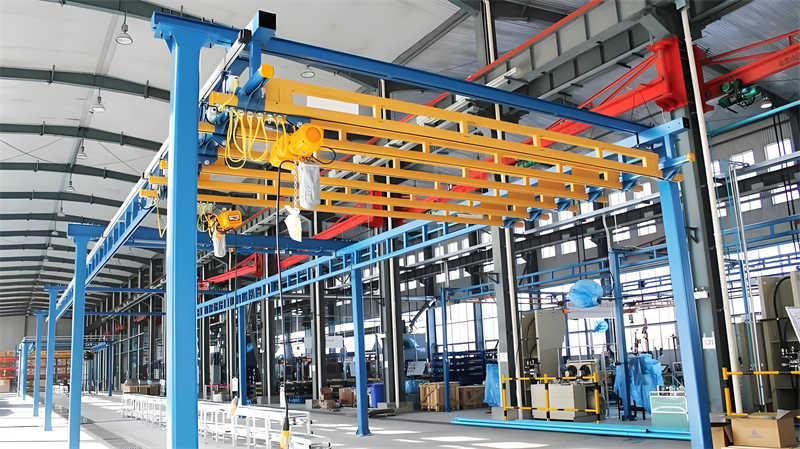
KBK, short for the German Kombiniert Kran Bauweise (Combined Crane System), is a standardized, modular lifting system. Think of it as building blocks for creating a perfectly tailored material handling solution.
- Structure: It consists of lightweight aluminum or steel tracks, trolleys, suspension points, and curves that can be easily connected.
- Key Characteristics:
- Modularity: Systems can be configured in straight lines, curves, and switches to create complex two-dimensional or three-dimensional layouts.
- Low Deadweight: Being exceptionally lightweight, KBK systems place minimal stress on existing building structures.
- Precision Handling: Designed for smooth, low-effort movement, allowing operators to position loads with pinpoint accuracy.
- Ideal Applications: Perfect for repetitive, precision tasks in assembly cells, packaging lines, CNC machine feeding, and clean-room environments where handling lightweight to medium loads (typically up to 2 tons) is required.
What is a Single-Girder Overhead Crane? The Workhorse of the Workshop
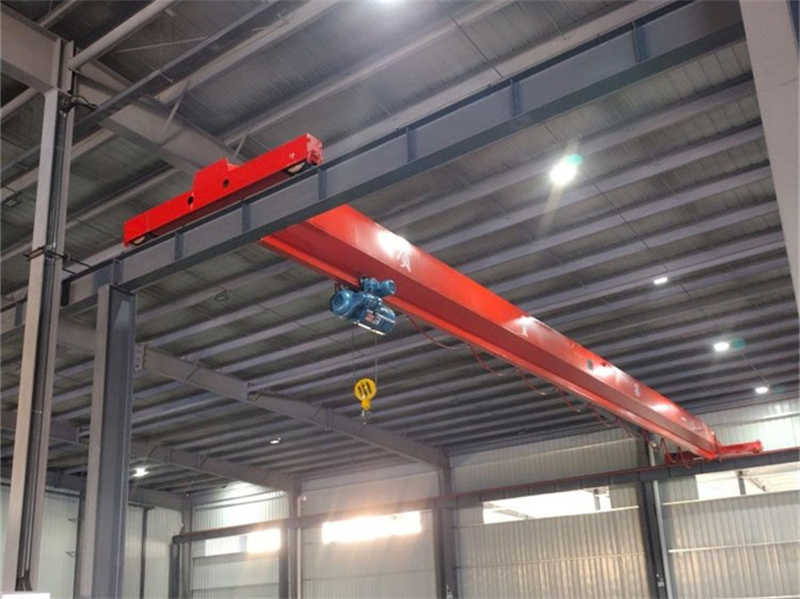
A single-girder overhead crane is a more traditional and robust crane system designed for heavy-duty applications across large, open spaces.
- Structure: It features a single main girder supported by two end trucks that run on elevated rails, usually attached to the building’s support columns. A hoist trolley moves along the bottom flange of the girder.
- Key Characteristics:
- High Load Capacity: Built for strength, these cranes handle significant weights, typically ranging from 1 ton to 20+ tons.
- Wide Coverage: They provide service to a large, rectangular bay area, making them ideal for workshops and warehouses.
- Durability: Engineered for rigorous, industrial use with high reliability.
- Ideal Applications: Best suited for general material handling, loading/unloading trucks, moving heavy raw materials, and servicing large areas in manufacturing plants, steel warehouses, and foundries.
Part 2: A Head-to-Head Comparison
To make an informed decision, let’s compare these systems across critical operational parameters.
| Feature | KBK Crane | Single-Girder Overhead Crane | The Key Question for You |
|---|---|---|---|
| Load Capacity & Structure | Lightweight modular design. Lower capacity (usually ≤ 2 tons). | Heavy-duty, rigid girder design. Higher capacity (1t to 20t+). | What is the maximum weight you need to lift? |
| Coverage & Flexibility | Extremely high flexibility. Can create curves, branches, and drops to specific stations. Easy to reconfigure. | Covers a large, rectangular area. Path is fixed. Not easily modified after installation. | Is your layout complex and subject to change? |
| Building Requirements | Low requirements. Can be suspended from existing roof structures (with verification). Ideal for light-duty buildings. | High requirements. Requires robust runway rails supported by building columns or freestanding supports. | What is your building’s load-bearing capacity? |
| Precision & Control | Superior precision. Smooth movement allows for exact positioning, ideal for assembly tasks. | Efficient for movement. Faster travel speeds but generally less precise for fine adjustments. | Is pinpoint accuracy or rapid transfer more critical? |
| Cost Considerations | Lower initial hardware cost per station. Cost can add up for large areas. Easy installation. | Higher initial investment in crane and infrastructure (runway beams). Better ton-for-ton value for heavy loads. | What is your budget, and what is the Total Cost of Ownership (TCO)? |
Part 3: Your Step-by-Step Selection Guide
Follow this simple process to identify the right solution for your assembly line.
Step 1: Define Your Core Requirements
Ask yourself these fundamental questions:
- Maximum Load Weight: What is the heaviest item you will lift? (Add a safety margin).
- Work Area & Flow: Do you need to cover a wide area or serve specific, fixed points? Is the path straight or complex?
- Operational Tasks: Is the primary need for precise, delicate positioning or for powerful, high-speed movement of pallets?
- Building Constraints: What are the height and load-bearing capabilities of your facility?
Step 2: Use the Decision Matrix
- Choose a KBK System if:
- Your loads are under 2 tons.
- You require high precision and flexibility for assembly tasks.
- Your production layout is subject to change.
- Your building has limited load-bearing capacity.
- Choose a Single-Girder Overhead Crane if:
- Your loads are over 2 tons.
- You need to cover a large, rectangular area.
- The primary task is heavy lifting and transport, not fine assembly.
- Your facility has strong runway support structures.
Step 3: Consider a Hybrid Solution
For the most complex operations, the optimal solution might be a combination of both. For example, a single-girder overhead crane can be used for primary transportation of heavy sub-assemblies across the workshop, while KBK systems are installed at individual stations for precise positioning and assembly.
This is where Dongqi Crane excels. Our engineers specialize in designing custom and integrated lifting solutions that leverage the strengths of different crane types to create a seamless, efficient workflow tailored specifically to your process.
Part 4: Why Partner with Dongqi Crane?
Selecting the right equipment is only half the battle; choosing the right partner is equally important. Dongqi Crane is your trusted advisor and supplier.
- Comprehensive Product Portfolio: We offer a full range of both high-quality KBK systems and robust single-girder overhead cranes. This allows us to provide unbiased, objective advice focused solely on your needs.
- Expert Engineering Support: Our team offers free, on-site assessments to analyze your workflow and space, delivering a recommendation that optimizes both performance and budget.
- Uncompromising Quality & Safety: All Dongqi Crane products are manufactured to international standards (ISO, FEM, DIN) and come with full certifications, ensuring complete safety and reliability.
- End-to-End Service: From initial consultation and custom design to installation, training, and after-sales support, we are with you every step of the way.
Conclusion: Empower Your Production Line with the Right Choice
There is no one-size-fits-all answer in material handling. The “best” crane is the one that aligns perfectly with your unique operational requirements, space constraints, and budget. By understanding the fundamental differences between KBK and single-girder cranes, you are now equipped to make a confident decision.
Still unsure which solution is optimal for your assembly line? You don’t have to figure it out alone.
Let the experts at Dongqi Crane guide you. We turn your lifting challenges into competitive advantages.
Your Next Step: Request Your Free Consultation Today!
Contact Us Now
- Schedule a Free, No-Obligation On-Site Assessment with our lifting specialists.
- Download our detailed product catalogs for KBK and Overhead Cranes.
- WhatsApp:+86 18638815424
Choose Dongqi Crane—Where the Right Lift Meets the Right Solution.
