
Engineering a Lifeline for Hot Work: The Core Technologies Behind Dongqi’s Metallurgical Cranes
In metallurgical environments, where radiant heat and particulate matter are relentless, equipment failure is not an option. A crane breakdown can halt an entire production line, create significant safety risks, and incur substantial financial losses. At Dongqi Crane, we address these challenges not with modifications, but with fundamental, purpose-driven engineering. Our Metallurgical Double Girder Electric Overhead Cranes are built from the ground up with integrated systems designed to withstand the extreme conditions of your job-shop.
Here’s a detailed look at the core technologies that define our robust design:
1. Advanced Heat Protection System: Shielding the Crane from Intense Radiation
The first line of defense is a comprehensive suite of heat mitigation measures.
- Thermal Insulation Plates: We install specially engineered heat-resistant stainless-steel plates beneath the main girders and on the end carriages. This critical barrier effectively deflects a significant portion of the radiant heat rising from the molten metal or hot workpieces below, preventing it from directly heating the crane’s primary structure and internal components.
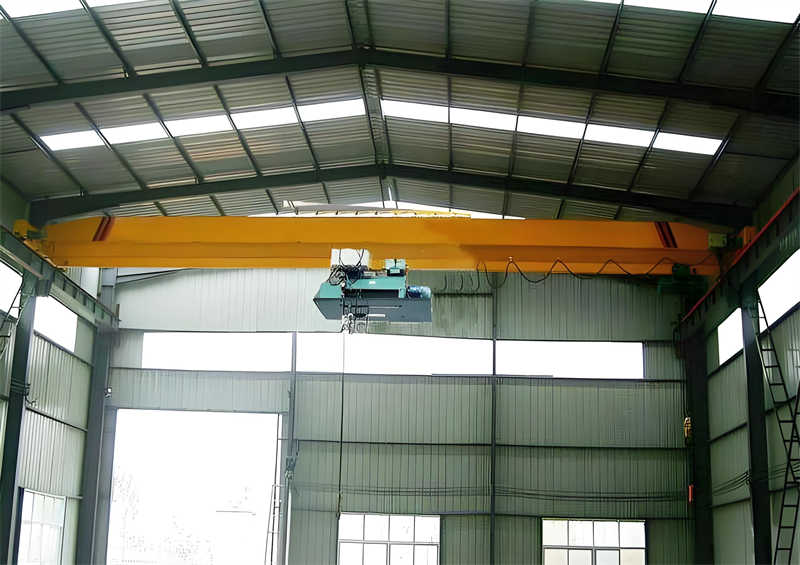
- Anti-Radiation Hoist Assembly: Recognizing that the hoist is most exposed, we employ a double-girder, low-headroom design that positions the hoist mechanism above the main girders, farther from the heat source. For extreme applications, we offer a specialized long-drop hoist configuration. This design uses an extended cable reefing system that keeps the vital hoist motor, gearbox, and drum safely elevated away from the heat, while only the hook block and its heat-resistant guards descend into the high-temperature zone.
- High-Temperature Wire Ropes: Standard wire ropes can anneal and lose strength under heat. We specify high-performance wire ropes with independent steel cores (IWRC) and often a special coating or material grade designed to maintain integrity and flexibility at elevated temperatures, drastically reducing the risk of unexpected failure.
2. Mission-Critical Component Upgrades: Ensuring Reliability at Every Point
Every electrical and mechanical component is selected or engineered for high-temperature duty.
- Class-H Insulated Motors with Independent Cooling: Our electric hoist and travel motors are fitted with Class-H insulation, rated to withstand temperatures up to 180°C (356°F)—far exceeding the capabilities of standard Class-B or F motors. Crucially, each motor is equipped with an auxiliary cooling fan. This independent forced-air system ensures consistent cooling, even when the crane moves slowly or stops, preventing heat buildup that leads to insulation breakdown and motor burnout.
- Pressurized and Climate-Controlled Electrical Enclosures: The control system is the crane’s brain and must be protected. Our IP54 or higher rated electrical cabinets are fully sealed against dust and moisture. For high-heat areas, we integrate a closed-loop air conditioning unit or a air-to-air heat exchanger. This system actively cools the interior, maintaining a safe operating temperature for sensitive components like Variable Frequency Drives (VFDs), programmable logic controllers (PLCs), and contactors. This eliminates thermal shock, stabilizes performance, and extends component life by years.
- Redundant Braking Systems: Safety is paramount. Our cranes feature a fail-safe dual-braking system. This includes an regenerative/electrical brake for precise control and a mechanical, spring-set, fail-safe brake that automatically engages in the event of a power loss. This redundancy ensures a load can be safely held and controlled under any circumstance, providing operators with critical confidence.
3. Structural Integrity: The Foundation of Long-Term Performance
The crane’s structure must resist not just load stress, but also thermal stress.
- Robust Fabrication Based on FEM Standards: Main girders are fabricated from high-quality Q345B alloy steel,
known for its excellent strength-to-weight ratio and better yield strength at moderate temperatures compared to standard carbon steel. Our design calculations adhere to FEM 1.001 and other international standards, incorporating generous safety factors to account for dynamic loading and long-term exposure to demanding conditions. - Precision Manufacturing and Quality Assurance: Superior design requires superior execution. Critical weldments are performed by certified welders using Submerged Arc Welding (SAW) and other automated techniques for deep penetration and consistency. All major welds are subjected to Non-Destructive Testing (NDT) like ultrasonic or radiographic inspection to ensure they are free from defects. This rigorous process guarantees the structural integrity needed for a decades-long service life.
Conclusion: An Investment in Reliability, Not Just Equipment
Choosing a Dongqi Metallurgical Crane means investing in a system where every component, from the largest girder to the smallest electrical contact, has been conscientiously selected and engineered to work in harmony under extreme stress. It is this holistic, no-compromise approach to design that delivers what matters most: uninterrupted productivity, enhanced safety, and a lower total cost of ownership.
Discover the Dongqi difference. Contact our engineering team today to discuss how we can configure a reliable lifting solution for your specific high-temperature application.
Keywords:
- Metallurgical Crane Design
- Heat Protection System
- Thermal Insulation Plate
- Class-H Insulation Motor
- Independent Cooling Fan
- Climate-Controlled Enclosure
- Variable Frequency Drive (VFD)
- Redundant Braking System
- FEM Standard Design
- Non-Destructive Testing (NDT)
- Dongqi Crane Engineering
