
Double Girder Overhead Crane vs. Jib Crane: A Comparative Analysis for Automotive Assembly Plants
1. Introduction
The automotive assembly process demands precision, efficiency, and optimal space utilization. Choosing the right lifting equipment—whether a double girder overhead crane or a jib crane—can significantly impact productivity, safety, and long-term operational costs.
As a leading manufacturer of industrial cranes, Dongqi Crane provides customized lifting solutions for automotive manufacturers worldwide. This guide compares the two crane types, helping you make an informed decision based on your assembly line requirements.
2. Double Girder Overhead Cranes in Automotive Assembly
2.1 Structural Advantages for Automotive Applications
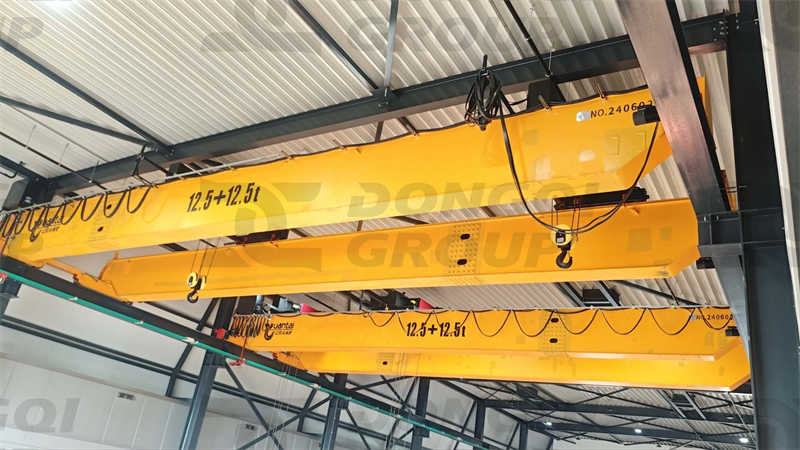
Double girder overhead cranes are the backbone of modern automotive assembly lines, offering unparalleled strength and stability for heavy-duty material handling. Their robust construction features:
- Twin welded steel girders that distribute weight evenly, preventing deflection even at maximum capacity.
- Box-type or truss designs (Dongqi’s patented designs reduce deadweight while maintaining rigidity).
- High-strength end carriages with precision-machined wheels for smooth travel along runway beams.
2.2 Precision Handling Capabilities
Automotive assembly demands sub-millimeter accuracy when positioning vehicle bodies or large subassemblies. Dongqi’s double girder cranes deliver this through:
- Variable Frequency Drive (VFD) control – Enables soft starts/stops and speed adjustments (0-20 m/min customizable).
- Anti-sway technology – Inertia-based control systems minimize load oscillation during high-speed transfers.
- Automated positioning systems – Laser-guided load centering (±1mm repeatability) for perfect alignment in welding/painting stations.
2.3 Customized Solutions for Automotive Workflows
A) Body Shop Applications
- White body handling: Specialized lifting frames (Dongqi’s ELO-magnetic or vacuum lifters) prevent sheet metal deformation.
- Over-and-under hook clearance: Extra 500mm headroom designs allow unimpeded movement of tall assembly jigs.
B) Paint Shop Adaptations
- Explosion-proof configurations: Certified motors/electricals (ATEX, NEC) for hazardous vapor environments.
- Stainless steel components: Corrosion-resistant trolleys and hoists withstand chemical exposure.
C) Final Assembly Line
- Dual-hoist systems: Simultaneous lifting of chassis and cabin (synchronized via Dongqi’s PLC control).
- Ergonomic pendant stations: IP65-rated waterproof controls with emergency stop cascades.
3. Jib Cranes in Automotive Assembly
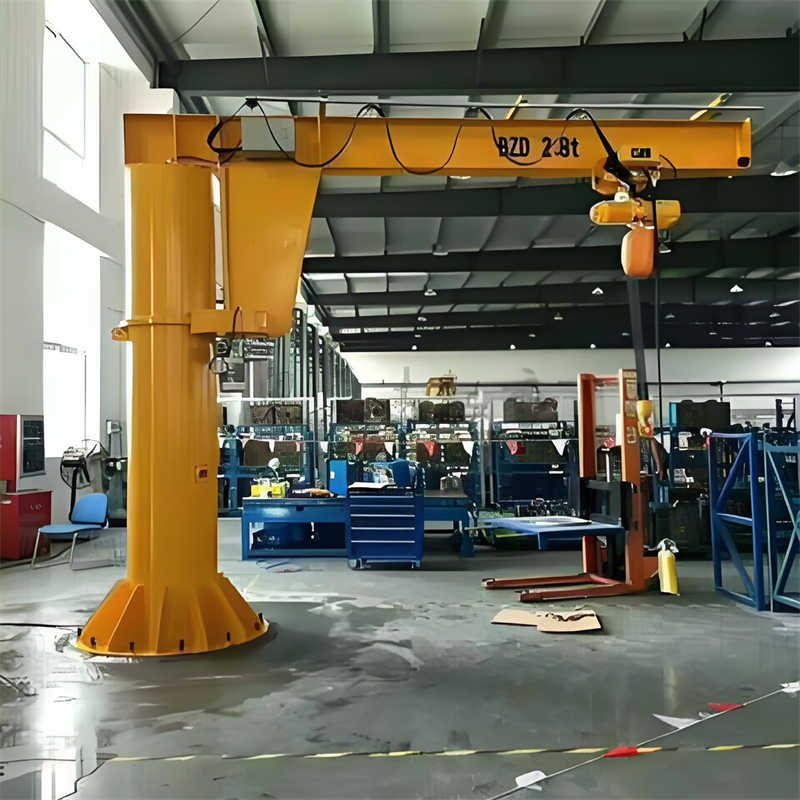
3.1 Key Features
- Compact and flexible – Ideal for localized lifting tasks.
- Rotation capability (180°–360°) for precise part positioning.
- Light to medium capacity (0.5–10 tons).
- Minimal space requirements – Can be wall-mounted or floor-supported.
3.2 Best Applications
✔ Engine and transmission assembly – Precise placement of powertrain components.
✔ Dashboard and interior installation – Maneuvering delicate parts with ease.
✔ Maintenance and repair stations – Assisting in quick part replacements.
3.3 Dongqi Crane’s Solutions
- Ergonomic operation – Reduces worker fatigue with smooth manual or electric rotation.
- Explosion-proof options – Suitable for painting and hazardous zones.
- Modular designs – Easy integration into existing workstations.
4. Key Comparison: Double Girder Overhead Crane vs. Jib Crane for Automotive Assembly
4.1 Structural and Installation Considerations
| Factor | Double Girder Overhead Crane | Jib Crane |
|---|---|---|
| Structural Support | Requires reinforced runway beams with foundation work | Minimal structural modifications (wall/floor-mounted) |
| Installation Time | 2-4 weeks (professional installation required) | 1-3 days (plug-and-play deployment) |
| Ceiling Height | Minimum 6m clearance recommended | Operates in spaces as low as 3m |
| Mobility | Fixed installation along runway | Portable options available (mobile jib cranes) |
4.2 Operational Performance Metrics
| Parameter | Double Girder Overhead Crane | Jib Crane |
|---|---|---|
| Maximum Speed | 20-32 m/min (travel) | 5-8 m/min (manual) / 12 m/min (motorized) |
| Positioning Accuracy | ±1mm (with laser guidance) | ±0.5mm (encoder-controlled) |
| Duty Cycle | FEM 4M (heavy continuous) | FEM 3M (medium duty) |
| Noise Levels | <75 dB (with sound-dampened gearboxes) | <60 dB (near-silent operation) |
4.3 Load Handling Capabilities
| Capability | Double Girder Overhead Crane | Jib Crane |
|---|---|---|
| Standard Capacity | 10-500 tons | 0.5-10 tons |
| Lifting Height | Up to 30m | Typically 2-6m |
| Load Stability | Active sway control for large surface areas | Manual counterbalance for precise positioning |
| Special Attachments | Spreaders, C-hooks, vacuum lifters | Vacuum cups, tool balancers, torque arms |
4.4 Spatial Efficiency and Coverage
| Aspect | Double Girder Overhead Crane | Jib Crane |
|---|---|---|
| Work Envelope | Full bay coverage (up to 40m span) | 2-8m radius work area |
| Interference | Requires dedicated overhead space | Operates within existing workstation footprint |
| Multi-Crane Systems | Up to 4 cranes can operate in same bay | Typically single-unit per station |
| Obstruction Clearance | 500mm minimum side clearance | Can operate within 200mm of walls |
4.5 Cost Analysis and ROI
| Financial Factor | Double Girder Overhead Crane | Jib Crane |
|---|---|---|
| Initial Investment | $50,000-$500,000+ | $5,000-$50,000 |
| Installation Cost | 20-30% of equipment cost | 5-10% of equipment cost |
| Energy Consumption | 15-30 kW (typical operation) | 1-5 kW |
| Maintenance Cost/Year | 3-5% of initial cost | 1-2% of initial cost |
| Typical Payback Period | 3-5 years | 6-18 months |
4.6 Safety and Compliance Features
| Safety Aspect | Double Girder Overhead Crane | Jib Crane |
|---|---|---|
| Overload Protection | Electronic limiter + mechanical brake | Load cell monitoring + mechanical stop |
| Emergency Stop | Category 0 (instant power cutoff) | Category 1 (controlled stop) |
| Collision Avoidance | Laser scanners + anti-collision software | Physical bumpers + limit switches |
| Compliance Standards | CMAA Class D, FEM 4M | CMAA Class B, FEM 3M |
4.7 Smart Technology Integration
| Technology | Double Girder Overhead Crane | Jib Crane |
|---|---|---|
| Automation Ready | Full integration with AS/RS systems | Limited automation capabilities |
| Data Collection | Load tracking, maintenance alerts | Basic cycle counting |
| Remote Monitoring | Real-time performance analytics | Manual inspection logging |
| Industry 4.0 | Compatible with MES/ERP systems | Standalone operation |
4.8 Decision Matrix for Automotive Applications
| Application | Recommended Solution | Why? |
|---|---|---|
| Body-in-White Transfer | Double Girder | Needs heavy payload capacity + long-distance movement |
| Engine Marriage | Jib Crane | Requires micron-level precision in confined space |
| Paint Shop Operations | Double Girder (explosion-proof) | Hazardous environment needs enclosed systems |
| Battery Pack Installation | Articulating Jib | Demands multi-axis positioning flexibility |
This expanded comparison provides automotive engineers with:
- Quantifiable performance data for informed decision-making
- Direct cost comparisons for budget planning
- Application-specific guidance tailored to assembly line needs
- Dongqi’s technological differentiators in both product categories
Would you like to include specific ROI calculation examples from actual automotive installations?
5. How to Choose the Right Crane for Your Automotive Plant?
5.1 Hybrid Solutions
Many automotive plants benefit from a combination of both cranes:
- Double girder cranes for moving large car bodies along the main assembly line.
- Jib cranes for precise component installations at individual workstations.
5.2 Dongqi Crane’s Support Services
- 3D layout planning – Optimizes crane placement for maximum efficiency.
- Load analysis & simulation – Ensures the right crane configuration for your needs.
- After-sales maintenance – Keeps your lifting systems running smoothly.
5.3 Future-Proofing Your Investment
- Smart crane upgrades (remote monitoring, anti-sway systems).
- Modular expansions – Adding capacity as production scales up.
6. Conclusion
Selecting between a double girder overhead crane and a jib crane depends on your load requirements, workshop layout, and production flow. Dongqi Crane offers tailored solutions for automotive manufacturers, ensuring efficiency, safety, and cost-effectiveness.
📩 Contact Dongqi Crane today for a free consultation or download our “Automotive Crane Selection Guide” to optimize your assembly line!
