
Dongqi Cranes: Integrated Dual-Purpose Lifting Solutions for Optimized Material Handling
Introduction: A Focus on Operational Efficiency
In metal processing and heavy manufacturing, operational efficiency is directly influenced by material handling. Facilities commonly manage a diverse range of items, from bulk scrap and raw materials to finished plates and fabricated components. Relying on multiple, single-purpose cranes for these different tasks can lead to capital inefficiency, underutilized equipment, and congested floor space.
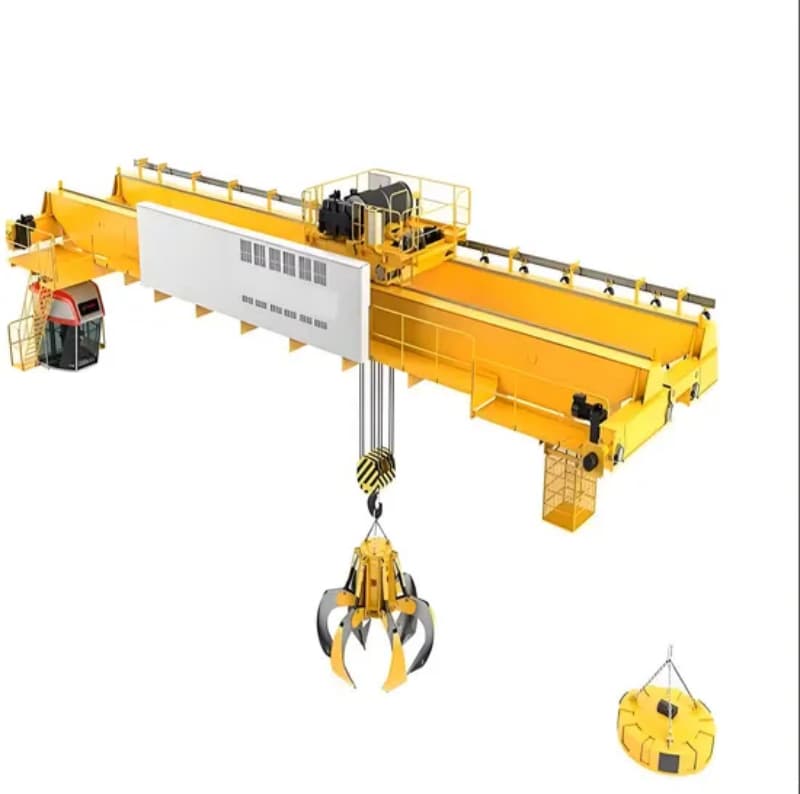
Dongqi approaches this operational challenge by providing integrated equipment solutions. Our CE-certified Double Girder Grab & Electromagnetic Dual-Purpose Overhead Crane is engineered to perform multiple material handling functions with one primary machine. This focus on functional integration aims to improve asset utilization and workflow continuity, supporting more streamlined operations.
Part 1: Addressing Core Industry Challenges in Metal Processing and Heavy Manufacturing
Effective material handling is a fundamental component of operational efficiency in industries that process both bulk and finished goods. The inherent diversity in material forms—from loose scrap and raw bulk to precisely fabricated components—presents a persistent logistical challenge. An analysis of common operational setups reveals several interconnected challenges that can impact productivity, cost control, and workflow management.
1.1 Key Operational Inefficiencies
Facilities relying on a traditional approach, which utilizes separate machines for discrete functions, often encounter the following constraints:
- Process Interruptions and Downtime: The requirement to use different cranes for different materials inherently creates stoppages in workflow. For instance, completing a task involving bulk material with a grab-equipped crane and then requiring a magnet for finished steel necessitates either moving the material to a different crane-served area or performing a time-consuming attachment changeover on a standard crane. This transition time between tasks represents direct, non-value-added downtime that extends production cycles.
- Suboptimal Asset Utilization: Single-purpose cranes are, by design, idle when their specific function is not required. A magnet crane may sit unused during scrap-clearing operations, while a grab crane may be inactive during precision handling of finished plates. This leads to a lower overall utilization rate for the capital invested in the lifting equipment fleet.
- Spatial Inefficiency and Layout Constraints: Deploying multiple cranes often requires dedicated runways, clearances, and work zones for each machine. This can lead to congested floor plans, complicate factory layout optimization, and reduce the flexible space available for other production activities or storage. In some cases, the overlapping working areas of multiple cranes are underutilized or create safety conflicts.
1.2 Financial and Resource Implications
The operational inefficiencies translate into measurable financial and resource impacts:
- Capital Expenditure (CAPEX): Procuring two or more specialized cranes represents a significantly higher initial investment compared to a single, multifunctional unit. This includes not only the cost of the cranes themselves but also the associated electrical infrastructure, runway systems, and installation for each machine.
- Operational Expenditure (OPEX): The ongoing costs of maintaining multiple pieces of equipment are compounded. This includes separate maintenance schedules, a larger inventory of spare parts for different models, and higher energy consumption across multiple drive systems. Training requirements for operators and maintenance staff are also multiplied.
- Lifecycle Management Complexity: Managing the total cost of ownership for a mixed fleet is administratively more complex. Coordinating service intervals, tracking the health of various systems, and planning for the eventual refurbishment or replacement of disparate equipment adds a layer of ongoing managerial overhead.
1.3 Management and Safety Considerations
Beyond direct costs and efficiency, the traditional approach introduces additional layers of complexity:
- Fleet Management: Scheduling the use of different cranes to meet fluctuating production demands can be a logistical challenge, potentially leading to bottlenecks if the required crane is occupied elsewhere or under maintenance.
- Training and Proficiency: Operators may need certification or specific training on multiple crane types and control systems. Maintaining proficiency across different equipment can be more challenging than mastering a single, versatile interface.
- Safety Protocol Consistency: Ensuring uniform safety standards and pre-operation checks across a varied fleet requires robust procedures and diligence. Different machines may have unique risk profiles or operational precautions.
In summary, the conventional method of segregating material handling functions across specialized machines, while straightforward in concept, can introduce significant inefficiencies at the operational, financial, and managerial levels. These challenges form the basis for evaluating alternative solutions focused on equipment integration and functional consolidation.l is to provide a piece of equipment that offers flexibility to adapt to varying daily tasks.
Part 2: Product Overview: Design and Functionality
The Dongqi CE-certified Double Girder Grab & Electromagnetic Dual-Purpose Overhead Crane is engineered to address the material diversity challenge through integrated functionality. Its design prioritizes operational versatility, structural integrity for demanding cycles, and adherence to international safety standards, consolidating multiple handling tasks into a single, reliable asset.
2.1 Core Functionality and Attachment System
The crane’s primary value is its ability to efficiently handle two distinct material types via a quick-change attachment system.
- Electromagnetic Lifter for Finished Goods:
- Purpose and Design: This attachment is engineered for the secure and precise handling of flat or formed ferrous materials, such as steel plates, coils, beams, and fabricated components. The electromagnetic circuit is designed to provide a consistent and powerful magnetic field, ensuring a stable grip across the entire contact surface of the load.
- Control and Safety: The lifter is integrated with the crane’s control system, allowing for variable power adjustment to suit different load weights and thicknesses. A critical safety feature is the standard or optional backup power system (e.g., battery or capacitor-based), which activates in the event of a primary power failure, ensuring the load is held safely until it can be lowered to the ground, mitigating drop risks.
- Hydraulic Grab Bucket for Bulk Materials:
- Purpose and Design: Optimized for loose, granular, or fragmented materials like metal scrap (turnings, shredded pieces), raw ore, and sand. The grab typically features a multi-tine (often 4 or 5 tines) design. The tine geometry and closing kinematics are calculated to achieve a high fill factor with minimal material spillage during lifting and movement.
- Power and Efficiency: It is powered by a dedicated hydraulic power unit mounted on the crane’s crab unit. The hydraulic system provides high closing force to penetrate and secure dense piles of material, enabling efficient loading, unloading, and stockpiling operations that would be impractical with a magnet or hook.
- Integrated Quick-Change Attachment System:
- Mechanical Interface: The system employs a standardized, robust mechanical connection point (such as a pin-locking or rotating-latch mechanism) between the crane’s hoist and the attachments. This interface is designed for alignment accuracy and structural strength, ensuring a secure connection under full load.
- Hydraulic/Electrical Coupling: Automated multi-coupling plates for hydraulic and electrical connections enable rapid and clean engagement/disengagement between the crane and the attachment. This allows the hydraulic functions of the grab or the electrical power and control signals for the magnet to be connected or disconnected without manual handling of hoses or cables.
- Operational Process: The changeover procedure is designed to be performed by the crane operator from the cabin or via remote control. The sequence typically involves lowering the current attachment onto a dedicated parking stand, unlocking the connection, moving the crane to the second attachment, and engaging the new connection. The entire process can be completed in a matter of minutes, dramatically reducing the non-productive time associated with task switching.
2.2 Structural Design and Key Components
The crane’s architecture is built for durability and precision in intensive industrial environments.
- Double Girder Bridge Configuration:
- Advantages: Compared to single girder designs, the double girder structure offers superior load-bearing stability and rigidity. This results in reduced beam deflection (sag) under load, which contributes to more precise load positioning and smoother travel motion of the crab unit along the bridge. It is the preferred configuration for heavier capacities (>20t), longer spans (>20m), and applications requiring high positioning accuracy.
- Construction: The main girders are fabricated from high-grade steel plate into optimized box-section profiles. Internal stiffening diaphragms are welded at calculated intervals to prevent distortion and ensure torsional stability.
- Drive and Motion Systems:
- Travel Drives: The bridge (long travel) and crab (cross travel) are powered by “three-in-one” drive units. These integrate an electric motor, a reduction gearbox, and a fail-safe brake into a single, compact module. This design offers reliability, ease of maintenance, and efficient power transmission.
- Hoisting Unit: The main hoist is equipped with a high-torque motor and a dedicated gearbox. It features a dual braking system, usually comprising a primary electro-mechanical brake and a secondary safety brake, ensuring controlled and safe lifting/lowering.
- End Trucks and Wheels: The bridge end trucks house the travel wheels. Double-flanged wheels guide the crane along the runway rails. For spans subject to thermal expansion or minor alignment issues, horizontal guide wheels may be added to prevent rail grinding and ensure smooth travel.
- Control and Electrical System:
- Operator Interface: Control is provided via a pendant station or a radio remote control, offering the operator clear visibility and safe distance from the load. The control interface includes clear indicators for load weight, attachment status, and fault diagnostics.
- Component Quality: The electrical panel is assembled using components from recognized international suppliers (e.g., for contactors, variable frequency drives, and programmable logic controllers). This approach aims to ensure control reliability, ease of troubleshooting, and global availability of spare parts.
- Variable Frequency Drives (VFDs): VFDs are typically employed on key motion axes (hoist and travel). They provide soft-start/soft-stop capabilities, precise speed control, and reduced mechanical stress on the structure and drivetrains.
2.3 Compliance and Integrated Safety Features
The crane is designed and manufactured to comply with recognized international standards.
- CE Certification and Standards:
- The CE mark indicates conformity with the essential health and safety requirements of the European Union’s Machinery Directive (2006/42/EC) and other applicable directives (e.g., the Electromagnetic Compatibility Directive).
- Design and manufacturing generally follow relevant ISO and FEM (Fédération Européenne de la Manutention) standards, which govern structural design calculations, duty cycle classifications, and testing procedures.
- Built-in Safety Devices:
- Load Limiting: An electronic overload limiter prevents the crane from lifting loads beyond its rated safe working load.
- Limit Switches: Redundant limit switches (both working and ultimate) are installed on the hoist and travel motions to prevent over-travel.
- Emergency Stop: Easily accessible emergency stop buttons are located on the pendant and along the bridge walkway.
- Mechanical Safety: Buffer and end stops are installed at the extremities of travel, and physical guards are fitted on moving parts.
- Electrical Safety: The system includes protections against phase failure, under-voltage, and short circuits. The control circuit operates at a safety extra-low voltage (SELV) where applicable.
Part 3: Project Support and Service Framework
Dongqi’s engagement model is structured to provide comprehensive support throughout the entire lifecycle of the equipment, from initial concept to daily operation. This framework is designed to ensure the crane solution is correctly specified, smoothly integrated, reliably operated, and sustainably maintained.
3.1 Pre-Sales Technical Consultation and Solution Development
This initial phase focuses on aligning the equipment specification with the client’s specific operational needs and site conditions.
- Detailed Needs Assessment:
- Process and Layout Analysis: Dongqi engineers work with client teams to understand the material flow, including types of materials (scrap, plate, coils), daily/weekly handling volumes, required cycle times, and the physical plant layout.
- Site-Specific Data Collection: This involves reviewing building drawings, collecting data on runway span, lifting height, existing runway rail specifications, and available power supply to ensure the proposed crane integrates seamlessly.
- Customized Specification and Proposal:
- Technical Specification Drafting: Based on the assessment, a detailed technical proposal is developed. This includes defining the crane’s rated capacity, span, lifting height, duty cycle (FEM/ISO class), precise motor powers, travel speeds, and the selection of optional features (e.g., cabin vs. remote control, specific branding of components).
- Layout and Integration Planning: Proposed layout drawings are created, showing the crane’s interaction with building columns, other equipment, and safe working zones. Interface requirements with existing infrastructure (e.g., electrical feeders, safety systems) are clearly outlined.
3.2 Project Execution and Delivery
Once an order is placed, a structured project management process ensures timely and quality delivery.
- Design Finalization and Manufacturing:
- Detailed Engineering: The approved specification moves into detailed engineering, where final design calculations, fabrication drawings, and electrical schematics are produced.
- Quality-Assured Manufacturing: Manufacturing follows standardized procedures. Key processes, such as main girder welding, may involve non-destructive testing (NDT). Major purchased components (motors, drives, hoist gearboxes) are sourced from qualified suppliers with accompanying certificates.
- Factory Acceptance Testing (Optional but Recommended):
- Clients or their appointed representatives can witness pre-delivery tests at the factory. This typically includes:
- No-Load Test: Checking all motions (hoist, long travel, cross travel) for smooth operation and control responsiveness.
- Load Test: Conducting a 125% Static Load Test (crane is lifted and held with a test weight 25% above rated capacity to verify structural integrity) and a 110% Dynamic Load Test (operating all functions with a 10% overload to verify performance under dynamic stress). Test reports and videos are documented.
- Clients or their appointed representatives can witness pre-delivery tests at the factory. This typically includes:
- Packaging, Shipping, and Documentation:
- Equipment is professionally packaged for sea or land freight, with critical components clearly marked and protected.
- A comprehensive documentation package is supplied, including:
- Technical Documentation: General arrangement drawings, foundation load drawings, electrical diagrams, and parts lists.
- Certification: CE Declaration of Conformity, test reports, and certificates for major components.
- Manuals: Detailed operation and maintenance manuals.
- Installation and Commissioning Support:
- Dongqi provides detailed installation manuals and can offer technical guidance remotely.
- For international projects, Dongqi can deploy experienced field service engineers to supervise the installation, perform final commissioning checks, and conduct functional testing on-site to ensure the crane is operational according to specification.
3.3 After-Sales Support and Lifecycle Services
Reliable long-term support is critical for maximizing equipment uptime and lifecycle value.
- Warranty and Reactive Support:
- A standard warranty period (e.g., 12-18 months) covers defects in materials and workmanship. A clear warranty claim process is established.
- Remote troubleshooting is provided via phone, email, or video call to resolve operational issues promptly.
- Preventive Maintenance and Inspection Services:
- Maintenance Plans: Dongqi can provide recommended preventive maintenance schedules, listing inspection points, lubrication requirements, and component check/replacement intervals (e.g., wire ropes, brake pads, electrical contacts).
- On-Site Inspection Services: Periodic on-site inspections by Dongqi service technicians can be arranged to assess the crane’s condition, perform adjustments, and identify potential issues before they lead to failure.
- Spare Parts Supply:
- Parts Identification: Clear parts lists and diagrams in the manual facilitate easy identification of needed components.
- Global Logistics: An efficient spare parts supply chain ensures the availability of both standard consumable parts and specialized components. Critical spare parts kits can be recommended for initial purchase to minimize downtime.
- Training and Knowledge Transfer:
- Operator Training: Basic operational training is provided during commissioning, covering safe use of controls, daily checks, and basic attachment handling procedures.
- Maintenance Training: More in-depth training for client maintenance personnel can be arranged, focusing on system overview, routine maintenance tasks, and basic diagnostic procedures.
3.4 Partnership for Continuous Improvement
Dongqi views projects as long-term collaborations, seeking feedback to improve both product and service.
- Feedback Loop: Client feedback on equipment performance and service experience is actively solicited and used for product refinement and process improvement.
- Upgrade and Retrofit Consultation: As client needs evolve or technology advances, Dongqi can provide consultation on potential equipment upgrades or retrofits to extend the useful life and capabilities of the crane.
Part 4: Evaluating the Solution
4.1 Comparative Overview
The following table outlines general considerations when comparing a dual-purpose crane to a traditional multi-crane approach.
| Consideration | Traditional Multi-Crane Setup | Integrated Dual-Purpose Crane |
|---|---|---|
| Equipment Footprint | Requires space and infrastructure for multiple machines. | Consolidates functions into one crane system, potentially freeing up floor space. |
| Functional Flexibility | Functions are fixed per machine; changing tasks requires moving cranes. | One crane can switch between bulk and finished material handling. |
| Capital & Operational Cost | Higher initial investment in multiple units. Ongoing costs for maintaining several machines. | Single machine investment. Maintenance activities are focused on one primary asset. |
| Process Flow | Material flow depends on coordination and availability of different cranes. | May streamline flow where one crane serves multiple stages of a process. |
4.2 Illustrative Application Contexts
The dual-purpose design can be applicable in various settings where both loose and solid materials are present. For example:
- In a steel mill scenario, such a crane could be used to unload and store raw scrap material with the grab, and later handle finished rolled products with the magnet, within the same storage or loading bay.
- In a heavy equipment manufacturing context, a single crane in a fabrication bay could manage steel plate for cutting (using the magnet) and subsequently clear away resulting scrap or cut-offs (using the grab).
These examples illustrate the potential to reduce equipment duplication and handle diverse materials through functional changeover.
Conclusion and Next Steps
The Dongqi Double Girder Dual-Purpose Crane is designed as a functional solution for facilities seeking to consolidate material handling tasks. By integrating two common functions into one crane, it aims to address considerations of space utilization, asset efficiency, and process flow.
For a detailed assessment of how this equipment could integrate into a specific operation, we recommend a technical review. Sharing key parameters—such as typical material types, daily volume, and facility layout—allows for the preparation of a preliminary specification and feasibility overview.
We provide this information to support informed decision-making regarding material handling equipment.
