
Dongqi Crane’s High-Temperature Double-Girder Bridge Cranes for Molten Metal Handling in Steel Mills
Introduction: The Crucible of Steelmaking Demands Unyielding Reliability
At the pulsating core of every steel mill lies the critical, high-stakes operation of molten metal handling. Transporting searing ladles of steel or iron (exceeding 1300°C/2372°F) between furnace, ladle station, and casting line is the lifeblood of production. Yet, this essential process subjects overhead cranes to an environment of extreme duress: intense radiant heat, conductive heat transfer, thermal shock, molten metal splatter, and pervasive abrasive dust. The consequences of standard crane failure here are catastrophic: structural deformation, electrical system meltdowns, seized mechanisms, accelerated cable degradation, and ultimately, grave safety hazards like uncontrolled load descent or structural collapse.
Dongqi Crane understands this crucible. Our specialized Double-Girder Bridge Cranes are engineered from the ground up not just to survive, but to thrive and ensure safety in these punishing conditions. We don’t offer off-the-shelf solutions; we deliver custom-engineered High-Temperature Molten Metal Handling Cranes designed for maximum uptime, longevity, and operator safety.
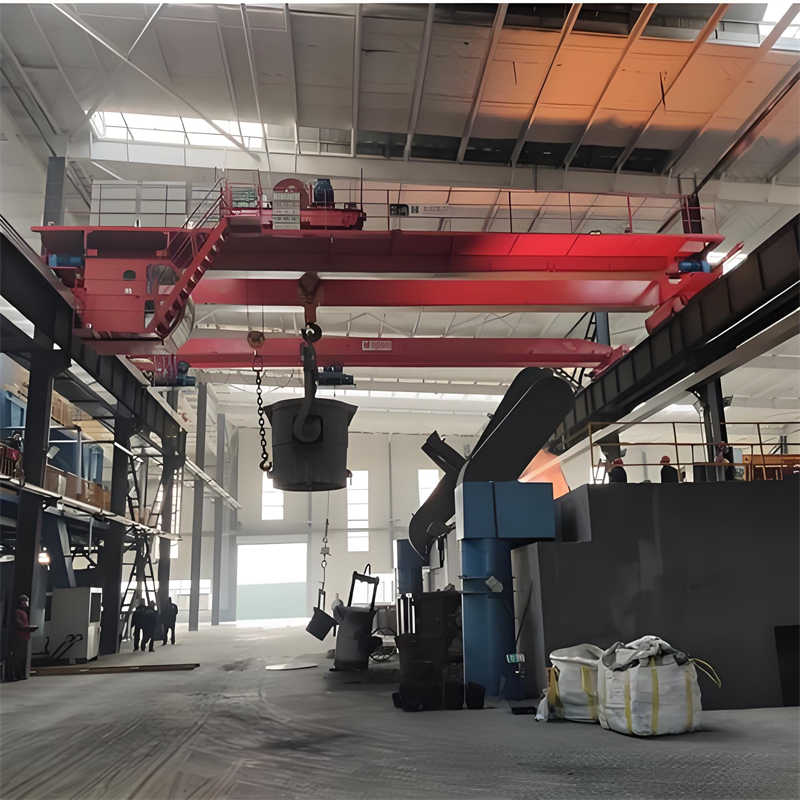
Part 1: Dongqi’s Core Defense – High-Temperature Engineering Mastery
- Structural Fortitude: Built to Withstand the Heat
- Superior Materials: Main girders, end carriages, and trolley frames utilize premium high-temperature alloy steels (e.g., Q345B/C/D or equivalent international grades like S355JR), specifically chosen for their retained strength and resistance to creep deformation at elevated temperatures. Critical fasteners are high-strength, accounting for thermal expansion.
- Optimized Design:
- Enhanced Rigidity: Increased girder depth and optimized cross-sections counteract thermal stress-induced deflection and creep.
- Thermal Barrier System: Critical protection comes from high-performance insulating/reflective boards (e.g., ceramic fiber, composite mineral boards) strategically installed on the bottom flange facing the heat source, drastically reducing radiant heat transfer to the primary structure.
- Thermal Expansion Management: Precision engineering incorporates calculated expansion gaps and flexible connections at key points to prevent destructive stress build-up.
- Advanced Surface Protection: Structures are coated with specialized high-temperature, anti-corrosion paints (e.g., silicone-based resins, rated >400°C/750°F), shielding against oxidation and heat degradation.
- Electrical & Control Sanctuary: Cool, Protected, Intelligent
- High-Temp Rated Components: Every critical element – motors, brake coils, contactors, relays, PLCs, VFDs – is specified to minimum H-class (180°C/356°F) insulation rating, often exceeding this baseline.
- Thermal Isolation & Active Cooling:
- Sealed, Insulated Electrical Enclosures: The nerve center (drives, controls) resides within a dedicated, sealed electrical house or control cabinet, featuring robust thermal insulation.
- Forced Air/Conditioned Cooling: Integrated, high-capacity air conditioning or forced ventilation systems maintain a safe internal operating temperature (typically <55°C/131°F), creating a vital “cool zone.”
- Sensor Protection: Critical limit switches, load cells, and encoders are shielded with dedicated heat-resistant guards or specified as intrinsically high-temperature resistant models.
- Robust Cable Management:
- High-Temp Cabling: Silicon rubber insulated cables (rated >180°C/356°F) or equivalent are standard, ensuring flexibility and insulation integrity under heat stress.
- Mechanical & Thermal Shielding: Cables in vulnerable areas are routed through continuous metallic flexible conduits or high-temp protective conduits.
- Optimal Routing: Cable paths are meticulously planned to maximize distance from primary heat sources.
- Mechanical Endurance: Lubrication and Protection for Vital Movements
- Critical Component Shielding:
- Hoisting Mechanism: Drums and sheave assemblies are protected by heat-deflecting shields/guards.
- Travelling Mechanisms (Bridge & Trolley): Wheel assemblies, gearboxes, and bearings are enveloped by heat-resistant shrouds/side skirts. Bearings are fully sealed to exclude high-temperature dust ingress.
- High-Performance Lubrication:
- Extreme-Pressure, High-Temp Greases: All lubrication points utilize synthetic lubricants (e.g., polyurea, complex calcium sulfonate) formulated for exceptional thermal stability, oxidation resistance, and load-bearing capacity – resisting wash-out, evaporation, and carbonization.
- Centralized Automatic Lubrication (Recommended): Ensures precise, timely, and safe delivery of grease to critical points, significantly reducing manual maintenance frequency and exposure risk.
- Critical Component Shielding:
- Safety Redundancy: Fail-Safes for the Most Critical Moments
- High-Temperature Braking Assurance: Brake drums/discs and linings are constructed from specialized, heat-resistant materials maintaining consistent friction coefficients and structural integrity at high temperatures. Brake designs incorporate effective heat dissipation.
- Multi-Layered Safety Systems:
- Dual Braking (Hoist): Standard configuration features independent primary (service) and secondary (safety/emergency) brakes.
- Overspeed Protection: Prevents catastrophic runaway scenarios.
- Redundant Hoist Limit Switches: Combines robust mechanical (e.g., weight lever) and precise electronic (rotary encoder) limits.
- Precision Load Monitoring: Integrated load cells and Overload Limit Devices provide accurate weight data and prevent dangerous overloads.
- Structural Monitoring (Optional): Real-time girder deflection monitoring systems provide early warning of potential issues.
- Active Cooling Solutions: Conquering Extreme Heat Zones (Optional/Configurable)
- Targeted Forced-Air Cooling: Directs airflow onto high-heat components like motors or brakes.
- Closed-Loop Water Cooling (For Severest Conditions): Where proximity to furnaces or ladles creates unparalleled thermal loads (e.g., very short hook paths over furnaces), Dongqi offers engineered water cooling systems for electrical houses, critical motors, or brakes. Leverage our proven expertise in implementing these complex solutions effectively.
Part 2: The Dongqi Crane Advantage – Engineered for Excellence
Choosing Dongqi Crane for your molten metal handling needs means investing in unparalleled reliability, safety, and value:
- Deep Domain Expertise: Decades of focused experience designing and building cranes for the harshest metallurgical environments worldwide. We speak the language of steelmaking.
- True Customization: We don’t force-fit. Every Dongqi High-Temperature Crane is tailor-made based on your specific plant layout, ladle size, process flow, and thermal mapping analysis.
- Uncompromising Quality & Standards:
- Designs rigorously adhere to GB/T 3811 (Crane Design Code), FEM 1.001, ISO 8306, and stringent Molten Metal Safety Standards (e.g., CMAA 70/74, EN 14492-2, local AQ regulations).
- Critical components sourced from globally renowned, quality-assured suppliers.
- Manufacturing excellence with strict process control, including non-destructive testing (NDT).
- Proven Longevity & Reduced TCO: Our holistic thermal defense strategy dramatically extends equipment service life and minimizes unplanned downtime, delivering a superior return on investment.
- Safety as Core Philosophy: Multiple, independent safety systems are intrinsic to our design, providing the highest level of protection for personnel, equipment, and valuable molten loads.
- Global Support Network: From expert installation and commissioning to comprehensive maintenance support and readily available spare parts, Dongqi provides lifelong partnership ensuring your crane operates at peak performance.
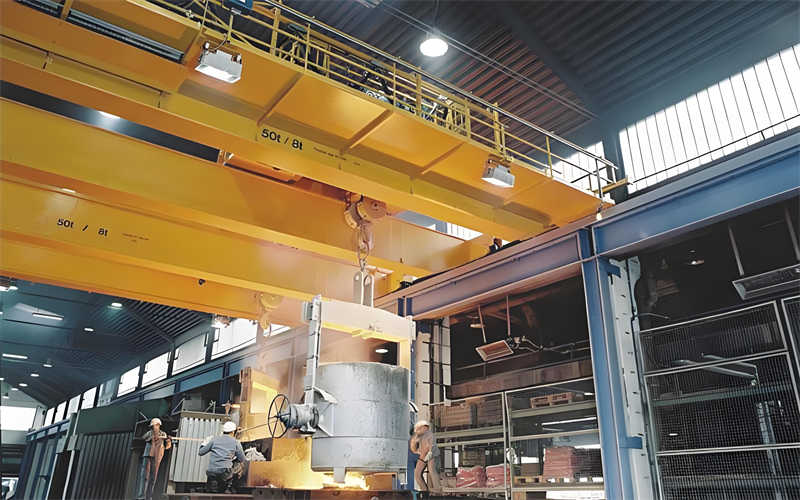
Part 3: Proven Performance in the Furnace Glow (Examples)
- Scenario A (Major Asian Integrated Mill): Dongqi supplied custom 150t/30m span Double-Girder Cranes for the BOF steel transfer aisle. Featuring enhanced thermal barriers (ceramic boards) and H-class electricals with chilled electrical houses, these cranes achieved a > 30% reduction in maintenance downtime related to heat issues compared to previous units and have exceeded their design lifespan in continuous operation.
- Scenario B (European Speciality Steel Producer): For a demanding secondary metallurgy bay handling precise alloy additions, Dongqi delivered cranes with specialized water-cooled electrical enclosures and advanced load cell systems. The solution provided exceptional reliability in close-proximity high-heat zones and critical weight accuracy for process control.
Conclusion: Secure Your Molten Metal Flow with Dongqi’s High-Temperature Expertise
In the relentless heat of steel production, standard cranes are a liability. Dongqi Crane’s purpose-built High-Temperature Double-Girder Bridge Cranes represent the pinnacle of safety, reliability, and durability for molten metal handling. We transform a high-risk operation into a secure and efficient process flow.
Don’t gamble with safety or productivity. Contact Dongqi Crane today for a detailed consultation. Our engineering team will assess your specific challenges and deliver a crane solution engineered to excel in your unique high-temperature environment.
Partner with Dongqi Crane – Where Safety Meets the Heat of Production.
Contact Dongqi Crane Now:
- Website: https://pk.craneyt.com/
- Email: sales010@cranesdq.com
- Phone: +86 18638815424
Dongqi Crane: Lifting the Future, Safely. Certified to ISO, CE, and Global Safety Standards.
