
Taming the Molten Flow: An In-Depth Look at Dongqi Crane’s A5 Duty 20-Ton Cabin-Controlled Double Girder Overhead Crane Solution for Steel Mills
Introduction: The Central Artery in a Sea of Molten Steel – The Ultimate Crucible for Cranes
Within the vast, roaring expanse of a modern integrated steel mill, the air shimmers with heat, dust hangs perpetually, and the ground vibrates with the thunder of colossal machinery. This is an environment where raw power meets precision engineering, and where the margin for error is virtually nonexistent. At the heart of this orchestrated chaos, overhead cranes perform a role far more critical than simple material handling; they are the indispensable central arteries of production, seamlessly connecting the stages of smelting, casting, rolling, and finishing. Their reliable operation dictates the rhythm and safety of the entire plant.
However, this pivotal role comes with extraordinary demands. An overhead crane in a steel mill is subjected to a unique combination of “hell-forged” challenges that would swiftly incapacitate standard industrial equipment:
- Extreme Dynamic & Impact Loading: The crane must manage not just the static weight of 20-ton loads, but also the significant dynamic forces and potential shock loads generated by swinging ladles of molten metal, shifting heavy ingots, or the sudden engagement of electromagnets with scrap steel.
- Hostile Environmental Onslaught: Intense radiant heat from furnaces and ladles, airborne conductive metallic dust, abrasive particulates, and occasional splashes of molten slag create a persistent assault on the crane’s structural integrity, electrical systems, and mechanical components.
- Relentless, High-Intensity Duty Cycles: The “A5 Duty” classification, while defined as “moderate use intensity,” translates in a steel mill to a grueling reality of frequent starts and stops, high load factors, and near-continuous operation across multiple shifts. Endurance is not a feature; it is a prerequisite for survival.
- Non-Negotiable Precision & Safety: Maneuvering a multi-ton ladle of molten steel over valuable equipment and personnel, or precisely stacking finished coils, demands millimeter-level control. Safety is paramount, with zero tolerance for system failure.
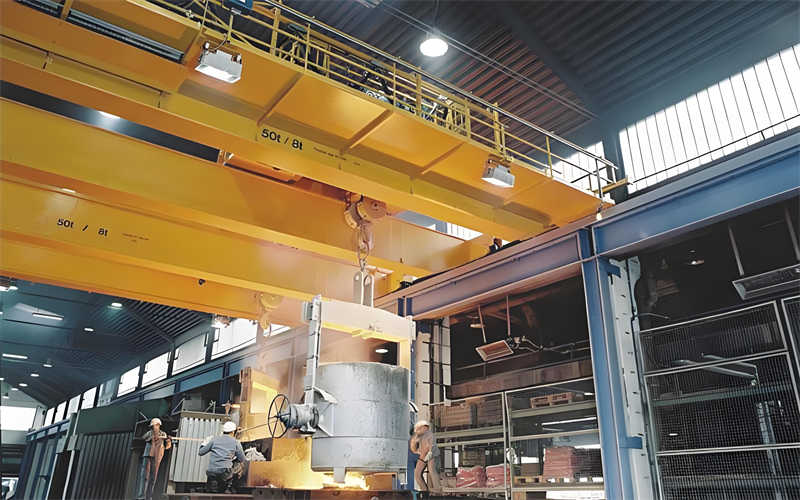
It is within this formidable context that Dongqi Crane introduces its purpose-built solution. We present not a generic catalog product, but an “Endurance Engineered” system – the A5 Duty 20-Ton Cabin-Controlled Double Girder Overhead Crane. Every facet of its design, from the macro structure to the micro circuitry, is a direct, calculated response to the brutal realities of steel production.
Chapter 1: Decoding the Core – The True Meaning of “A5 Duty” in a Steel Mill
Beyond the textbook definition, “A5 Duty” (FEM 1.001 / ISO 4301) embodies a specific performance covenant in the steel industry. It signifies a crane engineered not for sporadic heavy lifts, but for the sustained, rigorous tempo of material flow—constantly handling loads approaching its 20-ton capacity, with high hook utilization and numerous daily operational cycles.
Dongqi Crane translates this requirement into concrete engineering principles:
- Structural Fortitude for Fatigue Resistance: Our double girder design undergoes rigorous Finite Element Analysis (FEA) to identify and reinforce stress concentration zones. The optimized box girder construction ensures superior resistance to the cyclic loading that causes metal fatigue. We guarantee that the permanent main girder deflection remains well within strict standards, preserving precision and integrity over decades of service.
- Mechanical Systems Built for Sustained Effort: Critical drive components – the hoist, trolley, and bridge travel motors, gearboxes, and brakes – are selected and sized not merely for the nominal 20-ton load, but for the A5 (or higher) duty cycle requirement. This includes adequate thermal capacity margins to prevent overheating during peak production periods and robust construction to withstand constant engagement.
- Electrical Endurance: The control system utilizes industrial-grade contactors and relays with high mechanical and electrical lifespans. The programmable logic controller (PLC) is programmed with optimized acceleration/deceleration ramps to minimize mechanical shock during frequent starts and stops, extending the life of the entire drive train.
Chapter 2: The Art of Stability – The 20-Ton Double Girder System
In the demanding environment of a steel mill, the choice of a double girder configuration is non-negotiable for a 20-ton capacity crane. It provides the essential rigidity, torsional stability, and smooth travel characteristics that form the physical foundation for safe and precise load handling, especially under the dynamic conditions of moving molten metal or unbalanced loads.
Dongqi’s engineering elevates this foundation:
- Tailored Drive Performance: The hoist mechanism is not a standard pull. It is configured with specific variable frequency drive (VFD) torque and speed profiles. For ladle handling, this means imperceptibly smooth, controlled lifts and lowers to prevent slag splash. For billet or coil handling, it enables rapid yet stable traversing to maintain production pace.
- Precision Control and Sway Management: Advanced sensorless vector control technology provides exceptional speed regulation and torque control across the entire operating range. For critical applications, we offer an optional active anti-sway system that uses algorithms to automatically compensate for load pendulum, enabling operators to position heavy loads with pinpoint accuracy, first time, every time.
- Redundant Safety Architecture: Safety is layered. The primary hoist brake is complemented by a secondary safety brake. A precision load cell-based overload limit device provides continuous weight monitoring and will prevent hazardous overloads. These systems are especially critical when the consequence of failure is catastrophic.
Chapter 3: The Command Citadel – The Cabin Control Station Designed for Adversity
In a steel mill, the operator’s cabin transcends its traditional role. It becomes a “Safety Citadel” and an “Efficiency Command Post,” designed to protect the human operator while maximizing their control and situational awareness.
Dongqi’s cabin is a showcase of human-centric design within an industrial fortress:
- Environmental Isolation & Protection: The cabin is a fully sealed, pressurized, and air-conditioned unit. It features double-paned insulated glass, external sun visors, and dedicated cooling systems for areas with extreme radiant heat. This creates a safe, clean, and temperature-controlled oasis, shielding the operator from external hazards and fatigue.
- Ergonomics and Panoramic Visibility: The interior is laid out according to human factors engineering. An air-suspension operator’s seat, logically arranged control pendants or touch-screen interfaces, and panoramic windows minimize operator strain and provide an unobstructed view of the hook path and surrounding floor, essential for safe navigation in a congested mill.
- Integrated Information Hub: A central color touchscreen display provides real-time data: load weight, hoist height, travel coordinates, motor status, and diagnostic fault codes. This transforms the cabin into an intelligent hub, empowering the operator to make informed decisions and preempt potential issues.
Chapter 4: Forged in Fire – Specialized Enhancements for the Mill Environment
Our design philosophy extends to anticipating and mitigating the specific degradation factors present in a steel mill.
- Heat Radiation Defense: For cranes operating near furnaces or casting platforms, we install reflective heat shield plates on the undersides of the main girders and trolley. Critical cables and electrical components in exposed areas are protected with high-temperature resistant sleeves or conduit and strategically routed away from major heat sources.
- Combating Conductivity and Contamination: To thwart conductive metallic dust, all mechanical joints, wheel assemblies, and bearing housings feature enhanced sealing. Electrical cabinets are specified with a minimum IP54 rating (Ingress Protection), with IP65 available for harsher zones. The cabin’s pressurization system further ensures dust cannot infiltrate the operator’s space.
- Design for Maintainability: Recognizing that maintenance in such an environment must be swift and simple, we employ modular component designs, easy-access maintenance platforms and walkways along the bridge, and centralized automatic lubrication systems for crucial bearing points. This design philosophy maximizes equipment uptime and simplifies servicing.
Conclusion: Choosing Dongqi – A Commitment to Reliable Productivity
The Dongqi Crane A5 Duty 20-Ton Cabin-Controlled Double Girder Overhead Crane is more than a collection of specifications on a datasheet. It is the physical manifestation of a scenario-driven engineering philosophy, uncompromising manufacturing standards, and an obsessive focus on detail. Every weld, every wire, and every component selection is a deliberate step towards one goal: transforming the label “suitable for steel mills” into a demonstrable, reliable performance advantage that operates day in and day out.
We position ourselves not just as a supplier, but as a trusted partner in heavy industry. Our offering extends beyond the crane itself to encompass the comprehensive support that guarantees continuous production, enhances safety culture, and optimizes logistical flow within your facility.
We invite you to move beyond generic specifications. Bring us the layout of your melt shop, your rolling mill, or your finishing bay. Share with us your most challenging material handling sequences. Let our engineering team collaborate with yours to design, build, and support the Dongqi crane solution that becomes the reliable, powerful, and intelligent backbone of your steel-making operation.
