
Customized Type 40t Double Beam EOT Overhead Crane
Introduction
The 40-ton capacity catapults operations into the echelon of mega-heavy industrial lifting. Here, each lift is a capital-intensive event, involving machinery that forms the backbone of national infrastructure, energy grids, or global supply chains. A standard crane is a profound liability at this scale; a Customized Type 40t Double Beam EOT Overhead Crane is engineered as a mission-critical, fixed industrial asset. This guide explores how a fully bespoke 40-ton solution is conceived as an integrated system, designed to deliver unyielding reliability, pinpoint control, and absolute safety under the most extreme duty cycles and environmental challenges, serving as the undisputed workhorse of primary industries.
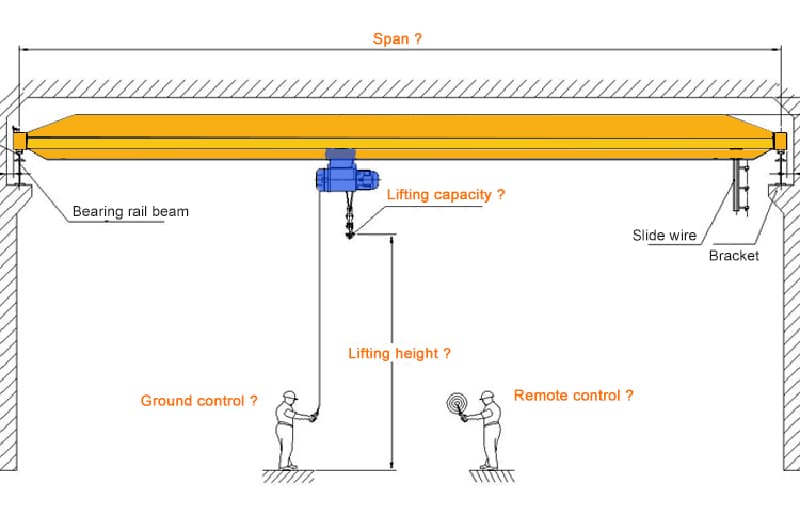
The Design Philosophy: Engineering Resilience and Foresight into Every Component
Managing a 40-ton load is an exercise in predictive engineering and risk mitigation. The forces at play demand not just strength, but an intelligent design that anticipates stress, manages energy, and incorporates fail-safes at a systemic level. Off-the-shelf designs cannot accommodate the unique confluence of span, speed, precision, and environmental factors required.
The philosophy for a 40-ton crane is Total System Engineering. It requires a structural design with inherent over-capacity, calculated to withstand not only the rated load but also decades of dynamic stresses, potential shock loads, and fatigue cycles. Concurrently, its drive, control, and safety systems must be architected with redundancy and intelligence, transforming raw power into predictable, manageable, and documentable motion. Customization is the meticulous process of synthesizing these complex subsystems into a cohesive, high-availability asset tailored to your facility’s specific operational and strategic footprint.
Foundational Engineering Domains for 40-Ton Capability
1. Monumental Structural Engineering & Dynamic Analysis
The superstructure is a testament to advanced structural engineering, designed for multi-decade service life under severe conditions.
- Deflection-Critical Girder Systems: Design utilizes non-linear dynamic FEA simulations and fatigue life analysis to create girder configurations that prioritize near-zero operational deflection. For critical applications, full-width welded box girders with internal stiffening diaphragms or robust truss girders with optimized nodal points are employed. The goal is to create a structure so rigid that it provides a perfectly stable platform for precision placement, irrespective of load position or travel speed.
- Multi-Bogie Drive & Load Distribution Systems: To manage immense wheel loads (often exceeding 50 tons per wheel), the bridge employs multi-wheel bogie assemblies on each end truck. These bogies often feature hydraulic or mechanical equalization to ensure uniform load distribution across all wheels and the runway rail, preventing localized overstress. Laser-guided alignment systems can be integrated to monitor and correct bridge skew in real-time.
2. High-Torque, Multi-Redundant Power & Drive Systems
Power systems are designed for maximum uptime, efficiency, and control fidelity.
- Tandem or Multi-Motor Hoist Drives: The hoisting mechanism is typically a tandem-drive system with two synchronized motors and gearboxes, providing inherent power redundancy. For the highest availability, a completely independent auxiliary hoist of significant capacity (e.g., 10-15 tons) is included. Components like forged steel sheaves, precision-ground gear teeth, and hardened shafting are specified for maximum durability and minimum maintenance intervals.
- Advanced Drive Technology with Active Energy Management: The system employs regenerative AFE (Active Front End) drives with common DC bus technology. This allows braking energy from one motor to be used by another, dramatically improving overall electrical efficiency. Sensorless vector control provides exceptional low-speed torque and speed regulation, enabling the operator to “inch” a 40-ton load with centimeter-level accuracy.
3. Industrial-Grade Control, Data Acquisition, and System Integration
The control system is the central nervous system, designed for reliability, data transparency, and future-proof integration.
- Fault-Tolerant Control Architecture: A triple-modular redundant (TMR) or dual-redundant hot-standby PLC system may be employed for continuous process applications where unscheduled stops are catastrophic. This is paired with a dedicated, certified Safety PLC (SIL3/PLe) overseeing all protective functions.
- Comprehensive Data Historian and Analytics Suite: Every operational parameter—load weight, motor currents, temperatures, travel distances, cycle counts, and error events—is logged with timestamps. This data feed supports predictive maintenance algorithms, warranty validation, operator performance analysis, and seamless integration with Plant Asset Management (PAM) systems.
4. Systemic Safety, Prognostics, and Functional Resilience
Safety is an inherent, multi-layered, and self-diagnosing feature engineered into every subsystem.
- Intelligent, Multi-Parameter Load Management System: This system integrates strain-gauge based weighing, anti-sway algorithms using input from inertial measurement units (IMUs), and dynamic load moment calculation to prevent dangerous conditions. It can automatically derate crane capacity or limit speed based on wind conditions (for outdoor cranes) or load attachment geometry.
- Comprehensive Prognostic Health Management (PHM) Network: A network of advanced sensors provides continuous health assessment: ultrasonic testing for critical welds, online oil particle counters in gearboxes, fiber-optic strain gauges on primary girders, and partial discharge monitoring for high-voltage components. This PHM system enables a shift from scheduled to condition-based maintenance, maximizing component life and preventing unexpected failures.
Technical Specifications: The Architectural Blueprint for 40-Ton Industrial Mastery
The following table details the engineered framework for a Customized Type 40t Double Beam EOT Crane. Each specification is a critical variable in the performance equation.
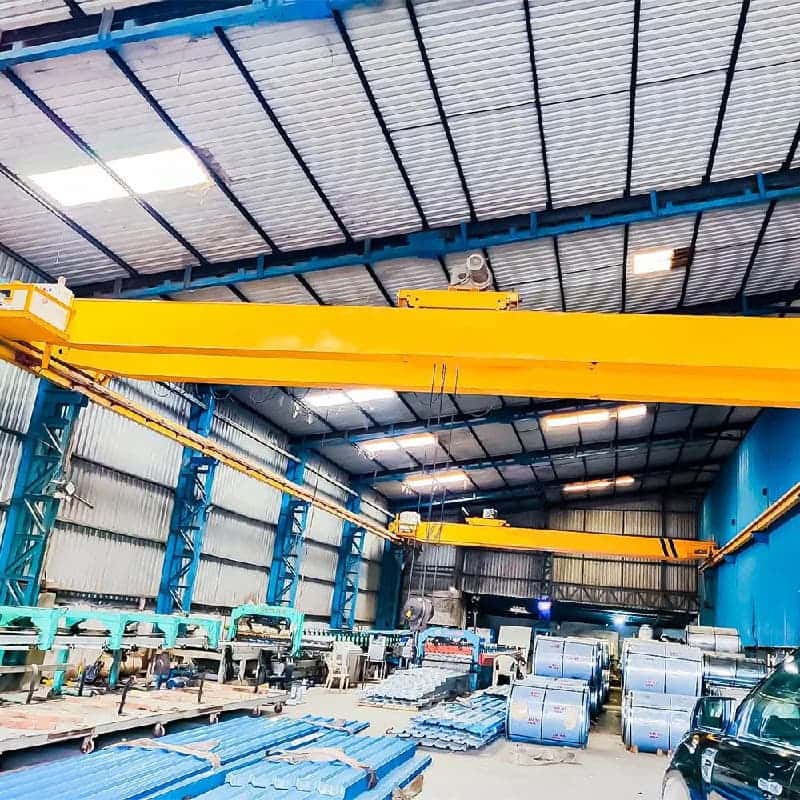
| Parameter | Engineering Baseline | Customization Imperative for 40t |
|---|---|---|
| Capacity | 40 Tons (80,000 lbs) | Design per most stringent global standards (FEM 1.001, CMAA Class F/G). Requires full Design Verification Report (DVR) by an independent certifying authority and often third-party witness testing (125% static, 110% dynamic). |
| Span | Fully Custom (Up to 65m+) | A major engineering project. Solutions may include double-girder with tie-bars, lattice truss girders, or hybrid designs. Full dynamic analysis for wind, seismic (if applicable), and deflection is compulsory. |
| Lifting Height | Fully Custom | Features multi-speed hoists (e.g., main, precision, and creep speeds) for complete control. Multi-fall rope reeving is standard to manage rope loads and provide redundancy. |
| Duty Class | A7/A8 (Very Heavy Duty / Continuous Severe) | Standard for primary metal, heavy forging, and shipbuilding. All components are rated for maximum thermal and mechanical stress, with service factors applied to bearings, gears, and motors. |
| Control Power | 690V / 1kV / 3.3kV, 3 Phase, 50/60Hz | Complete engineered power solution, including harmonic analysis, transient voltage protection, and often a dedicated MV/LV substation. Power quality and reliability are paramount. |
| Control System | Redundant/TMR PLC + SIL3 Safety PLC + Common DC Bus AFE Drives | Enables maximum uptime, highest safety integrity, superior energy efficiency, and complex process automation. |
| Speeds (Engineered Range) | Optimized for process efficiency with an overriding priority on controlled acceleration/deceleration ramps and absolute load stability. | |
| – Hoisting | 1.5 ~ 4.5 m/min | |
| – Trolley Traverse | 8 ~ 12 m/min | |
| – Bridge Travel | 10 ~ 18 m/min | |
| Girder Configuration | Engineered Mega-Heavy Double Girder (Advanced Truss, Reinforced Box, or Hybrid) | The selection is a cornerstone of the project, involving detailed studies on material, fabrication methodology, transportation, and erection feasibility. |
| Safety & Monitoring | SIL3 / PLe Architecture with Integrated PHM and Data Historian | Focus on functional safety, cyber-security for industrial networks, comprehensive data logging, and predictive analytics. |
| Environmental Specification | Up to IP66/IP67, Corrosion Class C5-M/I | Bespoke protection packages: pressurized & air-conditioned cabins/panels, heat-reflective cladding, stainless steel components, and specialized corrosion protection systems. |
| Protective Coating | Maximum Durability System (e.g., surface preparation to SA 2.5, thermal spray aluminum (TSA) or zinc, epoxy sealant, polyurethane topcoat) | Engineered for a 30+ year lifespan with minimal maintenance in the most aggressive industrial environments. |
Ideal Applications: The Domain of Industrial Titans
This crane is the definitive solution for primary industries where 40-ton lifts are integral to daily production.
- Primary Steelmaking & Continuous Casting: Handling ladles of molten steel, tundishes, and massive slab molds. Customization is centered on A8 duty cycle, extreme heat protection (water-cooled components, refractory shields), failsafe hydraulic ladle control systems, and spill containment designs.
- Heavy Forging & Open-Die Press Facilities: Manipulating massive ingots, press tools, and forged components for power generation and defense. Requires exceptional structural rigidity to withstand side-pull forces, precision control for press feeding, and high duty-cycle reliability.
- Shipbuilding, Dry Dock, & Offshore Heavy Lift: Moving and positioning entire ship engine blocks, mega-yacht hulls, and offshore wind turbine foundations. Demands extreme outdoor durability, high wind-rated operation (e.g., for Zone 4), seismic design, and often compliance with multiple marine classification societies (ABS, LR, DNV).
- Major Heavy Engineering & Infrastructure: Fabricating and assembling components for bridges (girders), hydroelectric dams (turbine runners), and mining infrastructure (crushers, mills). The crane must offer combination lifting capabilities (main + auxiliary), outdoor performance, and precise load spotting for large-scale assembly.
- Aerospace: Assembly of Launch Vehicles & Large Satellites: Handling rocket stages, fuel tanks, and satellite buses. Emphasizes cleanliness protocols, precision better than +/- 1mm, absolute vibration control, and often operation within specialized climate-controlled buildings.
Your Project Foundation: The Comprehensive Technical Dialogue
To initiate the engineering of your 40-ton solution, a deep and collaborative technical partnership is essential, beginning with:
- Total Operational & Load Spectrum Definition: A complete dossier including 3D models/weights/CG of all critical loads, a statistical analysis of the load spectrum, and a precise definition of the annual duty cycle (operating hours, starts/stops, average and peak loads).
- Greenfield or Brownfield Facility Analysis: For new facilities, collaboration on integrated runway and building design. For existing facilities, a detailed structural integrity audit including non-destructive testing (NDT) of runway supports and foundations. Full electrical system analysis.
- Total Process Integration Blueprint: A detailed Functional Design Specification (FDS) outlining the crane’s role within the larger automated or semi-automated process, including all interfaces with robotics, conveyors, AGVs, and Manufacturing Execution Systems (MES).
- Performance, Lifetime & Compliance KPI’s: Contractual targets for Mean Time Between Failure (MTBF), Mean Time To Repair (MTTR), lifetime energy consumption, and full compliance matrices for all relevant safety and environmental regulations.
- Total Lifecycle Support & Digital Twin Requirements: Specification for documentation (including a full digital twin for simulation), training simulators, long-term spare parts strategy, and remote diagnostic & support capabilities.
Conclusion: The Strategic Capital Foundation for Industrial Supremacy
Investing in a Customized Type 40t Double Beam EOT Overhead Crane is a capital decision that defines the heavy-lift capability and operational resilience of a world-class industrial facility. It is the procurement of a high-intelligence, ultra-reliable industrial partner engineered not just to lift, but to enable, protect, and optimize your most critical and capital-intensive processes. This crane is a strategic asset that directly safeguards production continuity, protects multi-million dollar equipment, and serves as a tangible testament to engineering excellence and operational ambition.
Initiate Your Mega-Project Engineering Partnership
The journey to your definitive 40-ton system is a collaborative engineering endeavor. Contact our mega-project engineering and execution team to commence with a detailed feasibility study and collaborative specification workshop. Let us demonstrate how a purpose-built 40-ton crane can be engineered as the foundational pillar of your facility’s most demanding and productive operations.
Navigate Our Mega-Heavy Lifting Portfolio:
- For ultra-heavy industrial applications, explore the engineered performance of our [Customized Type 30t Double Beam EOT Crane].
- To step into the domain of super-heavy lifting for primary industries, investigate the capabilities of our [Customized Type 50t Double Beam EOT Cranes].
