
Crane Selection and Safety Guide for Metallurgical Plants
Foreword: Safety and Efficiency – The Dual Cornerstones of Metallurgical Production
In the high-risk, high-investment metallurgical industry, lifting equipment is far more than an auxiliary tool. It serves as the “lifeline” of the production process. The scientific basis of its selection and the absoluteness of its safety directly impact personnel safety, asset protection, and production continuity. This guide aims to systematically outline the core knowledge and decision-making processes for metallurgical cranes—from initial selection to long-term safe operation. It is designed to be a clear, practical reference framework for plant managers, equipment engineers, and safety officers. As a professional partner deeply rooted in the metallurgical industry, Dongqi Crane is committed to sharing knowledge and experience to help clients build inherently safe and efficient production systems.
Part 1: The Foundation – Extreme Challenges and Special Crane Requirements in Metallurgical Plants
Chapter 1: The Inescapable Extreme Working Conditions
Metallurgical plants present a uniquely hostile environment for equipment:
- High Temperature: Continuous radiant heat from molten metal (creating ambient temperatures often exceeding 80°C/176°F) critically impacts the lifespan and performance of steel structures, electrical components, and wire ropes, accelerating aging and fatigue.
- Heavy Loads and High Frequency: Demanding production cycles require cranes to operate consistently at Class A6 (Heavy Duty), A7 (Very Heavy Duty), or higher. This involves frequent starts and stops, placing extreme stress on mechanical components.
- Abrasive Environment: High concentrations of dust and metal particulates lead to accelerated wear on moving parts and can compromise electrical insulation.
- Process Criticality: Operations like transferring molten metal demand absolute stability, while integration into continuous processes necessitates exceptional reliability to avoid costly all production lines suspended.
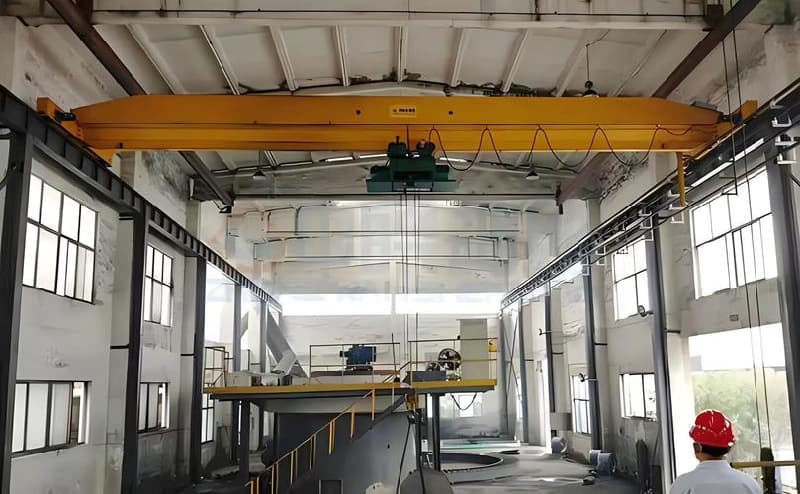
Chapter 2: The Lifeline of Regulations and Standards
Compliance is non-negotiable. Key standards include:
- International: ISO 12485 (Cranes – Reliability, Availability and Maintainability); FEM 1.001 (Rules for the Design of Hoisting Appliances).
- Regional/National: GB/T 26470 (Technical Conditions for Metallurgical Cranes – China); Machinery Directive and EN 15011 (Cranes – Bridge and Gantry Cranes – Europe).
- Critical Certifications:
- CE Marking: Essential for the European market, demonstrating compliance with strict health, safety, and environmental protection directives.
- Special Equipment Manufacturing License: A mandatory certification in many regions, including China, proving the manufacturer’s qualification to produce such high-risk equipment.
Part 2: Scientific Selection – Building a Lifting System Matched to Your Process
Chapter 3: The Decision Tree for Key Parameters
Selection begins with a clear understanding of the process. Follow this logic: What is being lifted (ladle, ingot, scrap, mold) → How it fits the process (charging, pouring, stripping, finishing) → Define the “what” and “how.”
Core Parameter Calculations:
- Capacity (Tonnage): Never base this on product weight alone. Include the weight of the lifting attachment (e.g., a ladle can weigh 30-50% of its payload). Always factor in potential for accidental overload (e.g., skulls in a ladle).
- Duty Class (A1-A8): Determined by the average daily operating hours and the load spectrum. Cranes in main production flows are typically Class A6 or higher.
- Span & Lifting Height: Requires careful 3D planning based on column spacing, plant layout, and stockpile heights.
- Speed & Positioning Precision: Balance productivity needs with smoothness and accuracy. Pouring applications demand exceptionally fine and stable micro-speeds.
Quick-Reference Selection Table:
| Application Scenario | Recommended Crane Type | Typical Duty Class | Key Selection Focus | Essential Safety Features |
|---|---|---|---|---|
| Steelmaking: Molten Metal Transfer | Casting Crane (e.g., Dongqi QDY) | A7/A8 | Dual braking, low-speed stability, heat-resistant structure, redundant hoist design | Load limiter, dual height limits, emergency descent power, real-time monitoring |
| Continuous Casting: Ladle Turret | Casting Crane | A7 | Precise positioning with turret, heat shielding, high duty cycle | Anti-collision system (multi-crane), auto-positioning at pour point |
| Rolling Mill: Slab/Billet Yard | General Duty Overhead Crane (QD) | A6/A7 | Impact resistance, high cycle count, fast handling | Load sway control, attachment anti-drop |
| Foundry: Mold Handling | Double Girder Crane | A5/A6 | Auxiliary hook precision, accurate spotting | Rope slack protection, zone limiting device |
Chapter 4: Core Component & Configuration Choices
- Drive & Braking System: The merits of integrated “three-in-one” drives for metallurgy; the necessity of dual braking (service + safety brake); disc vs. thruster brake analysis.
- Structural Design: Box girder types (off-center vs. on-center rails); layout of heat shield plates for thermal protection.
- Electrical & Control:
- Motor Insulation Class: Minimum Class F, recommended Class H.
- Control Mode: Application and safety considerations for cab, pendant, or remote/radio control.
- Core Safety Systems: Safety Monitoring System (SMS), variable frequency drives (VFDs), limit switches, and sensors.
Part 3: Safety in Practice – Total Lifecycle Management from Installation to Decommissioning
Chapter 5: The Golden Rules of Installation, Commissioning, and Acceptance
- Foundation & Runway: Installation precision (e.g., rail levelness, alignment) is critical for smooth operation and long wheel life.
- Load Testing: Detailed explanation of mandatory 125% Static Load Test and 110% Dynamic Load Test procedures and pass/fail criteria.
- Documentation Handover: Required file archive checklist: General arrangement drawings, electrical diagrams, major component certifications, type test reports, safety device commissioning records.
Chapter 6: Daily Operation & Maintenance: The Safety Red Lines
- Operator’s “Do Not Lift” Rules (Metallurgy Enhanced): Beyond standard rules, include metallurgy-specific clauses like “Do not lift un-solidified metal” or “Do not lift if safety device alarm is active.”
- Inspection & Maintenance Regime:
- Daily/Pre-shift Check: Brake adjustment, wire rope condition, unusual noises.
- Monthly/Quarterly Maintenance: Bolt torque checks on critical connections, electrical contact cleaning, lubrication system inspection.
- Annual Overhaul & Statutory Inspection: Conduct thorough disassembly and performance restoration in coordination with regulatory body inspections.
- Critical Component Life Management: Provide recommended inspection intervals and replacement criteria for wear parts like wire ropes, brake linings, and wheels.
Weekly Inspection Checklist (Example):
- [ ] Function of all emergency stop buttons
- [ ] Visual condition of wire rope (broken wires, deformation)
- [ ] Brake operation and clearance
- [ ] Condition of hook and latch
- [ ] Fluid levels (gearbox, hydraulic)
- [ ] Integrity of guards and covers
Chapter 7: Risk Mitigation & Modernization
- Common Failure Modes & Early Warnings: Link symptoms (e.g., structural cracks, brake drift, abnormal vibration) to potential root causes and immediate actions.
- The Data Value of SMS: How to use recorded operational data (overload events, motor running hours, fault logs) for predictive maintenance, shifting from reactive repair to proactive prevention.
- Safety Assessment & Retrofit of Aging Cranes: Guidance on evaluating older cranes (e.g., measuring girder deflection, assessing obsolete controls) and modernization options (e.g., adding SMS, upgrading to VFDs).
Part 4: The Future – Intelligence and Green Safety
- The Smart Trend: Introduction to IoT-based intelligent crane scheduling, the use of Digital Twin technology for simulation and training, and the growing adoption of anti-sway and auto-positioning systems.
- Green & Human-Centric Design: How energy-efficient designs (e.g., regenerative VFDs), low-noise operation, and ergonomic cabs contribute to long-term safety, productivity, and sustainability.
Conclusion: Safety is a Never-Completed Project
Selecting the right crane is the starting point for safety. Implementing rigorous management is its ongoing guarantee. Committing to continuous improvement secures its future. In this context, choosing a partner like Dongqi Crane—one that provides not just a product, but total lifecycle technical support, safety training, and a commitment to continuous partnership—becomes a strategic investment in your plant’s core resilience.
