
Cost-Benefit Analysis: Single Girder Bridge Cranes vs. Jib Cranes for Machine Shops
Introduction
In today’s competitive manufacturing landscape, machine shops face constant pressure to improve productivity while controlling costs. The choice of material handling equipment plays a pivotal role in this balancing act, with single girder bridge cranes and jib cranes emerging as two of the most common solutions – each with distinct advantages and optimal applications.
This comprehensive analysis compares these two crane types across multiple dimensions: initial investment, operating costs, space utilization, work efficiency, and long-term return on investment. By examining technical specifications, performance parameters, and real-world application cases, we’ll reveal the most cost-effective material handling solution for different workshop environments and operational requirements.
Equipment Overview and Technical Specifications
Understanding the fundamental structures and operating principles of single girder bridge cranes and jib cranes forms the foundation for meaningful cost-benefit analysis. These material handling solutions differ substantially in design philosophy, structural composition, and operation methods – factors that directly determine their respective applications and performance characteristics.
Single Girder Bridge Cranes
The core structure consists of:
- A main girder (typically I-beam or box girder design)
- Two end trucks
- An electric hoist
- Travel mechanisms
Key technical parameters:
- Capacity: 1-20 tons
- Span: 7.5-31.5 meters
- Lifting height: 3.2-40 meters
- Duty class: A1-A5 (light to medium duty)
- Lifting speed: 0.32-16 m/min
- Trolley travel speed: 3.2-40 m/min
- Bridge travel speed: 3.2-50 m/min
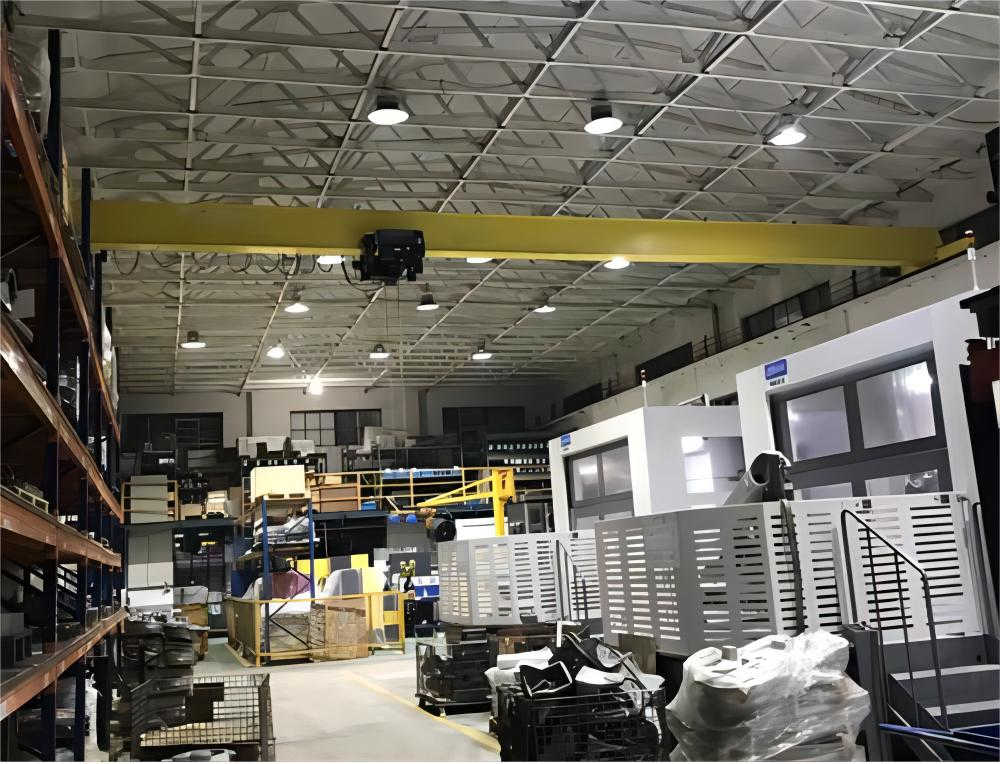
Dongqi Crane offers several variants including standard, low headroom, and European (FEM/DIN) designs to accommodate different spatial constraints.
Jib Cranes
Structural components include:
- Mast (floor or wall mounted)
- Rotating boom
- Lifting mechanism (electric or manual hoist)
- Rotation system
Typical specifications:
- Capacity: 2.5-20 tons
- Maximum radius: 10 meters
- Maximum lifting height: 15 meters
- Rotation: 180° or 360°
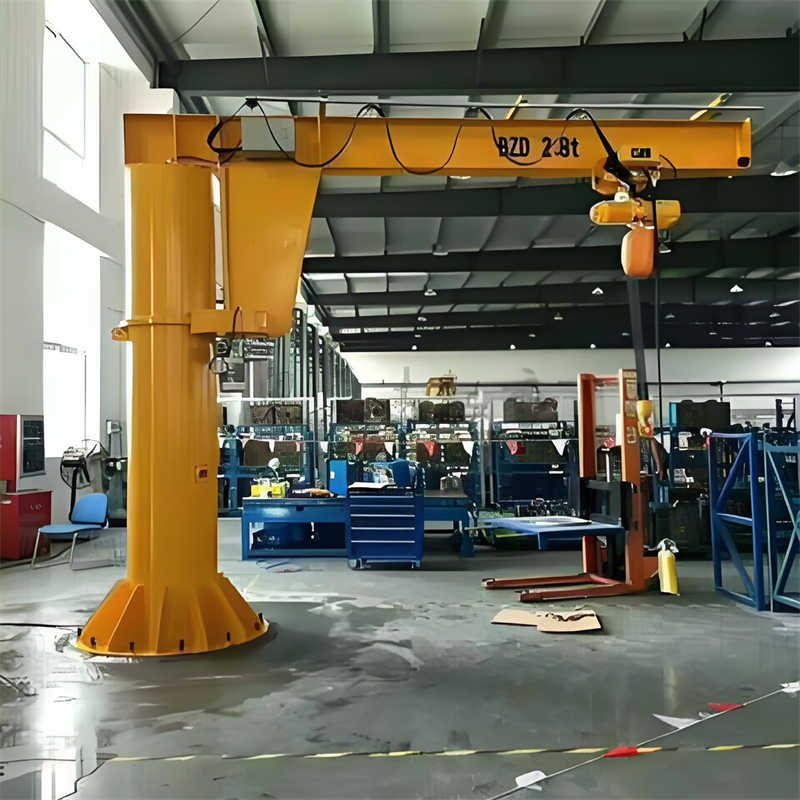
Jib cranes excel in compact spaces and offer flexible installation options with minimal impact on existing workshop structures.
Initial Investment Comparison
The purchase decision for material handling equipment must carefully consider upfront costs, which vary significantly between these two crane types based on multiple factors.
Single Girder Bridge Cranes
Cost components include:
- Equipment price:
- Base price range: $3,325 (1 ton) to $11,350 (20 ton)
- Example: 5 ton crane (19m span, 6m lift) = $4,765-$6,000
- Rail system:
- Adds 30-50% to total investment
- Includes runway beams, supports, and fasteners
- Installation and commissioning:
- Requires professional installation
- May need structural reinforcement
- Electrical modifications:
- New power and control circuits
Special designs like low headroom versions typically cost 15-20% more than standard models.
Jib Cranes
Cost structure is simpler:
- Equipment price:
- 2.5 ton model: $5,000-$8,000
- 20 ton model: $20,000-$30,000
- Installation:
- Simpler and faster
- Minimal structural modifications
- Lower labor costs
Jib cranes offer quicker deployment and lower initial investment, particularly for existing facilities.
Cost Comparison Table (5 Ton Capacity)
| Feature | Single Girder Bridge Crane | Jib Crane |
|---|---|---|
| Base Equipment Cost | $4,765-$6,000 | $7,500-$9,000 |
| Installation Cost | High ($3,000-$5,000) | Low ($1,000-$2,000) |
| Structural Modifications | Often required | Rarely needed |
| Total Initial Investment | $8,000-$11,000 | $8,500-$11,000 |
Operating and Maintenance Costs
Long-term operational expenses often outweigh initial purchase prices in total cost of ownership calculations.
Energy Consumption
Single girder bridge cranes:
- Three motion dimensions (longitudinal, transverse, vertical)
- 5 ton model power requirements:
- Hoisting: 7.5-10 kW
- Travel: 0.8-1.5 kW
- Annual energy use: Thousands of kWh in continuous operation
Jib cranes:
- Typically fewer powered axes
- Manual rotation options available
- Generally lower energy consumption
Maintenance Requirements
Single girder bridge cranes:
- Frequent systematic maintenance:
- Wire rope lubrication/inspection
- Sheave and bearing lubrication
- Rail cleaning/alignment
- Electrical system checks
- Quarterly professional inspections recommended
- Higher parts replacement costs (e.g., wire ropes 5-10% of initial cost every 3-5 years)
Jib cranes:
- Focus on rotation mechanism
- Less frequent maintenance
- Lower parts replacement costs
- Simpler repair procedures
Lifespan Comparison
- Single girder bridge cranes: 15-20 years (with proper maintenance)
- Jib cranes: 10-15 years (rotation mechanism fatigue life)
Space Utilization and Installation Flexibility
Workshop layout efficiency depends heavily on how material handling equipment interacts with available space.
Vertical Space Utilization
Single girder bridge cranes:
- Require substantial headroom for runway system
- Low headroom designs can minimize space loss (reducing clearance from 1120mm to 630mm)
Jib cranes:
- No overhead runway needed
- More efficient in height-constrained facilities
- Flexible mounting options (floor or wall)
Floor Space Impact
Single girder bridge cranes:
- Full workshop coverage
- Minimal floor space occupation (only columns)
- Optimized material flow paths
Jib cranes:
- Fixed work envelope (radius limited)
- Mast occupies floor space
- Best for localized work cells
Installation Flexibility
Single girder bridge cranes:
- Require substantial structural preparation
- Difficult to relocate
- Best for new facilities or major renovations
Jib cranes:
- Quick installation
- Minimal structural impact
- Easier to relocate
- Ideal for existing facilities
Productivity and Operational Efficiency
The choice between these crane types significantly impacts workflow efficiency and throughput.
Work Area Coverage
Single girder bridge cranes:
- Full workshop length and width coverage
- Three-dimensional movement capability
- Ideal for large work areas
- Typical duty cycle: 25-50%
Jib cranes:
- Limited circular work envelope
- Best for localized operations
- Typical duty cycle: 15-30%
Load Handling Efficiency
Single girder bridge cranes:
- Faster positioning (multiple powered axes)
- Better for frequent, long-distance moves
- Higher precision placement
Jib cranes:
- Quick access within work radius
- Excellent for repetitive, localized tasks
- Manual options allow fine positioning
Safety Considerations
Both crane types incorporate multiple safety features, but their risk profiles differ:
Single girder bridge cranes:
- Overload protection
- Limit switches
- Emergency stops
- Anti-collision systems
Jib cranes:
- Moment load monitoring
- Rotation limiters
- Foundation stability critical
Application Scenarios and Recommendations
Choosing between these crane types depends on specific operational requirements.
When to Choose Single Girder Bridge Cranes
Optimal for:
- Large work areas needing full coverage
- Frequent long-distance material movement
- High precision positioning requirements
- Facilities with adequate headroom
- Operations anticipating future expansion
- Higher duty cycle applications (25-50%)
When Jib Cranes Are Preferable
Ideal for:
- Space-constrained facilities
- Localized work cells
- Lower duty cycle operations (15-30%)
- Existing facilities with limited modification options
- Budget-conscious operations
- Applications needing quick deployment
Hybrid Solutions
Some facilities benefit from combining both crane types:
- Bridge cranes for main material flow
- Jib cranes for workstation support
- Optimizes both coverage and flexibility
Conclusion: Making the Right Choice
The decision between single girder bridge cranes and jib cranes involves careful consideration of multiple factors:
- Budget considerations:
- Jib cranes typically have lower initial costs
- Bridge cranes may offer better long-term value for intensive use
- Space constraints:
- Height-limited facilities favor jib cranes
- Large-area coverage needs favor bridge cranes
- Operational requirements:
- High throughput operations benefit from bridge cranes
- Localized work cells work well with jib cranes
- Future flexibility:
- Bridge cranes support expansion
- Jib cranes offer easier reconfiguration
Dongqi Crane recommends conducting a thorough analysis of your specific requirements before selecting a solution. Our engineering team can help evaluate your workspace, workflow, and budget to determine the optimal material handling system for your machine shop’s unique needs.
