
Comprehensive Guide to 50 Ton Double Girder Gantry Crane for Stone Slab Lifting
Abstract: This comprehensive guide explores the technical specifications, applications, and benefits of 50-ton double girder gantry cranes specifically designed for stone slab handling. It provides detailed information on design features, customization options, pricing factors, and selection criteria to help businesses in the stone industry make informed decisions when acquiring heavy-duty lifting equipment.
1. Introduction to Double Girder Gantry Cranes for Stone Slab Handling
The stone slab 50 ton double girder gantry crane represents a critical piece of equipment in the modern stone processing and handling industry. Specifically engineered to manage the substantial weight and dimensional challenges of stone slabs, these robust cranes have become indispensable in quarries, stone fabrication yards, and material handling facilities worldwide. The unique demands of lifting marble, granite, and other stone varieties—with their considerable weight, susceptibility to damage, and safety challenges—require specialized lifting solutions that standard cranes cannot provide.
The double girder gantry crane configuration has emerged as the preferred choice for heavy-duty stone applications due to its superior structural integrity, enhanced lifting capacity, and operational stability. Unlike single girder alternatives, double girder cranes feature two parallel main girders that provide balanced load distribution and increased hook height—critical factors when handling massive stone slabs that can weigh up to 50 tons or more. These cranes are specifically designed to withstand the challenging environments of stone processing facilities, including outdoor quarries with exposure to weather elements and indoor fabrication shops with space constraints.
As the global construction industry continues to demand natural stone products, the need for efficient, reliable, and safe material handling equipment has correspondingly increased. The 50 ton gantry crane fulfills this need by offering the perfect combination of lifting capacity, precision control, and durability required by modern stone processing operations. This article examines the technical specifications, design advantages, applications, and economic considerations of these specialized cranes, providing a comprehensive resource for businesses considering their implementation.
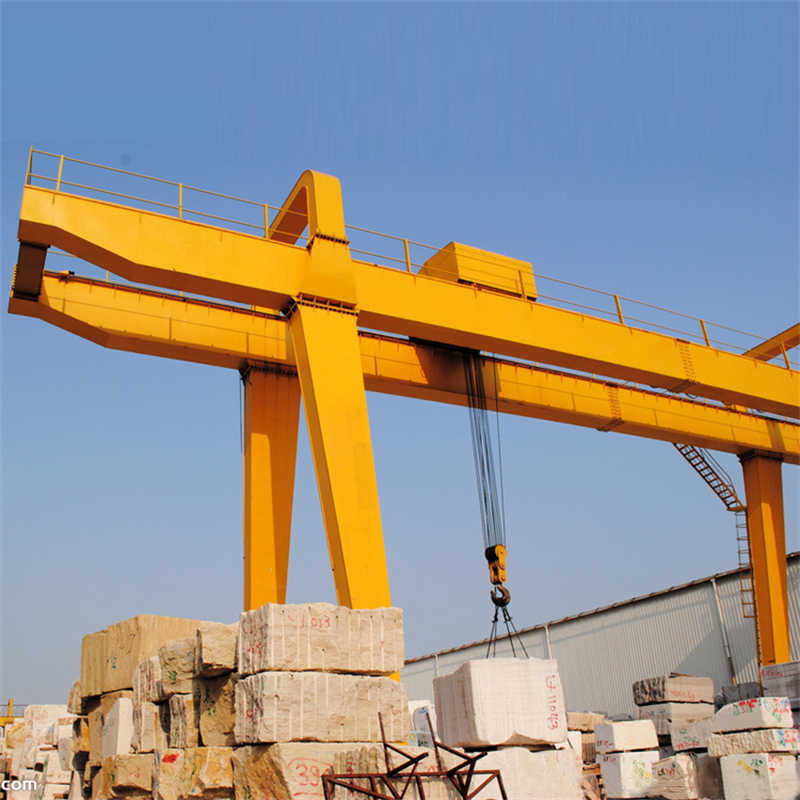
2. Structural Advantages of Double Girder Design for Heavy Lifting
The double girder gantry crane possesses distinct structural advantages that make it particularly suitable for handling heavy stone slabs. The fundamental design incorporates two parallel girders that form the primary load-bearing structure, creating a more balanced and stable platform compared to single girder alternatives. This configuration significantly enhances the crane’s load distribution capabilities, reducing stress on individual components and extending the equipment’s operational lifespan .
2.1 Enhanced Load Capacity and Stability
The dual-girder system provides superior structural integrity when handling massive stone slabs. The symmetrical distribution of weight across two girders rather than one allows for increased lifting capacity without compromising stability. This is particularly important when handling stone slabs, as their substantial weight—often approaching the crane’s maximum rated capacity—requires minimal deflection in the supporting structure. The double girder design typically exhibits reduced beam deflection compared to single girder configurations, ensuring precise and safe positioning of valuable stone materials .
2.2 Increased Hook Height
The double girder configuration provides greater hook height—the distance between the hook and the ground—which is essential for stacking stone slabs vertically or manipulating tall loads. This increased clearance enables more efficient use of vertical space in storage yards and processing facilities, allowing businesses to maximize their storage capacity by stacking slabs higher without compromising operational safety .
2.3 Superior Trolley and Hoisting Mechanism Support
The double girder design accommodates more robust trolley systems and hoisting mechanisms than single girder alternatives. The dual support structure enables the installation of heavy-duty hoists and specialized below-the-hook equipment necessary for securing stone slabs. This includes C-hooks, vacuum lifters, and stone clamps that require stable support systems to function effectively. The wider platform also allows for better integration of auxiliary systems such as anti-sway technology and precision positioning controls .
3. Technical Specifications and Performance Parameters
Understanding the technical specifications of 50-ton double girder gantry cranes is essential for proper selection and implementation in stone handling applications. These cranes are available in various configurations with customizable parameters to suit specific operational requirements.
Table: Key Technical Specifications of 50 Ton Double Girder Gantry Cranes
| Parameter | Typical Range | Customization Options |
|---|---|---|
| Lifting Capacity | 50 tons (main hook) | Up to 100+ tons available |
| Span | 10-40 meters | Based on facility dimensions |
| Lifting Height | 25-30 meters | Customizable based on needs |
| Lifting Speed | 5-15 m/min | Adjustable based on application |
| Trolley Speed | 30-40 m/min | Variable frequency drives available |
| Crane Travel Speed | 30-60 m/min | Customizable for precision |
| Work Duty Class | A5, A6 | Suitable for medium/heavy duty |
| Power Supply | 3AC 220-480V 50/60Hz | Various configurations available |
3.1 Load Capacity and Configuration
The 50 ton lifting capacity represents the maximum safe working load for these cranes, though many models are engineered with safety margins that exceed this nominal rating. Some configurations feature a main/auxiliary hook system (e.g., 50/10 ton) that provides versatility for handling different weight ranges within the same operation. The structural design typically includes reinforced support legs and box-shaped girders that maintain integrity under full load conditions .
3.2 Span and Height Considerations
The span of gantry cranes—the distance between the rail centers—typically ranges from 10 to 40 meters for stone handling applications. This parameter determines the coverage area and must be customized based on facility dimensions and operational requirements. Similarly, the lifting height of 25-30 meters (often customizable) enables stacking of multiple stone slabs or reaching elevated processing equipment .
3.3 Speed Parameters and Control Systems
The various speed parameters—including lifting speed, trolley traversing speed, and crane traveling speed—are optimized for stone handling operations. Lower lifting speeds (typically 5-15 m/min) provide precise control when positioning valuable stone slabs, while higher traversing and traveling speeds (30-60 m/min) maintain operational efficiency. These cranes offer multiple control options, including cabin control, remote control systems, and pendant stations, allowing operators to choose the most appropriate method for their specific application .
4. Applications in Stone and Marble Industry
The 50 ton double girder gantry crane serves multiple critical functions across the stone processing supply chain, from raw material extraction to finished product distribution. Its versatility and robust construction make it suitable for various applications within the stone and marble industry.
4.1 Quarry Operations
In natural stone quarries, these cranes facilitate the extraction and initial processing of massive stone blocks. Their ability to operate in challenging outdoor environments while handling irregularly shaped quarry blocks makes them indispensable for initial material handling. The high lifting capacity enables movement of the largest marble, granite, and limestone blocks from extraction sites to primary processing areas, often replacing multiple pieces of equipment with a single integrated solution .
4.2 Stone Processing and Fabrication Facilities
Within stone processing plants, double girder gantry cranes enable precise positioning of slabs during cutting, polishing, and finishing operations. The stability of the double girder design is particularly important during these processes, as vibration or sway could compromise cut quality or damage valuable materials. These cranes often work in conjunction with specialized below-the-hook devices such as vacuum lifters and stone clamps that require the stable platform provided by the double girder configuration .
4.3 Storage and Logistics Operations
The efficient storage and transportation of finished stone products represents another significant application for these cranes. The high lifting capacity and span capabilities allow for optimized storage yard layouts with vertical stacking of finished slabs. In logistics operations, they facilitate loading and unloading of stone products from transportation vehicles, reducing handling time and minimizing the risk of damage to finished materials .
5. Design Features and Safety Considerations
Stone slab 50 ton double girder gantry cranes incorporate numerous design features and safety systems specifically engineered for the demanding requirements of stone handling applications.
5.1 Structural Design and Construction
The crane structures typically utilize box-shaped girders manufactured from high-strength steel. Advanced manufacturing techniques including CNC cutting and automated welding ensure precise dimensional accuracy and consistent structural integrity. Additional processes such as shot-blasting (to Sa2.5 standard) and painting with zinc-rich epoxy coatings provide corrosion resistance—an essential feature for cranes operating in stone processing environments where water and abrasive particles are present .
5.2 Safety Systems and Protections
Multiple integrated safety systems protect both personnel and valuable stone materials during lifting operations:
- Overload protection systems prevent operation beyond the crane’s rated capacity, utilizing mechanical or electronic limiters to detect excessive loads .
- Anti-sway systems minimize pendulum motion that can be particularly dangerous with large stone slabs, enabling precise positioning while reducing the risk of impact damage .
- Emergency stop functions and limit switches provide rapid response capabilities in hazardous situations, while derailment protectors prevent accidents related to track misalignment .
- Collision avoidance systems utilize sensors to prevent interference with facility infrastructure or other equipment .
5.3 Environmental Adaptations
For stone industry applications, these cranes often include special adaptations for challenging operating environments. Outdoor models may feature enhanced weather protection including waterproof electrical components, heating systems for cold climates, and special coatings resistant to moisture and temperature variations. In dusty processing environments, additional filtration systems and component sealing protect critical mechanical and electrical systems from abrasive stone particles .
6. Customization Options for Specific Applications
The 50 ton double girder gantry crane offers extensive customization capabilities to address the specific requirements of individual stone processing operations.
6.1 Structural Configuration Options
Various structural configurations are available to suit different facility layouts and operational needs:
- A-Type Double Girder Gantry Cranes feature A-shaped outriggers that provide stability and balanced load distribution, making them suitable for frequent, heavy-load operations .
- U-Type Heavy Duty Gantry Cranes offer wider outrigger spacing that creates more clearance beneath the gantry, allowing easy access for large vehicles or extra-wide stone slabs .
- Truss Gantry Cranes utilize a triangular truss structure that reduces overall weight while maintaining strength, offering excellent wind resistance for outdoor applications .
6.2 Power and Control Systems
Customization options for power delivery and control systems include:
- Power supply systems including sliding bare copper conductors, cable reel systems, or festoon cables based on travel distance and facility layout .
- Control methods including cabin control, wireless remote control, and pendant stations tailored to operational preferences and safety requirements .
- Drive systems featuring variable frequency drives for smooth acceleration and deceleration, particularly important when handling fragile stone materials .
6.3 Specialized Lifting Attachments
For stone-specific applications, various specialized below-the-hook devices can be integrated:
- Vacuum lifters provide surface contact lifting without mechanical deformation of finished stone surfaces .
- Stone clamps and C-hooks designed specifically to secure stone slabs during lifting and transportation .
- Spread beam attachments distribute lifting points to maintain stability of oversized stone slabs .
7. Price Analysis and Economic Considerations
The stone slab 50 ton double girder gantry crane price varies significantly based on configuration, specifications, and customization features. Understanding the factors that influence pricing helps businesses make informed investment decisions.
7.1 Price Range and Determining Factors
The price for 50-ton double girder gantry cranes typically ranges from $15,000 to $130,000 for standard configurations, with highly customized or specialized models commanding higher prices . Several key factors influence the final cost:
- Span length: Longer spans require more material and structural reinforcement, increasing costs.
- Lifting height: Greater heights necessitate more powerful hoisting systems and additional structural support.
- Duty class: Cranes rated for higher duty cycles (A5/A6) incorporate more robust components, affecting price.
- Control systems: Advanced control options such as radio remote controls or automation systems add to the overall cost.
- Custom features: Specialized coatings, environmental adaptations, and proprietary safety systems contribute to price variations.
7.2 Economic Justification and Return on Investment
While the initial investment in a 50 ton double girder gantry crane is substantial, the economic benefits typically justify the expenditure through:
- Increased productivity through reduced material handling time and more efficient operations.
- Labor optimization by enabling a single operator to handle loads that would otherwise require multiple workers.
- Reduced product damage through precise control and secure lifting, minimizing losses from broken or damaged stone slabs.
- Lower maintenance costs compared to multiple pieces of equipment performing similar functions.
- Versatility to handle various tasks within the operation, reducing the need for specialized equipment for different applications.
7.3 Total Cost of Ownership Considerations
Beyond the initial purchase price, businesses should consider the total cost of ownership throughout the equipment’s operational lifespan. This includes factors such as:
- Energy consumption based on usage patterns and local utility rates.
- Preventive maintenance requirements and associated labor and parts costs.
- Potential downtime and its impact on production schedules.
- Expected service life and residual value at equipment replacement.
8. Selection Guide and Implementation Considerations
Choosing the appropriate 50 ton double girder gantry crane for stone slab handling requires careful consideration of multiple factors to ensure optimal performance and return on investment.
8.1 Assessment of Operational Requirements
A thorough analysis of current and anticipated future needs forms the foundation for proper crane selection:
- Lifting capacity requirements: Evaluate not only current maximum weights but also potential future needs that might justify additional capacity.
- Span requirements: Determine the necessary coverage area based on facility dimensions and workflow patterns.
- Lifting height needs: Consider both current stacking requirements and potential future space utilization strategies.
- Duty cycle analysis: Assess the frequency and intensity of use to determine the appropriate duty class specification.
8.2 Site and Environmental Factors
The operational environment significantly influences crane selection and configuration:
- Indoor vs. outdoor operation: Outdoor installations require additional weather protection and potentially enhanced wind resistance.
- Floor conditions: The supporting surface must adequately bear the dynamic loads imposed by the crane and its maximum payload.
- Obstructions and space constraints: Existing infrastructure may influence the crane configuration and dimensional parameters.
- Environmental conditions: Temperature extremes, moisture, dust, and corrosive elements may necessitate special protective features.
8.3 Implementation Planning
Successful implementation requires comprehensive planning across multiple dimensions:
- Foundation and rail system preparation: Ensure proper design and installation of supporting infrastructure.
- Utility integration: Plan for power delivery systems and control interfaces.
- Operator training: Implement comprehensive training programs for safe and efficient operation.
- Maintenance program: Establish preventive maintenance schedules and procedures from commissioning.
- Safety protocols: Develop and implement operational procedures that maximize safety for personnel and materials.
9. Conclusion
The stone slab 50 ton double girder gantry crane represents a sophisticated material handling solution specifically engineered for the demanding requirements of the stone industry. Its robust double girder design provides the structural integrity, lifting capacity, and operational stability necessary to handle massive stone slabs safely and efficiently. With customizable specifications spanning load capacity, dimensions, speed parameters, and control systems, these cranes can be tailored to suit virtually any stone processing application.
The comprehensive safety systems, specialized attachments, and environmental adaptations further enhance their suitability for stone industry applications, protecting both personnel and valuable materials during lifting operations. While the initial investment is substantial, the economic benefits through increased productivity, reduced material damage, and labor optimization typically deliver a compelling return on investment.
As the global demand for natural stone products continues to grow, implementing appropriate material handling technology becomes increasingly important for maintaining competitive advantage. The 50 ton double girder gantry crane provides stone industry businesses with a reliable, efficient, and safe solution for their heavy lifting requirements, supporting operational excellence throughout the material processing and handling workflow.
By carefully considering the technical specifications, customization options, and implementation factors discussed in this guide, businesses can select and configure the ideal gantry crane solution for their specific operational requirements, ensuring years of reliable service and optimal performance in the challenging stone industry environment.
