
The Definitive Guide to Specifying a 35T Double Girder Overhead Crane for Your Indoor Warehouse
Introduction: Navigating the Critical Investment in Warehouse Material Handling
The decision to integrate a 35T Double Girder Overhead Travelling Crane into your warehouse construction or expansion project is a significant one. This piece of equipment is not merely a procurement item; it is the backbone of your internal logistics, a critical asset that will impact operational efficiency, safety, and long-term facility productivity for decades. For project managers, facility engineers, and business owners, the specification process involves navigating a complex array of technical, structural, and operational factors.
At Dongqi Crane, we understand that this process extends beyond comparing catalog specifications. It is a strategic decision-making journey. This comprehensive guide is designed to serve as your objective framework, breaking down the key considerations for selecting the right Indoor Overhead Crane system. We will focus on the rationale behind choosing a Double Girder Design for such a substantial 35 Ton Capacity, and how its features directly translate to superior Material Handling Efficiency and lifetime value within a warehouse environment.
Chapter 1: Foundational Assessment – Defining Your Actual Needs
Before discussing crane types, a rigorous needs analysis is paramount. Misjudging requirements at this stage leads to either a costly over-specification or a dangerous, inefficient under-specification.
1.1 Critical Load Analysis: Is 35 Tons the Right Benchmark?
The “35T” in 35T Double Girder Overhead Travelling Crane is a starting point, but it must be validated.
- Maximum Single Piece Weight: What is the heaviest unique item, machine, or palletized load you will ever need to lift? Consider future-proofing—will your products or equipment get heavier?
- Typical Load Spectrum: How often will you operate at or near the 35-ton limit versus handling 10-20 ton loads? This influences the required duty class.
- Load Characteristics: Are loads compact and dense, or bulky and wide? This affects hook approach, spreader beam requirements, and visibility needs.
1.2 Operational Profile & Duty Cycle
How hard will the crane work? This determines its “Duty Class” (FEM/ISO standards like A3, A4, A5), which dictates the design margins for components like motors, brakes, and gears.
- Hours of Operation: Is it for occasional use (a few times daily) or continuous shift work?
- Lifts per Hour: The frequency of operation.
- Average Load Intensity: The percentage of maximum capacity used in typical cycles.
A Double Girder Design inherently supports higher duty classes (A5, A6) due to its robust construction. For a 35 Ton Capacity crane expected to see frequent, heavy use in a busy warehouse, specifying a duty class appropriate for intensive operation is non-negotiable for longevity and safety.
1.3 Spatial Geometry: The Warehouse as a Container
The crane must fit and function within the built environment.
- Span: The horizontal distance between the runway rails. This is dictated by your building’s column spacing and the area of coverage needed. Longer spans increase the complexity and cost of the crane bridge structure.
- Lift Height: The required vertical distance from the floor to the hook at its highest point. This determines the length of the hoist rope and affects building clear height requirements.
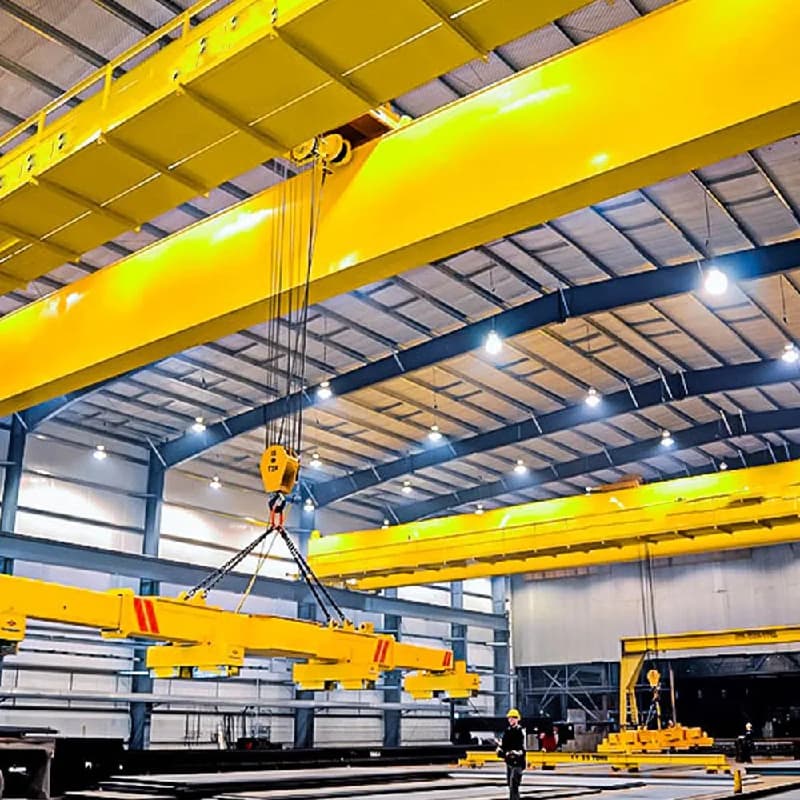
- Headroom: This is a key advantage of the Double Girder Design. The hoist is mounted between the girders, minimizing the distance from the rail top to the hook. This maximizes usable lift height under a given ceiling—a critical factor for stacking in high-bay warehouses.
- Clearances: Adequate space must be maintained from walls, columns, mezzanines, and other equipment to ensure safe travel.
Chapter 2: The Technical Rationale for the Double Girder Design in Warehouses
Why is the Double Girder Design the industry-preferred solution for heavy-duty Indoor Overhead Crane applications like a 35-ton warehouse crane?
2.1 Structural Integrity and Load Path
The twin-girder configuration creates a balanced, box-like bridge structure. This offers superior resistance to bending and torsional forces compared to a single girder, especially under full load across a long span. The result is minimal deflection, ensuring the trolley runs smoothly even with 35 tons suspended, which is crucial for precise load positioning.
2.2 Enhanced Hoist Performance and Maintenance
On a double girder crane, the hoist and trolley assembly travels on rails mounted on top of the main girders. This allows for:
- Larger Hoist Machinery: Accommodating more robust hoisting mechanisms, essential for smooth, controlled lifting of 35-ton loads.
- Easier Maintenance Access: Key components like gearboxes, motors, and drum assemblies are more accessible for inspection and servicing from a platform on the crane bridge.
- Cleaner Load Path: The hoist ropes descend cleanly between the girders, reducing the risk of interference.
2.3 Platform for Advanced Features
The design provides a natural, stable platform for essential and advanced features:
- Walkways and Maintenance Platforms: Safe, integrated walkways alongside the girder allow personnel to perform inspections and minor maintenance.
- Cabin or Remote Operation: An operator’s cabin can be mounted securely to the bridge structure. Alternatively, the design readily supports advanced radio remote control systems for floor-operated flexibility and safety.
- Auxiliary Hoists: A smaller secondary hoist can be easily fitted for handling lighter loads, improving overall Material Handling Efficiency.
Chapter 3: Specification Deep Dive: Components That Define Performance
Selecting a crane involves specifying its core subsystems. Each choice impacts performance, safety, and cost.
3.1 Hoisting Mechanism
- Rope Hoist vs. Chain Hoist: For 35 tons, a wire rope hoist is standard due to its strength, durability, and smooth operation. Look for features like a redundant braking system (primary motor brake + secondary mechanical load brake) and variable frequency drives (VFDs) for impeccable speed control.
- Lifting Speed: Determine the optimal speed for your workflow. VFDs allow for soft starts and stops, crucial for preventing load swing on delicate or tall items.
3.2 Travel Motions: Bridge and Trolley
- Drive Configuration: For spans over ~25 meters, dual-end bridge drive (motors on both sides) is essential to prevent crabbing (twisting of the bridge).
- Control Technology: VFDs on all travel motions are no longer a luxury but a standard for high-performance Indoor Overhead Cranes. They enable precise positioning, reduce mechanical shock, and significantly lower maintenance costs.
3.3 Electrical Systems and Control
- Power Supply: Closed conductor bar systems (safe sliding contact line) are recommended for clean, reliable power delivery in warehouse environments, superior to cable reels or festoon systems for long travel distances.
- Control Interface: Choices range from pendant push-button stations to full radio remote controls or operator cabins. The choice affects manpower requirements and operational visibility.
3.4 Safety Systems: A Non-Negotiable Layer
A modern crane is defined by its safety features. Essential systems include:
- Overload Limit Switch: Prevents the hoist from lifting beyond its rated 35 Ton Capacity.
- Limit Switches for Travel: Prevents the bridge, trolley, and hoist from over-traveling.
- Anti-Collision Systems: Critical if multiple cranes operate on the same or parallel runways.
- Emergency Stop Circuits: Strategically placed for immediate power cutoff.
Chapter 4: The Installation Ecosystem: Runway, Building, and Integration
The crane is only as good as its foundation. The warehouse construction must support it.
4.1 Runway System Design
This is often the most overlooked yet critical cost factor. It includes:
- Runway Beams: Steel beams (often wide-flange sections) that support the crane rails. They must be designed for the dynamic loads of the moving crane.
- Crane Rails: Precision steel rails (e.g., A120 or QU80 profile) mounted on the runway beams for smooth travel.
- End Stops and Bumpers: To absorb energy at the ends of travel.
4.2 Building Interface and Structural Reinforcement
Your building’s columns and foundations must bear the imposed loads (crane weight + load + impact factors). A qualified structural engineer must verify this. In new warehouse construction, the crane load data must be integrated into the structural design from the outset. Retrofits may require column strengthening.
4.3 Integration with Warehouse Operations
Consider how the crane interacts with:
- Storage Racking: Lift heights and hook approach must align with rack heights and aisles.
- Loading Docks: Can the crane service trucks directly, or is it for internal transfer only?
- Other MHE (Material Handling Equipment): Coordinate workflows with forklifts, AGVs, and conveyors.
Chapter 5: Total Cost of Ownership (TCO) and the Procurement Process
The lowest bid price rarely equals the lowest lifetime cost.
5.1 Evaluating TCO
- Initial Capital Cost: Purchase, delivery, installation, and commissioning.
- Operational Cost: Energy consumption, which is lower with efficient motors and VFDs.
- Maintenance Cost: Regular inspections, preventive maintenance, and parts replacement. A well-built Double Girder Design with quality components will have lower long-term maintenance costs.
- Downtime Cost: The business impact of crane failure. Reliability is an economic feature.
5.2 The Procurement Checklist
When evaluating suppliers like Dongqi Crane, consider:
- Design Compliance: Does it meet all relevant national and international standards (CMAA, FEM, DIN, GB)?
- Manufacturing Quality: What are the welding procedures, material certifications, and quality control protocols?
- Technical Support: Availability of installation supervision, commissioning services, and training.
- After-Sales Service: Clarity on warranty, availability of spare parts, and service response time.
Conclusion: Partnering for a Strategic Asset
Specifying a 35T Double Girder Overhead Travelling Crane for your indoor warehouse is a multifaceted engineering and business decision. It requires balancing immediate project constraints with long-term operational goals. The Double Girder Design stands out as the robust, reliable, and efficient solution for heavy-duty, high-cycle Material Handling Efficiency in a demanding warehouse setting.
At Dongqi Crane, our role is to be your technical partner in this process. We move beyond supplying equipment to delivering a certified, performance-guaranteed material handling system. We provide the detailed documentation, load charts, and structural data you need for your warehouse construction team, and we back our cranes with global support.
Your Next Step:
Begin your project with a data-driven conversation. Gather your preliminary load data, span, lift height, and operational profile. Contact Dongqi Crane’s engineering team for a preliminary technical review and a specification worksheet tailored to the Indoor Using 35T Double Girder Overhead Travelling Crane. Let’s ensure your investment is built on a foundation of clarity, precision, and professional expertise.
