
2025 Jib Crane Market Insights & Your Guide to the Right Fit
Here at Dongqi Crane, we partner with industries every day to solve very specific material handling challenges. Jib cranes, a core part of our offering, are not designed to move loads across vast factories, but to bring unparalleled efficiency, safety, and ergonomics to a single, critical workstation. As we look back on 2025, the configurations chosen by our customers provide a clear, practical blueprint of what industries truly need to optimize their workspaces.
Where Our Jib Cranes Are Making a Difference: Core Applications
Our products serve as essential tools in environments where precise, repetitive lifting within a defined circle is key to a smooth workflow. We commonly see them driving value in:
- Manufacturing & Machining Cells: For loading and unloading CNC machines, lathes, and presses, or feeding parts onto assembly lines. The goal here is to eliminate manual strain and keep the production rhythm steady.
- Maintenance & Service Bays: In automotive repair, heavy equipment shops, or facility maintenance areas for safely handling engines, motors, or bulky components. Flexibility and ease of use are paramount.
- Packaging & Staging Areas: For lifting bags, drums, or finished goods onto pallets, conveyors, or trucks in warehouses and distribution centers.
- Fabrication & Welding Shops: To position steel beams, plates, and other materials for cutting, welding, or assembly, where durability is critical.
What the 2025 Data Tells Us About Real-World Needs
The 2025 sales data for Dongqi Crane’s jib cranes reveals a clear, structured demand pattern from the market. Far from random, the distribution of configurations forms a distinct hierarchy that maps directly onto the operational priorities and financial logic of different industries. This pattern can be visualized as a “Core & Specialization” model.
The “Core & Specialization” Demand Hierarchy
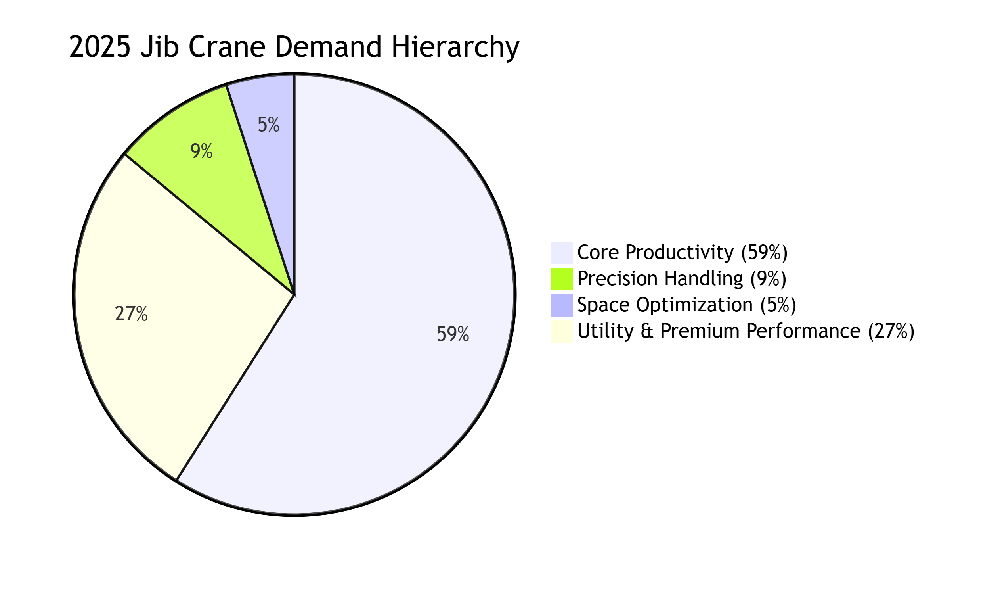
The following diagram illustrates how customer needs are segmented, from the broad, foundational requirements to highly specific, niche applications:
Layer 1: The Foundational Core (The Productivity Engine)
- Data: The configuration BZ + Electric Chain Hoist alone represents approximately 59% of column-mounted sales.
- Need Decoded: This is the universal baseline need. Customers across general manufacturing, assembly, and machining are primarily investing in a fundamental upgrade: replacing manual labor or inefficient methods with basic, reliable mechanization. The need is not for extreme precision or specialization, but for consistent, motorized lifting power to improve throughput, reduce worker fatigue, and establish a safe, repeatable workflow at a critical workstation. This is the essential “productivity engine” for countless workshops.
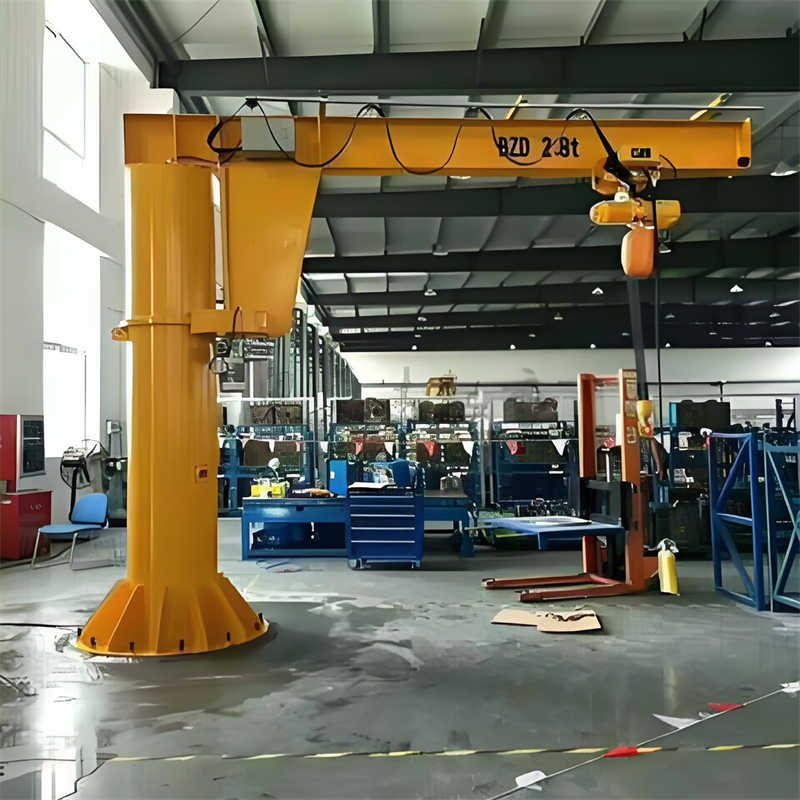
Layer 2: The Critical Specialist (Solving a Specific Pain Point)
- Data: The BZ + Electric Hoist + Vacuum Lifter configuration represents a significant ~9% of column-mounted sales.
- Need Decoded: This is a targeted investment to solve a high-cost problem. Customers in glass, sheet metal, and advanced panel processing are not just buying a crane; they are buying a risk-mitigation and quality-assurance system. The core need here is to eliminate the immense costs associated with surface damage, material breakage, and workplace accidents inherent in manually handling large, smooth, and expensive materials. This configuration directly protects profit margins and product integrity.
Layer 3: The Constrained Optimizer (When Space is the Priority)
- Data: The complete Wall-Mounted (BX) series accounts for a stable ~4.5% of total sales.
- Need Decoded: This segment addresses a physical constraint, not a load-handling one. For customers in tight repair bays, along crowded assembly walls, or in small-batch fabrication shops, floor space is a premium asset that cannot be sacrificed. The need is for full lifting capability with a zero floor-space footprint. The choice of a wall-mounted crane is a direct response to facility layout limitations, prioritizing spatial efficiency.
Layer 4: The Value & Performance Tiers (Meeting Extreme Conditions)
- Data: The remaining configurations (Manual Hoist, European-Style, Wire Rope Hoists) collectively form the final segment.
- Need Decoded: This tier bifurcates into two clear value propositions:
- The Utility Need (~9% Manual): For maintenance facilities, utilities, or low-volume operations, the need is for occasional, cost-effective lifting aid. The priority is low upfront cost and operational simplicity for tasks where frequent, powered operation is unnecessary.
- The Performance Need (~18% European/Wire Rope): For steel service centers, heavy fabrication, and high-cycle production, the need is for superior durability and performance under extreme conditions. Customers here are investing in a higher duty cycle, greater reliability, and smoother control to minimize downtime in demanding applications, focusing on total cost of ownership over initial price.
Connecting the Data to Your Strategy
This hierarchical analysis shows that customer selection is a rational match between their primary operational constraint (cost, space, material type, duty cycle) and the configuration designed to solve it.
- If your target market seeks basic efficiency gains, the core BZ electric chain hoist configuration is your foundational product.
- To engage high-value manufacturing sectors, demonstrating expertise in precision attachment solutions like vacuum lifters is key.
- For marketing to businesses in constrained spaces, highlighting the space-saving design of the BX series directly addresses their chief concern.
Would you like to explore how this demand hierarchy might shift when analyzed by specific geographic regions or business sizes? Providing such parameters could yield even more targeted strategic insights.
How to Choose the Right Configuration for Your Operation
Based on what we’ve learned from serving countless applications, we recommend focusing on these key questions:
- What are you lifting? Define the maximum weight, typical shape, and surface sensitivity of your loads. Standard pallets or parts? An electric chain hoist is likely perfect. Large, polished sheets? This directly points to the need for a vacuum lifter attachment.
- How often are you lifting? For high-frequency, production-oriented tasks, the productivity gain from an electric hoist is essential. For occasional, maintenance-focused use, a manual hoist may be a practical choice.
- Where is it being installed? Do you have open floor space for a freestanding column (BZ), or is the workstation against a wall, making a wall-mounted (BX) model the only logical fit?
- What is your operational pace? For a station that runs continuously, investing in a hoist with a higher duty cycle (like our European-style options) ensures long-term reliability and less downtime.
At Dongqi Crane, we view these trends not just as sales data, but as a collective lesson in solving real problems. Our role is to translate these insights into the right configuration for your unique challenge, ensuring your investment delivers daily value in safety, efficiency, and ergonomics.
Let’s configure your solution. To move from general trends to your specific requirements, please share key details about your intended application: the load weight/size, desired coverage radius, and typical daily lift frequency. With this, we can provide a precise and actionable recommendation.
