
2025 Annual Gantry Crane Sales Summary & Customer Selection Guide
Introduction
As we close the chapter on 2025, we at Dongqi Crane reflect on a dynamic and insightful year in the gantry crane market. Our sales portfolio has provided a clear window into evolving industry demands, customer priorities, and the diverse applications driving growth across various sectors. This document serves a dual purpose: to summarize the key trends observed in our 2025 sales distribution and, more importantly, to translate these insights into practical guidance for potential clients embarking on their own equipment selection journey. By analyzing the proportional popularity of our different gantry crane types, we can identify prevailing market forces and help you, the customer, make a more informed decision that aligns perfectly with your operational needs and budget.
2025 Sales Performance Overview
The past year demonstrated robust demand for gantry solutions, with our sales spanning a spectrum from highly specialized heavy-duty machines to versatile, entry-level equipment. A notable pattern emerged, highlighting distinct customer segments and their preferred solutions.
- The Dominance of Versatility and Accessibility: The most significant trend was the overwhelming popularity of our Portable Gantry Cranes, which constituted the largest segment of our unit sales, representing over three-quarters of our total gantry crane volume. This decisive majority underscores a massive demand for flexible, cost-effective, and easily deployable lifting solutions.
- Steady Demand for Established Workhorses: Combined, our MG-type (General-Purpose Gantry Cranes) and MH-type (Electric Hoist Gantry Cranes) represented a substantial and stable portion of our sales, together accounting for approximately one-fifth of the total units sold. The MG-type slightly edged out in units compared to the RTG, but both MG and MH types represent the core of traditional, robust gantry applications.
- The Niche for Specialized Power: Our Rubber-Tired Gantry (RTG) Crane, designed specifically for container handling, accounted for a smaller, yet highly significant portion of sales. This reflects its position as a specialized, high-productivity solution for specific, high-volume logistics and port environments.
This distribution is not merely a sales record; it is a narrative about market needs. The high percentage of portable models speaks to the growth in small to medium enterprises, workshops, maintenance departments, and construction sites requiring temporary or flexible lifting. The consistent share held by MG and MH types confirms the ongoing, irreplaceable role of standard gantry cranes in fundamental material handling across industries like steel, lumber, and manufacturing. The presence of the RTG, though smaller in percentage, highlights the continuous development and modernization in global logistics and containerized freight.
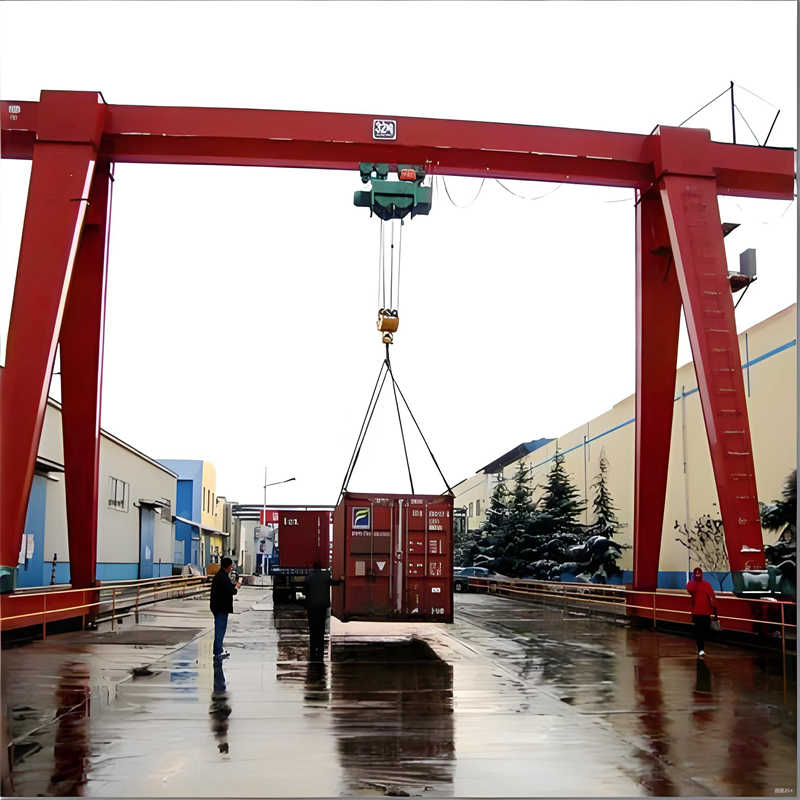
Detailed Product Line Analysis and Market Trends
1. Portable Gantry Cranes: The Champion of Flexibility (Approx. 78% of Sales)
This category’s dominance is the defining story of 2025. Customers are increasingly prioritizing adaptability, ease of installation, and lower initial investment. Portable gantries deliver exactly that. They require no permanent foundation, can be assembled and disassembled quickly, and are ideal for:
- Job Sites and Workshops: Where lifting needs are temporary or mobile.
- Maintenance and Repair Bays: For servicing machinery, vehicles, or engines.
- Limited-Space Applications: Their relatively lightweight and adjustable span make them perfect for constrained areas.
- Low-Capacity, Frequent Lifting: Tasks under 10-20 tons where a permanent crane is not justified.
The sales percentage indicates a market shift towards decentralized, project-based lifting capabilities. Companies are valuing the ability to move equipment to the task, rather than moving the task to a fixed crane. For Dongqi Crane, this has meant focusing on providing robust yet lightweight designs, easy-to-use locking systems, and models with adjustable height and span to maximize utility.
2. MG-Type & MH-Type Gantry Cranes: The Reliable Backbone (Combined ~20% of Sales)
These models represent the traditional heart of industrial gantry crane applications. Their steady sales share confirms that for many core operations, nothing replaces a dedicated, permanent, and robust structure.
- MG-Type (General-Purpose Double-Girder Gantry): Preferred for heavier-duty, continuous use in outdoor yards, storage areas, and loading docks. Its double-girder design offers superior stability for loads in the 5-50 ton range. Customers choosing this type typically have a fixed, long-term material flow, require higher lifting heights or spans, and may need to integrate specialized hooks or grabs. Its sales stability reflects ongoing investment in industrial infrastructure, warehousing, and bulk material handling.
- MH-Type (Electric Hoist Gantry Crane): This is often the go-to solution for factory workshops, assembly lines, and indoor/outdoor storage facilities requiring efficient, motorized lifting. The option for box (better manufacturing quality) or truss (better wind resistance) structures allows customization for the environment. The integrated CD1/MD1 electric hoist provides reliable and precise load control. Its A3-A5 duty cycle suitability makes it perfect for applications with regular but not excessively intense cycling. This model appeals to businesses seeking a significant upgrade from manual lifting or portable cranes for a fixed workstation, offering excellent value and reliability.
The combined market share of these types indicates healthy activity in manufacturing expansion, warehouse modernization, and renewable energy projects (e.g., handling wind turbine components).
3. RTG (Rubber-Tired Gantry Crane): The Specialized Performer (Approx. 3% of Sales)
While representing the smallest percentage in unit terms, the RTG is a high-value, strategic product. Its sales are driven by specific, large-scale projects:
- Container Terminals and Inland Depots: For stacking and handling shipping containers.
- Major Intermodal Logistics Hubs: Where efficient container transfer is critical.
- Large-Scale Project Cargo: Some models are adapted for heavy lifting in construction and shipbuilding.
The investment in an RTG signals a commitment to high-volume, standardized cargo handling. Its rubber-tired mobility offers more flexibility within a yard compared to rail-mounted options. This niche but vital share demonstrates Dongqi Crane’s capability to serve the high-end logistics and port equipment market.
Comprehensive Guide for Potential Customers
Choosing the right gantry crane is a critical investment decision. Here is our tailored advice, distilled from the trends we observed in 2025:
1. For Startups, SMEs, and Flexible Operations:
- Primary Recommendation: Portable Gantry Crane.
- Why: If your needs are variable, your space is shared, or your budget is constrained, start here. It offers the lowest barrier to entry, tremendous flexibility, and can handle a vast array of light to medium-duty tasks. It’s the perfect “first crane” or a supplementary tool for larger facilities.
- Key Questions: What is your maximum required capacity? How often will you need to move the crane? What are the space limitations (door height, floor space)?
2. For Established Factories, Warehouses, and Fixed Material Handling Points:
- Primary Recommendation: Evaluate between MH-Type and MG-Type.
- Choose MH-Type (Electric Hoist Gantry) if: Your lifting needs are consistent at a single workstation, capacities are low to medium (typically up to 20 tons), and you need reliable, motorized lifting. It’s ideal for production lines, packing areas, and maintenance stations with a defined workflow.
- Choose MG-Type (General-Purpose Gantry) if: You handle heavier loads (up to 50 tons+), require longer spans or higher lifts, operate in an exposed outdoor yard, or need to use specialized lifting attachments. It is the standard for scrap yards, timber yards, and heavy equipment storage.
- Key Questions: What is the duty cycle (how many hours/day, lifts/hour)? What are the environmental conditions (outdoor wind, indoor clean room)? Is the location permanent? What is the exact weight and dimensions of the typical load?
3. For Logistics Companies, Port Operators, and Large-Scale Industrial Projects:
- Primary Recommendation: RTG or Heavy-Duty MG Gantry.
- Choose RTG if: Your core business is the movement, stacking, and loading/unloading of standard ISO shipping containers. Its mobility and high stacking capability are unmatched for this purpose.
- Choose a Customized Heavy-Duty MG Gantry if: Your project involves oversized, non-containerized cargo like prefabricated building sections, bridge girders, or industrial modules. We can engineer solutions with very high capacity and reach.
- Key Questions: Is container handling the primary task? What are the required stacking heights and yard dimensions? What is the long-term throughput goal?
General Selection Principles for All Customers:
- Capacity & Span: Always buy a crane with a rated capacity and span that exceeds your current maximum need to account for future growth and ensure a safety margin.
- Duty Cycle: Match the crane’s work class (e.g., A3 for light use, A5 for heavy use) to your actual operational intensity. An underspecified crane will wear out quickly; an overspecified one is an unnecessary capital expense.
- Power Supply & Environment: Ensure your site has the correct power (380V 50Hz standard for MH/MG). Consider corrosion protection for coastal areas, special paints for chemical environments, and wind resistance for exposed sites.
- Supplier Support: Investigate the manufacturer’s reputation for quality control, availability of spare parts, and technical support. A crane is a long-term asset; reliable after-sales service is crucial.
Conclusion
The 2025 sales landscape for Dongqi Crane reveals a market that values both specialization and adaptability. While versatile, portable solutions are in the highest demand by volume, the sustained need for robust MG/MH gantries and the strategic role of RTGs paint a picture of a diverse and healthy industrial ecosystem.
We hope this summary and guide empowers you in your selection process. At Dongqi Crane, we are committed to providing not just equipment, but the right lifting solution. Our product range from the versatile portable to the mighty RTG ensures we can meet your unique challenge. We encourage you to contact our technical sales team to discuss your specific application, site conditions, and operational goals. Let us help you translate these market insights into a tangible, productive, and profitable investment for your business.
