
Smart Manufacturing New Era: How a 2-Ton KBK Flexible Crane Empowers Automotive Parts Production Line Upgrades
Introduction: The Quiet Revolution Hanging Above the Assembly Line
Walk into any modern automotive parts plant in 2026, and you may notice something that was not there a decade ago. Hanging from the ceiling, snaking above workstations, and gliding silently between production cells are lightweight, modular crane systems that look nothing like the hulking bridge cranes of traditional factories. These are KBK flexible crane systems—and they are quietly reshaping how automotive components move through the production process.
The automotive industry is undergoing its most dramatic transformation in a century. With vehicle model refresh cycles shrinking from 5–7 years to just 2–3 years, production lines must be reconfigured with unprecedented frequency. Multi-model mixed-line production, just-in-time parts delivery, and millimeter-level assembly precision have become non-negotiable competitive requirements. Traditional overhead cranes—with their fixed layouts, heavy infrastructure demands, and limited adaptability—struggle to keep pace.
Enter the KBK flexible crane. In recent years, KBK crane installations have increased by approximately 15% annually across global manufacturing facilities, reflecting the market’s recognition of their unique value proposition. The global overhead crane market, already valued at approximately USD 5.24 billion in 2025, continues to grow at a compound annual rate of 5.3%, driven substantially by the manufacturing sector’s demand for smarter, more flexible material handling solutions. Within this expanding market, flexible KBK systems represent the fastest-growing segment—projected to grow at 1.5 to 2 times the rate of the traditional crane market as manufacturers prioritize adaptable production lines and rapid layout reconfiguration.
This article focuses on a specific yet powerful configuration: the 2-ton KBK flexible crane system, and how it enables automotive parts manufacturers to upgrade their production lines for the demands of 2026 and beyond. We explore the technical architecture of KBK systems, examine real-world applications across the automotive parts production chain, and demonstrate how these seemingly modest cranes deliver transformative gains in efficiency, space utilization, and production flexibility.
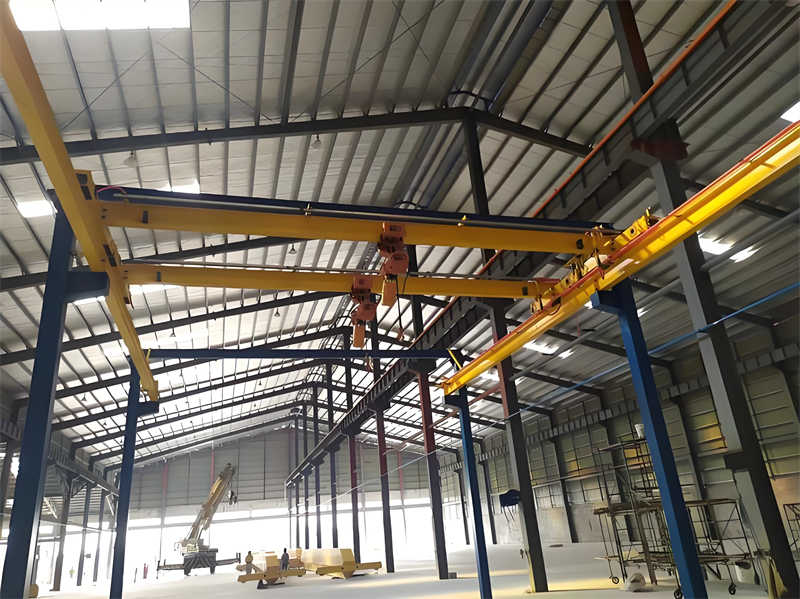
About Dongqi Crane: As a Sino-New Zealand joint venture headquartered in China’s renowned “Cradleland of Cranes” in Changyuan, Henan Province, Dongqi Crane operates a 240,000-square-meter manufacturing facility with over 3,600 employees, including 500 technicians and more than 70 senior engineers. With an annual production capacity exceeding 10,000 crane sets and products exported to 96 countries, Dongqi Crane combines European design philosophy with Chinese manufacturing scale. Our product portfolio includes a comprehensive range of KBK flexible crane systems, designed to FEM and ISO standards, with CE certification available for international markets.
Part 1: The Automotive Parts Production Challenge—Why Traditional Cranes Fall Short
1.1 The New Reality of Automotive Manufacturing
Today’s automotive parts production environment demands capabilities that traditional overhead crane systems were never designed to deliver.
First, production variety has exploded. A single assembly line may now produce components for electric vehicles, hybrid powertrains, and conventional internal combustion engines—sometimes on the same shift. This means material handling systems must accommodate different part sizes, weights, and handling requirements without requiring major reconfiguration between changeovers.
Second, space is at a premium. Automotive parts plants, particularly those in established industrial zones or retrofitted into existing buildings, operate within fixed floor areas. Every square meter of ground space occupied by crane columns, machine foundations, or storage areas is space that cannot host a production workstation. A Japanese automotive plant that introduced KBK systems was able to add 15% more production stations within the same factory footprint—equivalent to expanding the plant without laying a single brick.
Third, precision expectations have risen dramatically. Modern electric vehicle battery packs, sensor assemblies, and precision-machined drivetrain components require handling with sub-millimeter positioning accuracy. Dropping a battery module or scratching a machined surface during handling is not an option.
Fourth, production velocity continues to accelerate. Just-in-time and just-in-sequence manufacturing means parts must arrive at the right workstation at the right moment. Any bottleneck in material handling creates cascading delays throughout the production chain.
1.2 The Limitations of Traditional Cranes
Traditional bridge cranes and fixed jib cranes, while proven for heavy, centralized lifting tasks, exhibit fundamental limitations in the modern automotive parts environment:
Fixed Layouts Inhibit Flexibility: A conventional overhead crane is designed for a specific runway layout, typically covering a large rectangular bay. When the production line layout changes—as it frequently does during model changeovers—the crane cannot be easily reconfigured. Relocating a traditional crane system can take weeks of downtime and incur costs equivalent to a significant fraction of the original investment.
Space Inefficiency: Top-running bridge cranes require substantial building headroom (typically 9+ meters for industrial configurations) and impose high wheel loads that demand robust—and expensive—runway beams and supporting columns. These columns occupy valuable floor space that could otherwise host production equipment.
Centralized Service Creates Bottlenecks: A single large crane serving an entire production bay may service multiple workstations that require simultaneous lifts, creating a “crane waiting for hook, hook waiting for work” bottleneck. In stamping operations, this can extend die change times from what should be minutes to what becomes hours.
Precision Limitations Under Dynamic Loads: The start-stop shock loading of traditional contactor-controlled cranes creates load swing and positioning inaccuracy. When a precision-machined transmission housing must be aligned with a fixture to within a millimeter, a swinging load on a traditional crane simply cannot meet the requirement.
Dongqi Crane’s Engineering Observation: Through our project experience across automotive parts suppliers in Asia, the Middle East, and beyond, we have observed that facilities relying on traditional crane-only approaches typically experience 15–25% lower throughput during product changeovers and incur higher part damage rates compared to those implementing flexible, modular handling systems. The question is no longer whether to adopt flexible material handling—it is how to deploy it most effectively.
Part 2: Understanding the 2-Ton KBK Flexible Crane—Architecture and Capabilities
2.1 What Is a KBK Crane System?
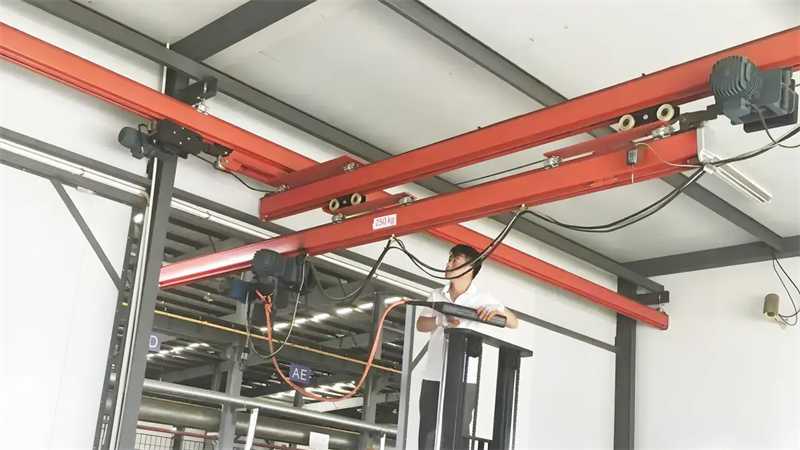
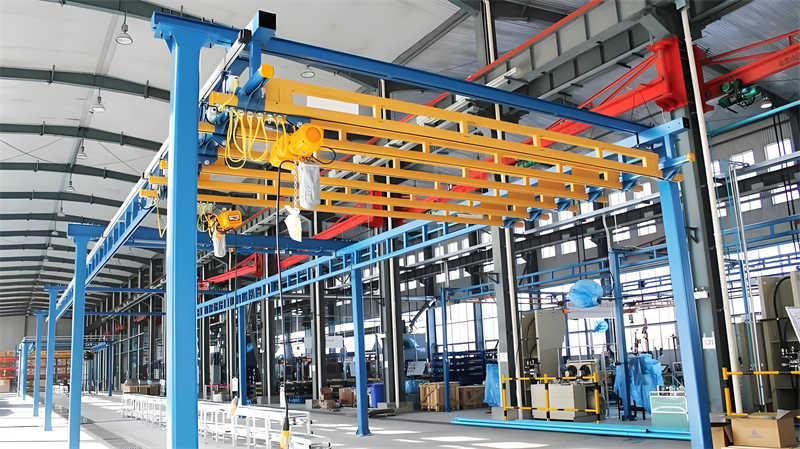
KBK—derived from the German “Kombiniertes Brückenkran” (Combined Bridge Crane)—is a modular, lightweight crane system composed of standardized components that can be assembled into countless configurations. Think of it as “industrial LEGO” for material handling: standard track sections, suspension components, trolleys, and hoists can be combined to create monorail systems, single-girder cranes, double-girder cranes, or complex multi-directional handling networks—all suspended from the building structure.
The system is characterized by:
- Modular Track Components: Cold-rolled steel or aluminum profile sections available in multiple sizes, connected by bolted joints that allow rapid assembly, disassembly, and reconfiguration.
- Suspended Installation: The entire system hangs from the roof structure via threaded rod hangers or clamping brackets, requiring zero floor-mounted supports.
- Enclosed Track Profile: The running surface is inside the profile, protected from dust and debris, ensuring consistently low rolling resistance.
- Manually or Electrically Operated Trolleys: Loads are moved by smooth-rolling trolley assemblies. For 2-ton configurations, electric hoists with push-button or radio remote control are standard.
The 2-ton capacity range is particularly significant for automotive parts applications. It covers the majority of component handling tasks—engine blocks, transmission assemblies, suspension subframes, battery modules, stamping dies, and sub-assemblies—without over-engineering the system. A 2-ton KBK crane provides ample capacity for these tasks while maintaining the lightweight, flexible characteristics that define the system’s value.
2.2 Core Technical Advantages
Space Liberation Through Ceiling-Level Installation:
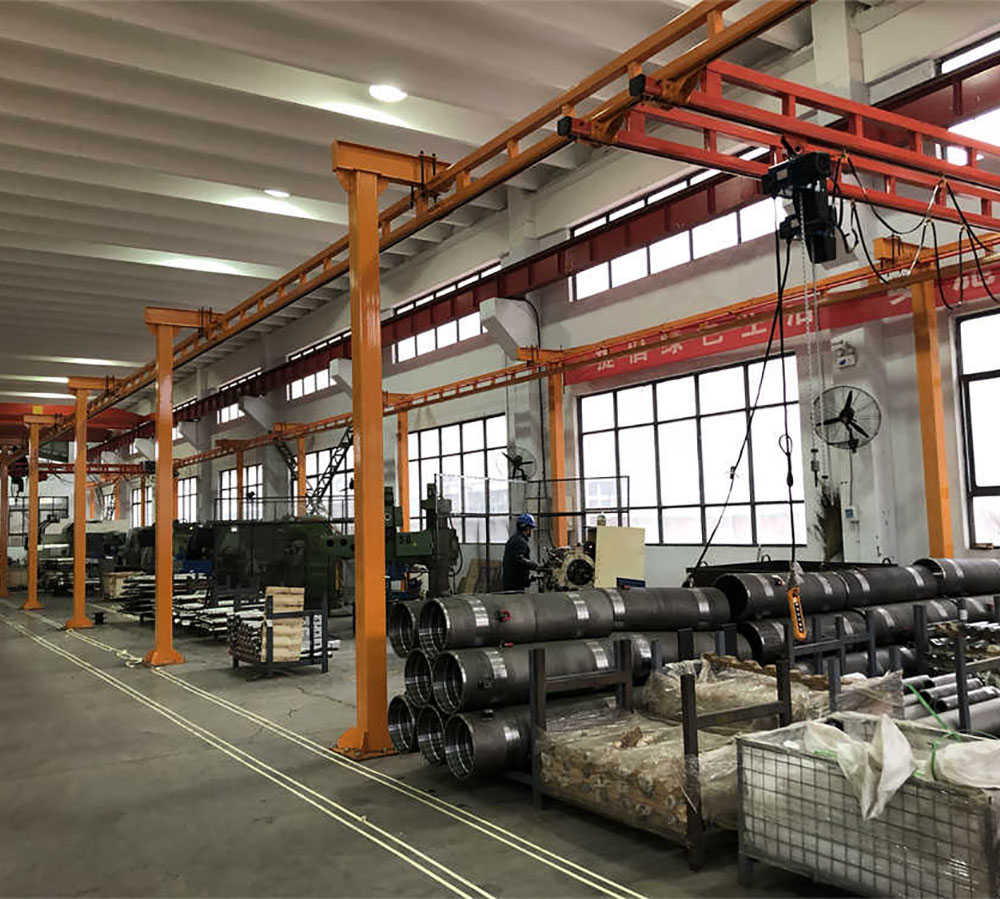
KBK track mounts directly to the ceiling or roof structure, occupying zero floor space. The track can be routed along ceiling beams, around columns, and through openings—following any path the material flow demands. This ceiling-level approach delivers multiple benefits simultaneously: freeing ground space for additional production workstations, eliminating trip hazards and floor obstructions, and preserving clear sightlines across the shop floor for improved safety and supervision. In automotive parts plants where floor space is often the binding constraint on production capacity, this single characteristic can justify the entire investment.
Flexible Layout That Adapts to Production Changes:
The modular nature of KBK systems means track layouts can be modified, extended, or completely reconfigured with minimal disruption. When a new vehicle platform requires changes to the production line layout, KBK components can be unbolted, rearranged, and reassembled—much like reconfiguring a model railway. Standard KBK systems allow layout modifications to be completed during planned maintenance windows rather than requiring multi-week shutdowns. For automotive parts suppliers serving multiple OEM customers with different component requirements, this adaptability is a strategic asset.
Precision Handling with Millimeter-Level Control:
Modern KBK systems, when equipped with appropriate hoist technology and controls, achieve positioning accuracy that traditional overhead cranes cannot match. Data from automotive applications confirms that KBK crane systems equipped with servo-controlled intelligent lifting devices can achieve positioning accuracy of ±1mm, which meets the stringent precision handling requirements of modern automotive parts manufacturing. This level of control is essential for tasks such as placing a machined transmission housing onto a fixture, aligning a battery module into a vehicle chassis, or setting a precision stamping die into a press—operations where even slight misalignment can damage expensive components.
Smooth, Ergonomic Operation:
The low-friction enclosed track design means operators can move heavy loads with surprisingly little effort. A 500 kg component suspended from a properly designed KBK system can be positioned by hand with minimal physical exertion. For 2-ton loads, electric travel and hoist motions with variable speed control provide effortless, precise control. This ergonomic advantage directly impacts productivity: operators who are not physically fatigued from wrestling with loads maintain higher throughput and make fewer positioning errors.
Proven Safety Architecture:
KBK systems incorporate multiple safety features as standard: overload protection that prevents lifting beyond rated capacity, emergency stop systems accessible at operator control stations, secondary fall-arrest devices that capture the load in the unlikely event of suspension failure, and limit switches preventing over-travel. These features collectively reduce the risk of load drops and collisions—critical in busy automotive parts facilities where personnel and expensive equipment are always nearby.
2.3 The 2-Ton Sweet Spot: Why This Configuration Dominates Automotive Parts Applications
The 2-ton capacity represents an engineering sweet spot for KBK systems in automotive parts production. It provides sufficient lifting capacity for the most common handling tasks while maintaining the lightweight, ceiling-suspended characteristics that differentiate KBK from heavier bridge cranes.
KBK crane systems are available in multiple capacity grades to suit a range of load requirements, and the lightweight models—particularly those in the sub-2,000 kg range—demonstrate the strongest demand growth profile in modern automotive manufacturing settings.
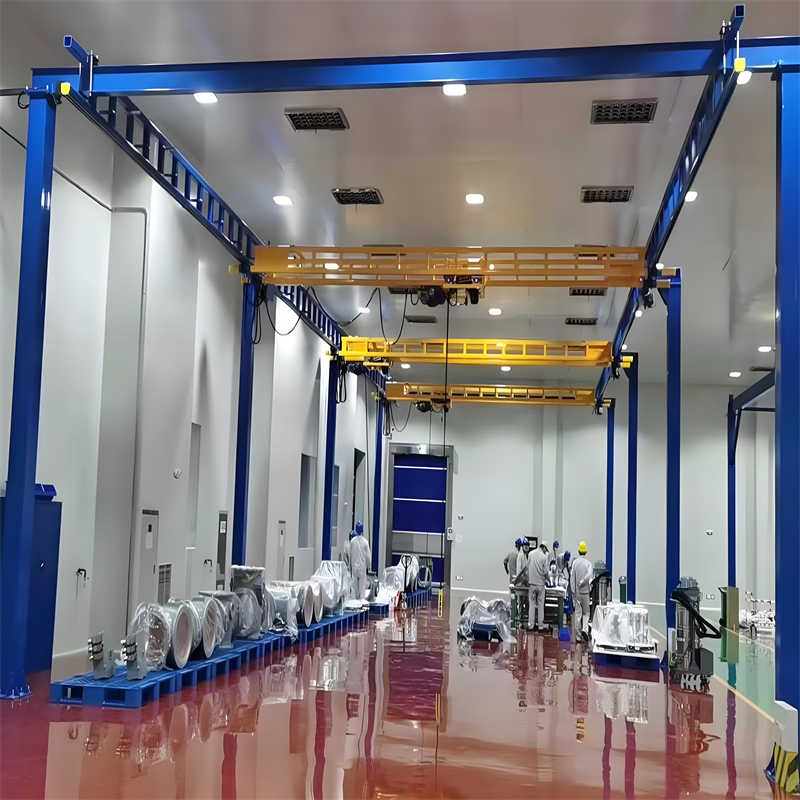
Key application mapping for 2-ton KBK cranes in automotive parts production:
| Application | Typical Load Weight | Handling Requirement | KBK Configuration |
|---|---|---|---|
| Engine block/sub-assembly handling | 100–800 kg | Precision placement on assembly fixtures | Single-girder with electric chain hoist, servo control |
| Transmission/gearbox assembly | 150–600 kg | Multi-station transfer with rotation capability | Double-girder with articulated lifting beam |
| Suspension subframe handling | 100–400 kg | High-frequency transfer between welding cells | Monorail loop with multiple pick-and-place stations |
| EV battery module placement | 200–800 kg | Ultra-precise positioning, anti-sway control | Single-girder with smart hoist, ±1mm positioning |
| Stamping die handling (small-medium) | 500–2,000 kg | Die change at press, precision alignment | Rigid KBK with servo hoist, load monitoring |
| Brake and driveline component assembly | 100–500 kg | Ergonomic assisted lift, multi-directional positioning | Single-girder with articulated arm attachment |
Part 3: Real-World Impact—How 2-Ton KBK Systems Transform Automotive Parts Production
3.1 Efficiency Gains: Quantifiable Improvements in Production Velocity
The most immediate and measurable benefit of deploying 2-ton KBK crane systems is the acceleration of material handling. In automotive parts production, where a production line may require dozens or even hundreds of component transfers per shift, even small improvements in handling time compound into significant throughput gains.
Industry data consistently demonstrates that implementing KBK crane systems can increase productivity by up to 30% in assembly and material handling operations.
This productivity improvement stems from several interconnected factors:
Reduced Transfer Time: Traditional crane operations involve waiting for the shared crane resource, slow travel speeds, and imprecise positioning that requires multiple attempts. A dedicated KBK system eliminates the waiting, provides faster cycle times, and enables first-time-correct placement. In one truck chassis production line, a combination of dual-hook synchronized KBK crane with two-speed travel functionality reduced individual component transfer time by 40%.
Parallel Operations: Because KBK systems can be deployed as independent modules serving individual workstations or production cells, multiple transfers can occur simultaneously without interference. This contrasts with centralized crane systems where all workstations compete for a single shared resource.
Faster Changeovers: The line reconfiguration advantage of KBK systems directly impacts production efficiency. Real-world data shows that production line changeover time can be reduced by 67% when modular KBK systems replace fixed crane installations. For automotive parts suppliers producing components for multiple vehicle platforms, this translates to more productive hours and faster response to customer demand fluctuations.
Seamless Integration with Automated Systems: KBK systems integrate effectively with automated guided vehicles (AGVs) and other automated material transport systems. A Chinese new energy vehicle manufacturer deployed KBK systems that coordinate with AGVs to create a seamless “air plus ground” material flow, reducing overall logistics cycle time by 30%.
3.2 Space Utilization: Creating Productive Capacity Without Construction
For automotive parts plants constrained by their existing building footprint, the space utilization benefits of ceiling-mounted KBK systems are transformative.
A German automotive parts supplier that introduced modular KBK crane systems documented two quantifiable improvements: production line changeover time decreased by 67%, and factory space utilization improved by 30%. These improvements were achieved without any building expansion. The space previously occupied by floor-based material handling equipment, staging areas, and circulation paths for forklifts was reclaimed for additional production workstations.
KBK crane systems unlock space in multiple ways:
Eliminating Floor Obstructions: Forklift traffic and floor-based handling create safety zones and circulation paths that consume productive floor area. Moving material transport to the ceiling eliminates these ground-level space requirements.
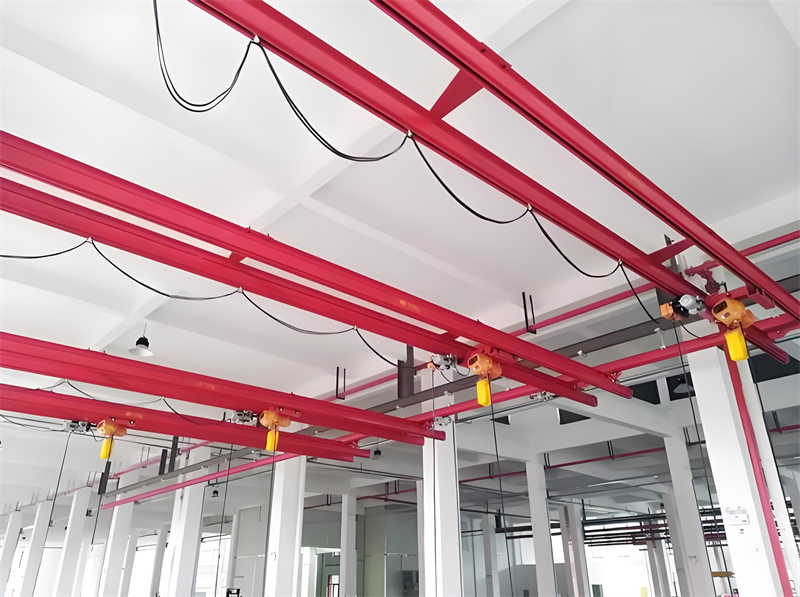
Vertical Space Stacking: The vertical clearance above workstations is typically unused. KBK systems utilize this “dead space” for material transport, effectively adding a second layer of activity without consuming additional floor area. KBK track installed at ceiling level serves as a dedicated material logistics layer, leaving the factory floor entirely free for production equipment, operator workstations, and value-adding activities.
Multi-Workstation Coverage: A single KBK monorail or area-spanning system can serve multiple workstations along its path. This eliminates the need for dedicated handling equipment at each station, further reducing equipment footprint.
3.3 Flexibility in Practice: Responding to Production Changes
Automotive parts production is subject to frequent changes: new component designs, production volume adjustments, and process optimization initiatives. A European-standard KBK system accommodates these changes with remarkable ease.
The modular architecture means that extending a track section to reach a new workstation, adding a branch line to serve an additional production cell, or reconfiguring the layout for a revised process flow involves unbolting, repositioning, and rebolting standardized components—work that can typically be completed during planned downtime. For KBK systems, small layout adjustments often require only minor modifications as long as the total component length has not changed substantially. This inherent flexibility is one reason KBK systems are widely favored in automotive manufacturing: users can continue using the same handling system after switching to a different vehicle model.
The adaptability of KBK systems directly supports key automotive industry requirements including multi-model mixed-line production with rapid model changeover capability, the ability to introduce new vehicle platforms without replacing material handling infrastructure, efficient line balancing through workstation reconfiguration, and scalability for production volume changes.
Part 4: KBK in the Broader Crane Ecosystem—Why Flexibility Complements Power
4.1 The Right Tool for Each Task
While KBK cranes excel at flexible, precision handling of components up to 2 tons, automotive parts production also involves heavier lifting tasks: coil handling for stamping operations, heavy die changing, and large sub-assembly transfers that may require capacities of 10 tons, 20 tons, or more.
The optimal approach for modern automotive parts plants is a layered material handling strategy:
- Heavy Central Lifting (10–50+ tons): European-standard double-girder overhead cranes or gantry cranes for coil receiving, heavy die maintenance, and large equipment installation. These cranes provide the structural robustness and high duty classification for occasional but critical heavy lifts.
- Production Cell Handling (1–5 tons): KBK flexible systems for the high-frequency, precision-oriented transfers that occur continuously throughout each shift.
- Workstation-Level Handling (up to 2 tons): KBK monorails or jib cranes for individual workstation loading and unloading, providing operators with immediate, ergonomic material handling at their point of use.
This layered approach ensures that each handling task is performed by the most appropriate equipment—avoiding both the inefficiency of using a heavy overhead crane for light, frequent transfers, and the inadequacy of using a light KBK system for occasional heavy lifts.
4.2 KBK as the Enabling Platform for Smart Factory Evolution
KBK systems do more than move parts—they are increasingly becoming data-generating nodes within the smart factory architecture. Because KBK track provides a defined, repeatable path network above the production floor, it is an ideal platform for integrating sensors, RFID readers, and automated control systems that track material flow in real time.
In modern implementations, sensors continuously monitor load weight, position, and operating status, with data streamed via industrial IoT platforms to the Manufacturing Execution System (MES). This data supports not only preventive maintenance scheduling but also real-time material flow optimization—ensuring that the right component arrives at the right workstation at the right moment, every time.
As automotive manufacturers move toward greater digitalization, the KBK system evolves from a simple material transport device into a “data node” and “flexible execution unit” within the intelligent factory ecosystem.
Part 5: The Digital Frontier—AI-Enhanced KBK Systems for 2026 and Beyond
5.1 When KBK Cranes Learn to Think
The 2026 landscape for KBK crane technology extends well beyond mechanical flexibility into the domain of intelligent, autonomous operation. AI-enhanced KBK systems are transitioning from experimental demonstrations to production-ready solutions that fundamentally change how material handling is performed and managed.
Traditional KBK cranes, while mechanically flexible, still depend on human operators to control movement, avoid obstacles, and coordinate multiple handling tasks. An operator must track the load throughout its journey, manually control speed and direction, and exercise constant vigilance to prevent collisions—particularly challenging in the confined, busy environments typical of automotive parts assembly areas.
The new generation of AI-enhanced KBK systems incorporates environmental perception and intelligent decision-making capabilities that effectively give the crane the ability to “think”:
Real-Time Perception and Autonomous Obstacle Avoidance:
Millimeter-wave radar and 3D vision sensors integrated into the trolley and lifting attachment continuously scan the path ahead, detecting obstacles—personnel, equipment, other loads—within a defined safety envelope. When an obstruction is detected, the control system automatically decelerates the crane and navigates around the obstacle, returning to the original path once the area is clear. Automotive parts plants that have implemented AI collision-avoidance modules on their KBK systems have reported the elimination of crane-related collision incidents.
Vision-Based Positioning with Centimeter Accuracy:
QR code landmarks installed along the KBK track combined with vision cameras on the lifting attachment enable automated positioning with repeatable accuracy. When an AGV delivers a component to a designated transfer point, the KBK system automatically navigates to that location, picks up the load, and transports it to the target workstation—all without operator intervention. This “machine-to-machine” coordination is particularly valuable for handling delicate components such as battery modules or precision-machined parts where misalignment during transfer can cause costly damage.
Intelligent Path Planning and Multi-Crane Coordination:
AI algorithms analyze the day’s production schedule and calculate optimal transport routes and task sequencing for multiple KBK units operating on shared track networks. The system manages traffic flow automatically—preventing conflicts, prioritizing time-critical moves, and ensuring efficient utilization of the entire handling network. One electronics factory that implemented this technology reported a 40% improvement in overall material handling efficiency.
Machine Learning for Continuous Improvement:
The AI system records every transport task—trajectory, duration, load characteristics, and operating conditions—and applies machine learning to progressively optimize operating strategies. As usage accumulates, the system becomes increasingly efficient: transport paths are refined, acceleration and deceleration profiles are optimized for load stability, and energy consumption is minimized. The system genuinely becomes “smarter” with continued operation.
5.2 Practical Impact on Automotive Parts Production
The integration of AI into KBK systems directly addresses several persistent operational challenges in automotive parts plants:
Labor Efficiency: A single operator can supervise multiple AI-enhanced KBK units simultaneously, reducing direct labor requirements for material handling by up to 60% while improving consistency and safety.
Damage Prevention: Autonomous obstacle avoidance and precision positioning prevent the collisions and misalignments that lead to component damage, equipment repair costs, and production downtime. Facilities implementing AI-enhanced systems report annual maintenance cost reductions of approximately 30%.
Production Continuity: AI-managed traffic flow eliminates the production delays caused by crane congestion and waiting, ensuring that material flow keeps pace with production requirements.
Data-Driven Process Optimization: The comprehensive operational data generated by AI-enhanced KBK systems feeds into continuous improvement initiatives, enabling plant management to identify and eliminate material handling bottlenecks with quantitative evidence rather than intuition.
5.3 Integration with the Broader Smart Factory Ecosystem
The logical evolution of AI-enhanced KBK systems is full integration with the digital twin and broader automation ecosystem of the automotive parts plant. By constructing a virtual model of the factory, KBK system operating paths and loading conditions can be simulated to identify potential issues and optimize layout before physical implementation. This digital integration enables deep coordination with robots, AGVs, and other automated equipment throughout the facility, progressively building toward a fully connected, autonomous material handling network.
Part 6: The Commercial Case—Why KBK Crane Investment Delivers Strong Returns
6.1 Total Cost of Ownership Analysis
Procurement teams evaluating KBK crane systems naturally focus on the initial purchase cost. However, the true economic case becomes clear when examining total cost of ownership over the equipment’s service life. KBK crane systems are typically designed for a service life of 15–25 years with proper maintenance, and the cumulative operational savings during that period far outweigh any upfront cost differences compared to traditional alternatives.
The economic advantages of KBK systems manifest across multiple dimensions:
Reduced Installation and Building Modification Costs:
Because KBK systems are ceiling-suspended, they require no floor foundations, no reinforced concrete columns, and no major civil engineering work. Installation is typically completed in days rather than weeks, and can often be performed without interrupting ongoing production activities. These factors alone can reduce total project costs by 20–40% compared to installing a traditional top-running bridge crane system with its associated structural requirements.
Lower Energy Consumption:
The lightweight design of KBK systems, combined with efficient electric hoists and variable frequency drives, results in energy consumption that is 30–50% lower than comparable traditional crane configurations. Over a 15-year operating life, these energy savings accumulate into significant financial returns—while also supporting corporate sustainability and carbon reduction targets.
Labor Efficiency Gains:
KBK systems enable one operator to handle tasks that previously required two or three workers. The smooth, ergonomic operation reduces physical strain and the associated risk of workplace injury, contributing to lower insurance costs and improved workforce morale.
Reduced Part Damage:
The precision positioning and smooth motion control of quality KBK systems prevent the component damage that frequently occurs with traditional crane handling. For automotive parts manufacturers dealing with high-value components—machined housings, finished assemblies, electronic modules—the reduction in scrapped or reworked parts directly improves profit margins.
Minimal Maintenance Downtime:
Standardized components, enclosed track profiles that protect running surfaces from contamination, and simple bolt-together construction contribute to high reliability and low maintenance requirements. When maintenance is needed, the modular design allows individual components to be replaced without disassembling the entire system.
6.2 Real-World ROI Examples from Automotive Applications
Multiple automotive industry deployments have documented compelling return-on-investment outcomes:
A European automotive parts supplier that invested in modular KBK crane systems achieved a 67% reduction in production line changeover time alongside a 30% improvement in space utilization, generating annual savings measured in millions of euros.
A Chinese truck manufacturer that implemented KBK light crane systems for chassis assembly documented a 40% reduction in per-transfer handling time, with the production line achieving measurably higher throughput without adding shifts or expanding the facility.
An automotive components plant that upgraded to KBK crane systems reported a 25% increase in productivity following implementation, driven by faster material flow and reduced operator fatigue.
These outcomes share a common thread: the initial investment in KBK crane infrastructure is recovered through sustained operational improvements that compound year after year.
Part 7: Dongqi Crane’s KBK Offering—Engineering, Quality, and Global Support
7.1 Our KBK Product Range
Dongqi Crane designs, manufactures, and supplies complete KBK flexible crane systems for the global market. Our KBK product range spans capacities from 80 kg to 3,200 kg, with standard track profiles available in multiple sizes to match load and span requirements. All KBK components are manufactured under our ISO 9001 quality management system, with CE certification available for products destined for European and other regulated markets.
Our KBK systems incorporate:
- High-quality cold-rolled steel track profiles with enclosed running surfaces for smooth, low-friction trolley movement
- Standardized bolted connections enabling rapid assembly and reconfiguration
- Compatible electric chain hoists with variable speed control, overload protection, and emergency braking
- Manual push-trolley and electric travel options
- Comprehensive range of curves, switches, turntables, and transfer devices for complex routing requirements
- Optional smart monitoring capabilities through the Dongqi AICrane platform
7.2 Engineering Support from Application to Commissioning
Every Dongqi Crane KBK project begins with a thorough application analysis. Our engineering team works with your production engineers and facility planners to understand the complete material handling picture: component types and weights, workstation layout, production volumes and cycle times, building structural characteristics, and future expansion or reconfiguration plans.
Based on this analysis, we provide a complete KBK system design, including track layout drawings, suspension point load calculations, hoist and trolley specifications, and control system integration. For building structures that require reinforcement at suspension points, we provide the necessary engineering recommendations.
7.3 Quality You Can Verify
We actively invite clients to inspect our 240,000-square-meter manufacturing facility in Changyuan, Henan Province. A factory visit allows you to witness our KBK component manufacturing processes, quality control procedures, and load testing capabilities. Over 2,000 sets of manufacturing and detection equipment are deployed across our facility, and every KBK system we ship is assembled and tested before dispatch.
7.4 Global Support Infrastructure
With products exported to 96 countries and a dedicated multilingual overseas service team of 36 professionals operating in English, Arabic, Spanish, Russian, and Korean, Dongqi Crane provides responsive international support. Our permanent office in Pakistan provides in-country service capability for South Asian clients, complementing our Changyuan headquarters engineering team.
Conclusion: The Smart Manufacturing Era Demands Smart Material Handling
The 2-ton KBK flexible crane system represents far more than a piece of lifting equipment. It is an enabler of production agility, a liberator of valuable floor space, a contributor to workplace safety and ergonomics, and an increasingly intelligent participant in the digital factory ecosystem.
For automotive parts manufacturers navigating the pressures of faster product cycles, mixed-model production, and relentless cost competition, investing in flexible material handling infrastructure is not a luxury—it is a strategic necessity. The KBK crane system, with its unique combination of modularity, precision, space efficiency, and scalability, has earned its place as a standard tool in modern automotive manufacturing facilities worldwide.
Contact Dongqi Crane to discuss your KBK crane requirements:
- Website: pk.craneyt.com
- Engineering Inquiry: Submit your project specifications for a customized proposal—response within 24 hours
- Factory Visit: Schedule a visit to our Changyuan manufacturing facility to inspect our KBK production and testing capabilities
- Overseas Support: Our dedicated multilingual team provides service in English, Arabic, Spanish, Russian, and Korean
With Dongqi Crane’s KBK flexible crane systems, you equip your automotive parts production line for the demands of 2026—and for the changes that 2027, 2028, and beyond will bring.
© 2026 Dongqi Crane. All rights reserved. This article provides general technical and application information. Specific system design should be performed by qualified engineers based on your actual facility conditions and operational requirements.
