
How to Choose an Electric Wire Rope Hoist: A Procurement Decision Guide for CD Type, MD Type, and European-Type Hoists
A Technical Selection Guide from DONGQI CRANE for Factory Owners, Procurement Managers, and Project Engineers
The electric wire rope hoist is the beating heart of any overhead crane system. It is the component that actually lifts the load—the mechanism that converts electrical power into vertical motion, day after day, year after year. Yet in many crane procurement projects, the hoist receives far less attention than it deserves. Buyers focus on bridge capacity and span dimensions, then treat the hoist as a generic commodity to be sourced at the lowest possible price.
This is a costly mistake. The hoist you select determines your lifting speed, positioning accuracy, energy consumption, maintenance requirements, and—most critically—whether your crane will perform reliably over its 15–25 year service life. A mismatched hoist can turn an otherwise well-engineered crane into a source of frustration, downtime, and unexpected expense.
At DONGQI CRANE, a Sino-New Zealand joint venture with over 40 years of manufacturing experience and products operating in 96 countries, we manufacture all three major categories of electric wire rope hoists: CD type (single-speed), MD type (dual-speed), and European-type (premium, FEM-compliant). We do not push one category over another. Our commitment is to help you select the right hoist for your specific application, budget, and long-term operational goals.
This guide provides a comprehensive, technically grounded comparison to help you make an informed procurement decision.
The Hoist as a System: Why This Decision Matters
Before diving into the differences between CD, MD, and European-type hoists, it is worth understanding what a wire rope hoist actually does—and why the configuration matters.
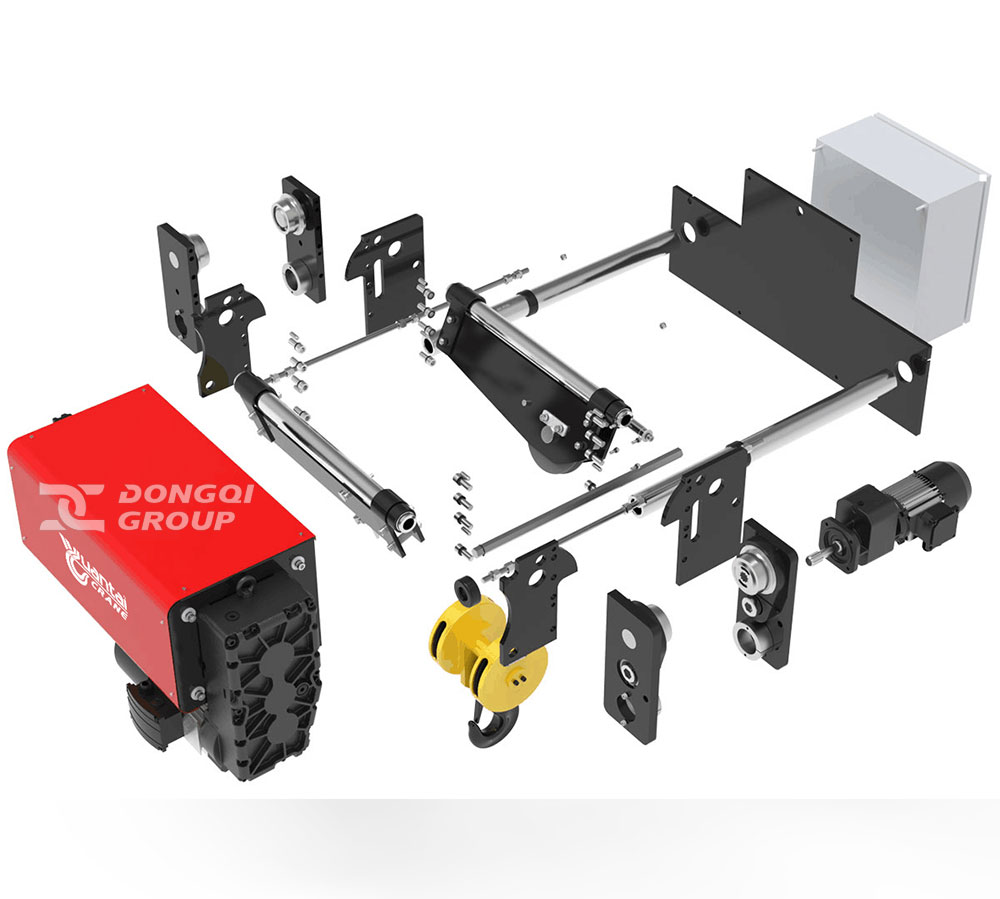
A wire rope hoist consists of several integrated subsystems:
| Subsystem | Function | Why Configuration Matters |
|---|---|---|
| Lifting Motor | Provides the power to raise and lower the load | Motor type determines speed control, energy efficiency, and duty cycle capability |
| Gearbox/Reducer | Converts high-speed motor rotation into high-torque drum rotation | Gear design affects noise, maintenance requirements, and service life |
| Drum and Wire Rope | Wraps the wire rope to lift the load | Drum diameter affects rope life; rope quality affects safety and replacement frequency |
| Braking System | Holds the load securely when power is removed | Brake design determines safety margin and maintenance intervals |
| Trolley/Running Mechanism | Moves the hoist horizontally along the bridge | Motorization and control affect positioning accuracy and cycle times |
| Control System | Receives operator commands and manages hoist functions | Pendant, radio remote, or automated control affects safety and productivity |
Each hoist category—CD, MD, and European—approaches these subsystems differently. Understanding those differences is the key to making the right choice.
Part 1: CD Type Wire Rope Hoist—The Reliable Single-Speed Workhorse
What Is a CD Type Hoist?
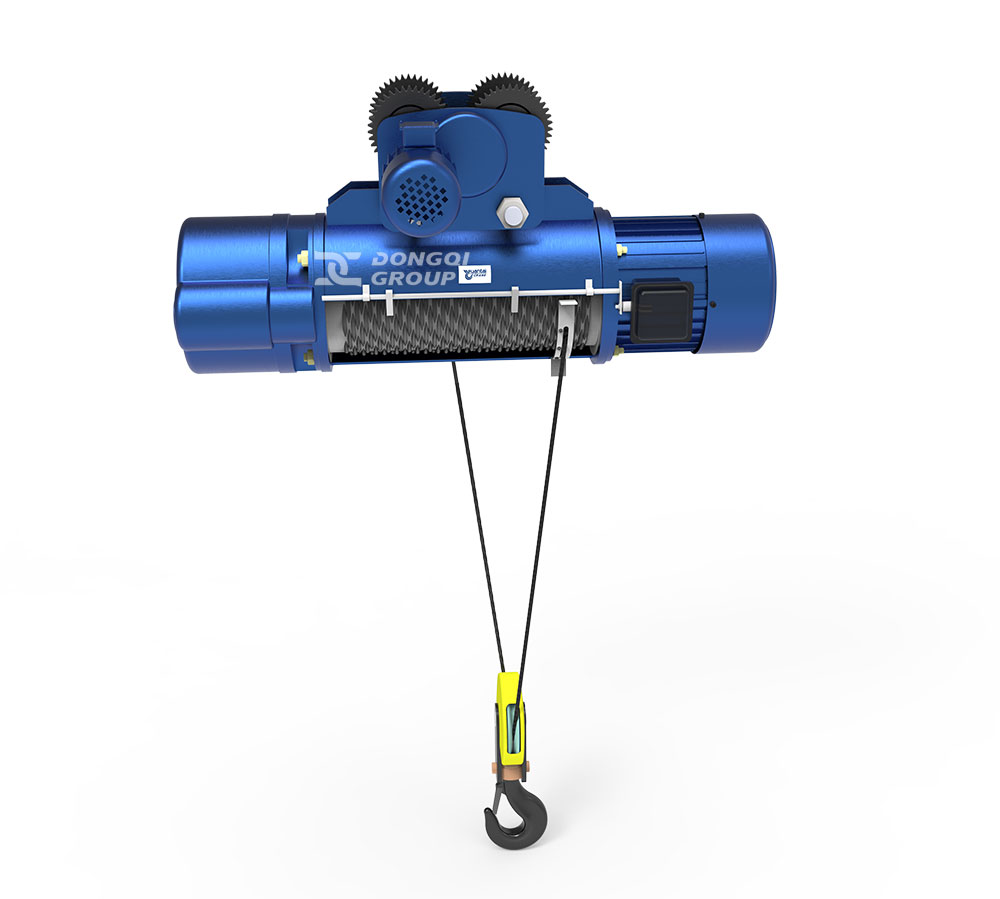
The CD type electric wire rope hoist is the most widely used lifting device in general industrial applications worldwide. Originally developed through joint design efforts by China’s major hoist manufacturers in the 1960s, the CD hoist is characterized by its distinctive conical rotor motor (also called a tapered rotor motor)—which is why it is frequently referred to as a “conical hoist.”
The defining feature of the CD hoist is its single-speed lifting capability. When the operator presses the “up” or “down” button, the hoist lifts or lowers the load at a constant, predetermined speed. There is no speed variation—what you select is what you get.
Core Design Characteristics
Conical Rotor Motor with Integrated Braking
The CD hoist’s lifting mechanism combines the drive motor and braking system into a single integrated unit. Both the motor rotor and stator are conical in shape. When power is applied, magnetic force pulls the rotor into the stator, simultaneously releasing the brake and generating rotational torque. When power is removed, a spring pushes the rotor back, engaging the brake automatically. This “power-on release, power-off brake” design is simple, robust, and inherently fail-safe.
Compact and Economical Structure
CD hoists are designed for manufacturing efficiency. Components are standardized and highly interchangeable across models, which reduces both initial cost and long-term spare parts expense. The structure is compact, lightweight, and easily integrated into single girder cranes, gantry cranes, jib cranes, and monorail systems.
Typical Specifications
| Parameter | CD Type Hoist Range |
|---|---|
| Lifting Capacity | 0.25 – 32 tons (standard); up to 80+ tons custom |
| Lifting Height | 6 – 30 meters (extendable with custom configuration) |
| Lifting Speed | 7–8 m/min (single constant speed) |
| Running Speed | 18–20 m/min |
| Work Duty Classification | M3–M4 (light to medium duty) |
| Operating Environment | -20°C to +40°C, humidity ≤85%, non-corrosive, non-explosive |
| Power Supply | 3-phase 380V 50Hz (custom voltages/frequencies available) |
Ideal Applications for CD Type Hoists
CD hoists excel in applications where speed consistency and reliability matter more than precision positioning or high-frequency cycling.
Recommended For:
- General Warehousing: Loading and unloading palletized goods where precise placement is not critical
- Light Manufacturing: Moving raw materials and finished products between workstations
- Maintenance Workshops: Occasional equipment changeouts and repair support
- Assembly Lines: Repetitive lifts of consistent weight where speed consistency is valued
- Small to Medium Factories: Operations with one or two shifts per day
When to Consider a CD Hoist
- Your lifting tasks are routine and repetitive with consistent load weights
- You do not require precise positioning at the millimeter level
- Your daily number of lifts is moderate (under 100 cycles per day)
- Your primary procurement driver is capital cost efficiency
- Your operation runs single-shift or light two-shift patterns
DONGQI CRANE CD Type Hoist Offering
DONGQI CRANE manufactures CD type wire rope hoists with capacities from 0.25 to 32 tons as standard, with custom configurations available up to 80+ tons. All units feature:
- Taper rotor motor with asynchronous braking for reliable, fail-safe operation
- Class 3 bevel wheel reducer with heat-treated alloy steel gears for durability
- CE and ISO certification ensuring global safety and quality compliance
- Pendant control standard; radio remote upgrade available
- Customizable power supply (220V–440V, 50/60Hz) for international compatibility
Part 2: MD Type Wire Rope Hoist—Precision Through Dual-Speed Control
What Is an MD Type Hoist?
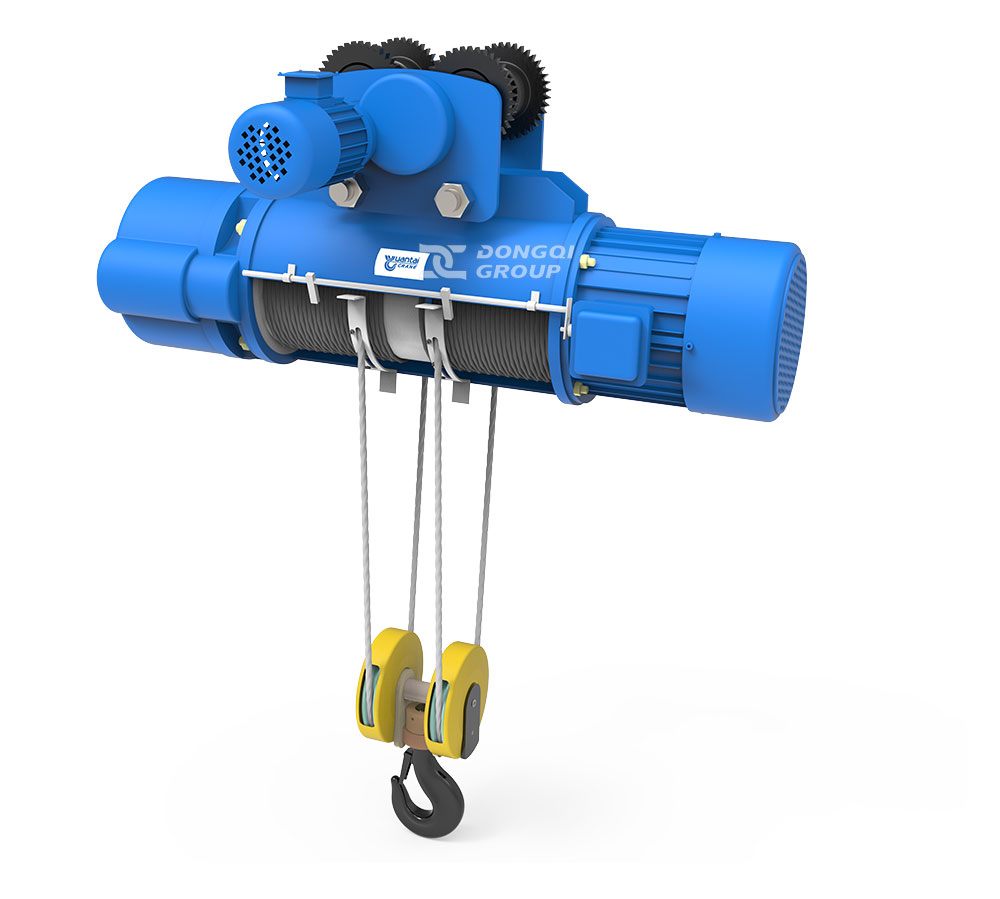
The MD type hoist is a direct evolution of the CD design, sharing the same fundamental architecture and conical rotor motor technology. The critical difference lies in the speed configuration: where CD hoists offer only a single lifting speed, MD hoists provide two distinct lifting speeds—a fast “working speed” for efficient load movement and a slow “creep speed” for precise positioning.
The slow speed is typically one-tenth of the fast speed. For example, a hoist with an 8 m/min fast speed will have a 0.8 m/min slow speed.This dual-speed capability transforms the hoist from a simple lifting device into a precision handling tool.
How Dual-Speed Works
MD hoists achieve dual-speed operation through one of two mechanisms, depending on the specific model and manufacturer:
Dual Motor Configuration (Traditional MD): The hoist contains a main motor for fast lifting and an auxiliary motor connected through a reduction gear for slow lifting. The operator selects the desired speed via the control pendant. This design is robust and well-proven across decades of industrial service.
Variable Frequency Drive (VFD) Configuration (Modern MD): Some contemporary MD hoists use a single motor controlled by a variable frequency drive, which electronically adjusts motor speed to provide both fast and slow operation. This approach offers smoother acceleration and reduced mechanical wear compared to dual-motor configurations.
Core Design Characteristics
Shared CD Heritage
MD hoists maintain the conical rotor motor architecture and integrated braking system of CD hoists. They are equally compact, equally reliable, and equally easy to maintain. The addition of dual-speed capability does not fundamentally alter the hoist’s structural design.
Expanded Application Versatility
The slow speed enables applications that CD hoists simply cannot handle effectively:
- Precision mold installation where alignment must be exact
- Machine tool feeding where components must be positioned with care
- Delicate assembly work where impact would damage components
- Maintenance and repair where controlled movement is essential for safety
Typical Specifications
| Parameter | MD Type Hoist Range |
|---|---|
| Lifting Capacity | 0.5 – 32 tons (standard); up to 80+ tons custom |
| Lifting Height | 6 – 48 meters (customizable) |
| Lifting Speed (Fast) | 7–8 m/min |
| Lifting Speed (Slow) | 0.7–0.8 m/min (1/10 of fast speed) |
| Running Speed | 18–30 m/min |
| Work Duty Classification | M3–M4 |
| Operating Environment | -20°C to +40°C, humidity ≤85% |
| Motor Protection | IP44/IP54 |
Ideal Applications for MD Type Hoists
MD hoists are the go-to choice for operations that require both productivity and precision.
Recommended For:
- Mold Shops and Die Handling: Precise positioning for mold changes in injection molding and die casting
- Machine Tool Support: Loading and unloading CNC machining centers, lathes, and milling machines
- Equipment Maintenance: Controlled positioning during pump, motor, and gearbox replacement
- Precision Assembly: Positioning heavy components that must align with existing structures
- Foundry Pattern Handling: Careful placement of patterns and cores without damage
When to Consider an MD Hoist
- Your operation requires both speed and precision from the same lifting device
- You handle valuable or delicate loads that cannot tolerate impact
- Your tasks include maintenance and repair work requiring controlled movement
- The incremental cost of dual-speed capability is justified by productivity gains or damage prevention
- You operate in a mixed-use environment where both rapid material movement and precision positioning occur
DONGQI CRANE MD Type Hoist Offering
DONGQI CRANE’s MD type double-speed wire rope electric hoists deliver precision and reliability for demanding industrial applications. Key features include:
- Dual-speed functionality: Fast speed for productivity, slow speed for precision positioning
- Capacities from 0.25 to 80 tons: Customizable to meet specific load requirements
- CE and ISO certified: Global safety and quality compliance
- Advanced safety features: Overload protection, upper/lower limit switches, and reliable dual braking systems
- Flexible control options: Pendant control standard; wireless radio remote available for enhanced operator mobility
- Durable construction: Heat-treated alloy steel gears in cast iron reducer housing for long service life
Part 3: European-Type Wire Rope Hoist—Premium Performance for Demanding Applications
What Is a European-Type Hoist?
The European-type wire rope hoist represents a fundamentally different design philosophy from CD and MD hoists. Rather than evolving from the conical rotor motor architecture, European hoists were developed independently to meet FEM (Fédération Européenne de la Manutention) standards—the rigorous performance and safety specifications that govern lifting equipment in European and other advanced industrial markets.
Where CD and MD hoists emphasize simplicity and cost-effectiveness, European hoists prioritize efficiency, precision, durability, and total cost of ownership. They are designed from the ground up for higher duty cycles, more demanding operating environments, and integration with automated and intelligent crane systems.
Core Design Characteristics
FEM-Compliant Engineering
European hoist design strictly adheres to FEM standards, which specify everything from structural calculations and fatigue life to safety margins and performance testing. This compliance ensures that European hoists meet the most demanding international requirements for safety and reliability.
C-Frame Compact Structure
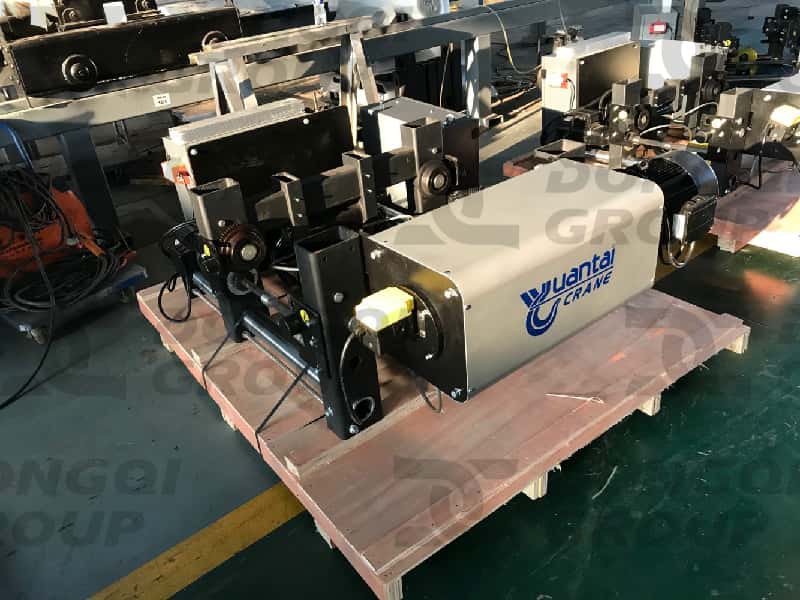
Unlike CD/MD hoists, which position the hoist mechanism beneath the crane girder, European hoists employ a C-frame design that wraps around the girder. This configuration provides a significantly lower hook approach—the distance from the bottom of the girder to the hook’s highest position. The result is 300–600mm of additional usable lifting height within the same building envelope, which can eliminate the need for costly building modifications.
Parallel Helical Gearbox with Aluminum Housing
European hoists use parallel shaft helical gearboxes rather than the worm gear reducers common in CD/MD designs. The gearbox housing is made from aluminum alloy, which reduces weight, improves heat dissipation, and resists corrosion. The gearbox is lubricated for life—no oil changes required throughout the hoist’s service life.
Independent Braking System
Instead of integrating the brake into the motor as CD/MD hoists do, European hoists employ dual electromagnetic disc brakes that operate independently of the motor. When power is removed, the brakes engage automatically. The braking torque is typically ≥1.8 times the motor’s rated torque, providing an exceptional safety margin. These brakes are self-adjusting and rated for 1 million cycles—effectively maintenance-free over the hoist’s service life.
High-Performance Motors
European hoist motors differ fundamentally from CD/MD conical rotor motors. Standard configurations use dual-speed pole-changing motors with a 1:6 fast-to-slow speed ratio. Premium configurations employ variable frequency drives (VFD) for fully stepless speed control from creep speed to maximum velocity. Motor protection is IP55 (dust and water spray resistant) with Class F insulation for high-temperature tolerance. All motor windings incorporate thermistors that automatically cut power if overheating is detected.
Modular, Compact Architecture
European hoists are designed around modular principles. The lifting motor, gearbox, drum, and limit switches are integrated into a single compact unit that minimizes space requirements while maximizing accessibility for inspection and maintenance. The running mechanism uses a “motor + gearbox + wheel” integrated (three-in-one) design, with bilateral drive on double girder trolleys for balanced, stable movement.
Typical Specifications
| Parameter | European-Type Hoist Range |
|---|---|
| Lifting Capacity | Up to 80+ tons (customizable beyond) |
| Lifting Height | Customizable; low-headroom design maximizes usable height |
| Lifting Speed | Stepless VFD or dual-speed; typically 0.8–8 m/min with smooth acceleration |
| Running Speed | VFD-controlled; typically 2–20 m/min |
| Work Duty Classification | M5–M7 (medium to heavy/continuous duty) |
| Motor Protection | IP55 standard; Class F insulation |
| Design Standard | FEM, DIN, HMI |
| Brake System | Dual electromagnetic disc brakes, ≥1.8× motor torque, 1 million cycle rating |
Ideal Applications for European-Type Hoists
European hoists are the preferred solution for demanding industrial environments where downtime is expensive and performance expectations are high.
Recommended For:
- Continuous Production Lines: Automotive assembly, steel processing, and 24/7 manufacturing operations
- High-Capacity Heavy Industry: Steel mills, shipyards, heavy equipment manufacturing
- Precision Manufacturing: Aerospace component handling, cleanroom operations, sensitive equipment installation
- Automated and Smart Crane Systems: PLC-controlled positioning, warehouse management system integration, remote monitoring
- Constrained-Height Facilities: Existing buildings where maximizing hook height is critical
- Harsh Operating Environments: High humidity, corrosive atmospheres, wide temperature ranges
When to Consider a European-Type Hoist
- Your operation runs multiple shifts or continuously
- Downtime costs are significant (measured in thousands per hour)
- You require precision positioning with stepless speed control
- Your building has limited headroom and maximizing lift height matters
- You are integrating with automated systems or Industry 4.0 initiatives
- Total cost of ownership (TCO) is your primary decision metric rather than initial purchase price
- Your duty cycle demands M5 or higher classification
The DONGQI CRANE European-Type Hoist Offering
DONGQI CRANE provides a full range of European-standard lifting equipment to global customers, including European standard single-girder cranes and European standard double-girder cranes.Our European-type hoist portfolio includes:
- Low Headroom Electric Hoists: Optimized C-dimension and hook approach to increase available lifting height by up to 30%
- Full VFD Drive Systems: Stepless speed control on all motions—hoisting, cross-travel, and long-travel—with smooth acceleration and deceleration
- Premium Components: High-performance motors, gearboxes, and control systems engineered for extended service life
- Marine-Grade Protection: Anti-corrosion coating, stainless/galvanized exposed parts, and IP54 electrical protection for harsh environments
- Smart Monitoring Options: Load cycle counters, fault recording, and operating hours monitoring for predictive maintenance planning
Part 4: Head-to-Head Comparison
The following table provides a consolidated comparison of the three hoist types across key decision criteria.
| Selection Criteria | CD Type (Single-Speed) | MD Type (Dual-Speed) | European-Type (Premium) |
|---|---|---|---|
| Speed Configuration | Single constant speed | Fast + slow (1:10 ratio) | Stepless VFD or dual-speed |
| Motor Type | Conical rotor (tapered) | Conical rotor (tapered) | Cylindrical rotor; VFD-compatible |
| Brake Design | Integrated conical brake | Integrated conical brake | Independent dual disc brakes; ≥1.8× motor torque; 1M cycle rating |
| Gearbox | Worm gear; cast iron housing | Worm gear; cast iron housing | Helical gear; aluminum alloy housing; lifetime lubrication |
| Work Duty Class | M3–M4 (light to medium) | M3–M4 (light to medium) | M5–M7 (medium to heavy) |
| Precision Positioning | Basic | Good (via slow speed) | Excellent (stepless VFD) |
| Hook Approach | Standard | Standard | Low-headroom design; recovers 300–600mm lift height |
| Maintenance | Periodic lubrication required | Periodic lubrication required | Lifetime lubrication; self-adjusting brakes; reduced maintenance |
| Relative Initial Cost | Baseline (lowest) | +10–20% vs. CD | +100% or more vs. CD |
| Energy Efficiency | Standard | Standard | 30–40% savings with VFD |
| Best For | General lifting; cost-sensitive applications | Mixed-use; precision + productivity | Continuous duty; high TCO sensitivity; automation |
Part 5: The Procurement Decision Framework
Rather than starting with a preference for a specific hoist type, start with a clear understanding of your operational requirements. The following decision framework will guide you to the appropriate selection.
Step 1: Define Your Load and Duty Profile
| Question | If Your Answer Is… | Consider… |
|---|---|---|
| What is your maximum lift weight? | ≤ 32 tons | CD or MD |
| > 32 tons | European or custom MD | |
| How many lifts per day? | < 100 lifts | CD |
| 100–200 lifts | MD | |
| > 200 lifts | European | |
| How many shifts per day? | Single shift | CD or MD |
| Two shifts | MD or European | |
| Three shifts / continuous | European | |
| What is the cost of unplanned downtime? | Low (non-critical operation) | CD or MD |
| Moderate | MD or European | |
| High (production line stops) | European |
Step 2: Assess Your Precision Requirements
| Question | If Your Answer Is… | Consider… |
|---|---|---|
| Do you need precise load positioning? | No—just get it close | CD |
| Sometimes—for certain tasks | MD | |
| Always—millimeter accuracy matters | European with VFD | |
| Do you handle delicate or high-value loads? | No | CD or MD |
| Occasionally | MD | |
| Regularly | European | |
| Does your operation include maintenance/repair tasks? | Rarely | CD |
| Sometimes | MD | |
| Frequently | MD or European |
Step 3: Evaluate Your Building Constraints
| Question | If Your Answer Is… | Consider… |
|---|---|---|
| Is your available hook height limited? | No—plenty of clearance | CD or MD |
| Yes—every millimeter counts | European low-headroom | |
| Does your facility have height restrictions? | No | CD or MD |
| Yes—building modifications would be costly | European |
Step 4: Consider Long-Term Financial Factors
| Factor | CD/MD | European |
|---|---|---|
| Initial Capital Cost | Lower | 2× or more |
| Energy Cost (10-year) | Higher | 30–40% lower with VFD |
| Maintenance Cost (10-year) | Higher | Significantly lower |
| Downtime Risk | Moderate | Low |
| Service Life | 10–15 years | 15–25+ years |
| Resale Value | Lower | Higher |
Important TCO Consideration: While European hoists command a higher initial purchase price—typically double or more that of CD/MD equivalents—the total cost of ownership picture often favors European hoists for demanding applications. Reduced energy consumption, lower maintenance requirements, and minimized downtime can recover the price premium within 2–5 years of operation.
Part 6: The DONGQI CRANE Support Model—Expertise Where You Need It
Selecting the right hoist is an engineering decision, not just a purchasing decision. At DONGQI CRANE, we provide the technical expertise to ensure you make the right choice.
Comprehensive Pre-Sale Engineering Review
Before we quote any hoist or crane system, our engineering team conducts a thorough review of your application requirements:
- Load spectrum analysis to determine correct work duty classification
- Duty cycle evaluation to ensure the hoist matches actual usage patterns
- Building constraint assessment to verify hook height and clearance feasibility
- Power supply verification to ensure electrical compatibility
- Future expansion consideration to avoid near-term obsolescence
Direct Engineer Dispatch for Installation and Commissioning
DONGQI CRANE does not rely on third-party agents or local representatives. When your hoist or crane arrives at your facility, we dispatch our own factory engineers directly from our China headquarters to your site anywhere in the world. Our engineers supervise alignment, oversee commissioning, conduct load testing, and provide operator training. You receive support from the engineers who designed and built your equipment—not subcontractors unfamiliar with the product.
Rapid Spare Parts Fulfillment
We maintain comprehensive parts inventory at our 240,000-square-meter manufacturing facility. Standard replacement components ship within 24–48 hours via international express courier, reaching most global destinations within 3–7 business days. For clients who prefer immediate on-site availability, we provide a recommended critical spares list at the time of purchase.
Remote Technical Support
Our engineering team provides video-assisted troubleshooting via WeChat, WhatsApp, or Zoom. Many operational questions and minor issues can be resolved remotely, minimizing downtime and avoiding unnecessary travel costs.
Conclusion: Match the Hoist to the Mission
The electric wire rope hoist is not a commodity item to be selected on price alone. It is the core lifting mechanism that will determine your crane’s performance, reliability, and operating cost for decades to come.
Choose a CD Type Hoist When:
- Your operation is cost-sensitive and runs single-shift
- Precision positioning is not required
- Your daily lift count is moderate (under 100 cycles)
- Reliability and simplicity are your primary concerns
Choose an MD Type Hoist When:
- Your operation requires both productivity and precision
- You handle valuable loads that benefit from controlled positioning
- Your tasks include both material movement and precision placement
- The incremental cost of dual-speed capability is justified by operational benefits
Choose a European-Type Hoist When:
- Your operation runs multiple shifts or continuously
- Downtime costs are significant
- Your building has limited headroom
- Precision positioning and stepless speed control are required
- Total cost of ownership is your primary decision metric
- You are integrating with automated systems
At DONGQI CRANE, we manufacture all three hoist types to the same exacting standards—ISO 9001, ISO 14001, ISO 45001, and CE certified. Our commitment is not to sell you the most expensive hoist, but to help you select the right hoist for your application. Because a hoist that perfectly matches your operational needs will deliver reliable, safe, and efficient service for decades—and that is the truest measure of value.
Ready to determine the optimal hoist configuration for your facility?
[Contact DONGQI CRANE’s engineering team today for a complimentary application review and custom proposal.]
DONGQI CRANE: Your Direct-from-Factory Partner for Overhead Cranes, Gantry Cranes, and Custom Lifting Solutions Since 1985.
CD Type • MD Type • European-Type Wire Rope Hoists
ISO 9001 • ISO 14001 • ISO 45001 • CE Certified
240,000m² Manufacturing Facility • 10,000+ Annual Capacity • Exports to 96+ Countries
Direct Engineer Dispatch Worldwide • Express Spare Parts Delivery • Remote Technical Support
