
Single Girder vs. Double Girder Bridge Crane: More Than a Price Difference—It‘s About Application Fit
A Comprehensive Selection Guide from DONGQI CRANE for Factory Owners, Plant Managers, and Procurement Professionals
When you begin the process of purchasing an overhead bridge crane, one of the first decisions you will face is whether to specify a single girder or a double girder configuration. Many buyers approach this decision through a single lens: price. A single girder crane is cheaper, so if the budget is tight, the choice seems obvious. But this oversimplified thinking leads to mismatched equipment, operational inefficiencies, and long-term costs that far outweigh any initial savings.
At DONGQI CRANE, a Sino-New Zealand joint venture with over 40 years of manufacturing experience and products operating in 96 countries worldwide, we have guided thousands of clients through this exact decision. The consistent lesson is that single girder and double girder cranes are not merely two price points for the same function—they are fundamentally different tools designed for fundamentally different applications.
This guide provides a comprehensive, technically rigorous comparison of single girder and double girder bridge cranes. Our goal is to equip you with the knowledge needed to make an informed decision based on your actual operational requirements, not just the numbers on a quote sheet.
Part 1: The Fundamental Difference—What Sets These Configurations Apart?
Before diving into specifications and applications, it is essential to understand the core structural distinction between single and double girder overhead cranes.
Single Girder Bridge Crane: Compact and Efficient
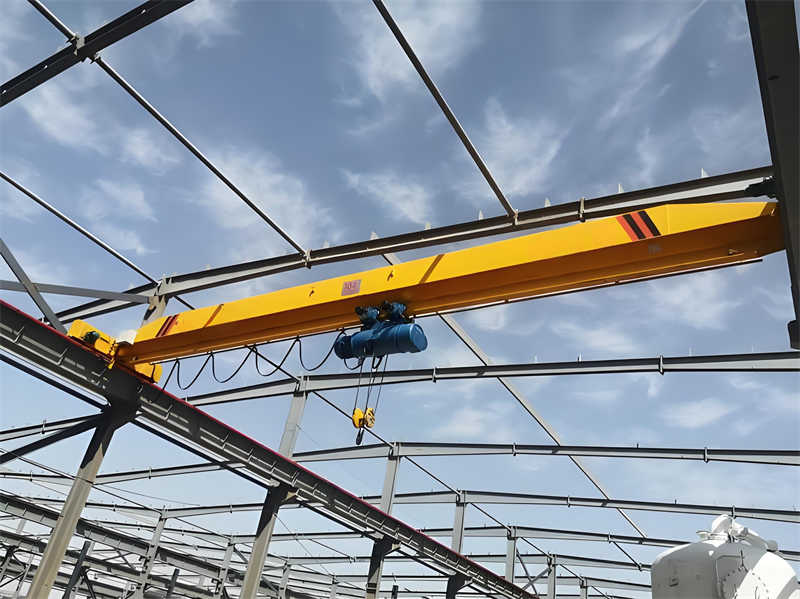
A single girder overhead crane features one main horizontal beam (the bridge girder) supported by end trucks that travel along parallel runway beams. The hoist and trolley assembly is typically suspended beneath this single girder. This configuration creates a lightweight, compact, and cost-effective lifting solution.
Key characteristics include a simpler structural design with only one main load-bearing beam, reduced overall crane deadweight which minimizes stress on the building structure, more compact vertical dimensions making them suitable for facilities with limited headroom, and faster installation due to fewer components and lighter assembly weights.
Double Girder Bridge Crane: Heavy-Duty Performance
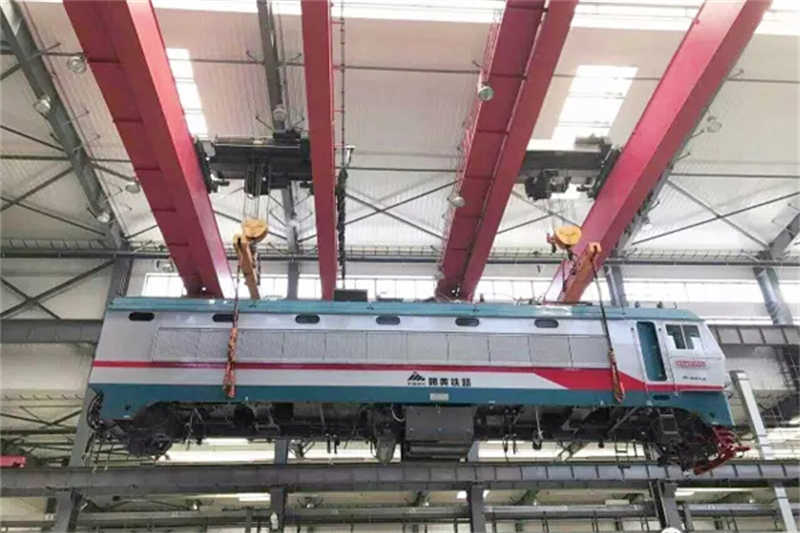
A double girder overhead crane employs two parallel bridge girders with the hoist and trolley assembly mounted on rails positioned on top of the girders. This configuration creates a fundamentally different load distribution pattern and unlocks capabilities that single girder designs cannot match.
The defining features include dual load-bearing beams that distribute forces more effectively across the structure, the hoist positioned above the girders rather than suspended below, significantly higher rigidity and running stability, and the ability to accommodate walkways, maintenance platforms, and auxiliary equipment directly on the crane structure.
The Hoist Position Difference—Why It Matters
The most consequential difference between these two configurations is where the hoist sits relative to the bridge girder. In a single girder crane, the hoist rides beneath the beam, which consumes vertical space that could otherwise be used for lifting. In a double girder crane, the hoist rides on top of the girders, allowing the hook to be raised between the two beams—effectively recovering the depth of the girders as additional lifting height.
For facilities where every millimeter of hook height is precious, this distinction alone often determines the appropriate configuration.
Part 2: Technical Specifications and Capacity Ranges
Capacity Limits
The most straightforward technical distinction lies in lifting capacity. Single girder cranes are typically designed for capacities up to 20 tons, with some manufacturers extending to 25 tons in specialized configurations. Beyond approximately 20 tons, double girder construction becomes necessary due to the structural demands of heavier loads.
Double girder cranes, by contrast, are engineered to handle capacities from 5 tons up to 500 tons or more, with no practical upper limit for custom-engineered solutions. The dual-beam design provides the structural rigidity required to safely manage extreme loads without excessive deflection or fatigue accumulation.
Span Capabilities
Single girder cranes generally operate effectively within spans of approximately 5 to 32.5 meters, with typical applications falling between 7.5 and 28.5 meters. As span increases, the single girder must become progressively deeper to resist bending moments, which eventually becomes inefficient compared to a double girder configuration.
Double girder cranes accommodate spans from 10.5 meters up to 35.5 meters or more in standard configurations, with custom designs extending far beyond these ranges. The dual-beam structure distributes bending stresses more efficiently, enabling longer spans without proportionally increasing girder depth or steel weight.
Lifting Height and Hook Approach
Single girder cranes provide lifting heights typically ranging from 6 to 30 meters, though the suspended hoist configuration means that the actual available hook height is reduced by the depth of the girder and the hoist body. This can be a critical limitation in facilities with restricted ceiling clearance.
Double girder cranes offer lifting heights from 6 meters to 300 meters or more in specialized applications. More importantly, because the hoist rides on top of the girders, the hook can be raised between the beams, effectively utilizing the full vertical space from the floor to the bottom of the bridge structure. For applications requiring maximum hook height within a given building envelope, double girder is often the only viable solution.
Double girder cranes also provide superior hook approach on both sides of the crane, particularly where large lifting heights are specified. This can translate to better floor coverage and more flexible material handling.
Part 3: Application Scenarios—Where Each Configuration Excels
Understanding the technical specifications is essential, but the real decision should be driven by how the crane will actually be used in your facility. Different applications demand different configurations.
When a Single Girder Crane Is the Optimal Choice
Light to Medium Manufacturing: Single girder cranes are ideally suited for light to medium load scenarios, such as machine shops, warehousing and logistics areas, and small assembly plants. In these environments, loads rarely exceed 15 tons, and duty cycles are moderate. The cost-effectiveness of a single girder design aligns perfectly with operational requirements.
Maintenance and Tool Rooms: Facilities that need a crane primarily for occasional equipment maintenance, die changing, or tool room support will find single girder cranes more than adequate. The lower initial investment and reduced structural demands on the building make them the practical choice for intermittent use.
Facilities with Limited Headroom: Single girder cranes are more compact and lighter than double girder cranes, making them a preferred choice for facilities where headroom and floor space are limited. The suspended hoist configuration, while consuming some vertical space, still results in a lower overall crane height compared to a double girder design.
Budget-Constrained Projects: When capital is limited and operational demands are moderate, single girder cranes provide the most cost-effective path to mechanized material handling. For lifting capacities up to 20 tons and spans up to 18 meters, single girder EOT cranes represent the most affordable purchase option.
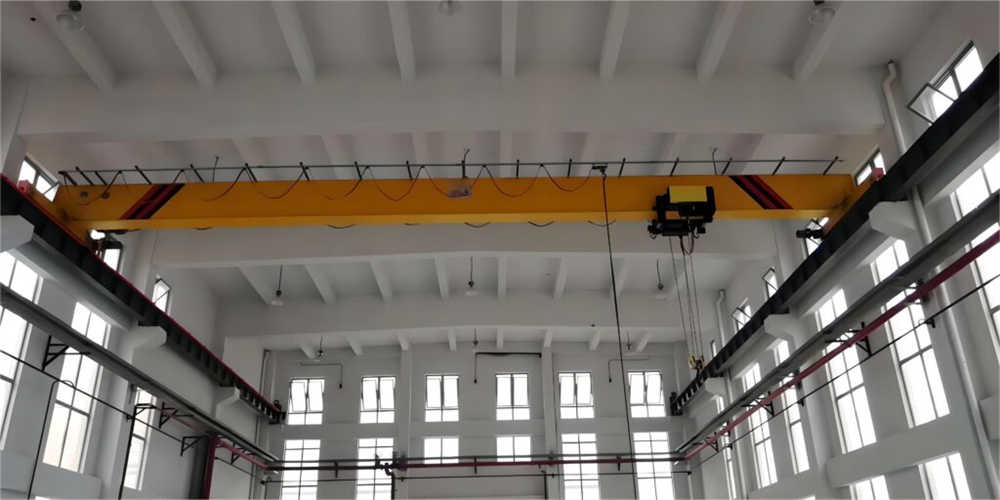
DONGQI CRANE Single Girder Offerings: Our HD series single girder overhead cranes deliver lifting capacities from 1 to 20 tons with spans extending to 31.5 meters. Available in work duty classifications from A3 to A5, these cranes incorporate premium components from SEW, NORD, ABB, Siemens, and Schneider Electric. European-standard models offer FEM 4m / ISO A7 duty ratings for demanding applications. Lightweight, FEA-optimized beam designs reduce wheel loads and building steel requirements.
When a Double Girder Crane Becomes Necessary
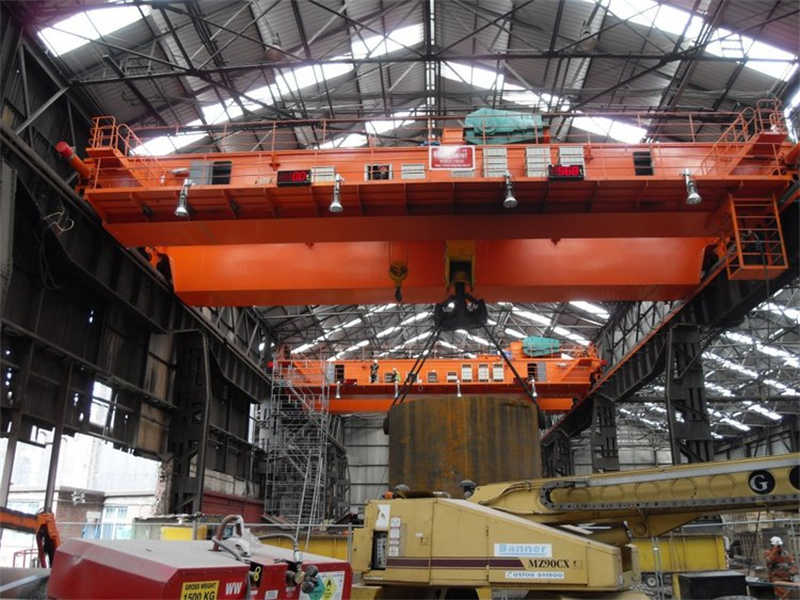
Heavy Manufacturing and Steel Processing: Industries that handle heavy components—steel mills, foundries, heavy equipment manufacturing, and shipyards—require double girder cranes. Double girder cranes are capable of lifting heavier loads compared to single girder cranes, making them suitable for industries that require moving large components and materials.
High Duty Cycle Operations: Facilities operating multiple shifts with continuous lifting demands cannot afford premature equipment failure. Double girder cranes offer higher rigidity, better running stability under heavy loads, and more effective use of available lifting height. The robust construction withstands the fatigue loading that would eventually compromise a single girder crane in the same application.
Large-Span Facilities: As building width increases, single girder designs become increasingly inefficient. The deeper beams required to span long distances add weight and cost that eventually exceed the economics of a double girder configuration. For spans beyond approximately 25 meters, double girder becomes the structurally and economically preferred solution.
Applications Requiring Walkways and Auxiliary Equipment: Double girder cranes can accommodate maintenance walkways, cabling systems, and auxiliary lifting devices directly on the crane structure. If a service platform is needed for maintenance access or if the crane must integrate with automated systems, a double girder crane is often the better option.
Future Expansion Planning: If your facility may eventually require higher capacities, longer spans, or increased duty cycles, specifying a double girder crane now can provide built-in expansion capability without replacing the entire crane system. The dual-beam structure offers greater flexibility for future modifications and upgrades.
DONGQI CRANE Double Girder Offerings: Our QD series double girder overhead cranes handle loads from 5 to 320 tons with spans up to 35.5 meters and lifting heights to 30 meters. For extreme heavy-duty applications, our QDX series extends to over 500 tons with fully customizable spans and lift heights. Premium SEW/NORD drives with VFD control, European-standard design options that reduce deadweight by 10-35%, and optional walkways, maintenance platforms, and auxiliary hoists are available.

Part 4: Cost Analysis—Understanding the True Financial Picture
Price is inevitably a factor in any procurement decision, but it should be understood within the context of value delivered over the crane’s service life. The initial equipment cost is only one component of the total financial equation.
Initial Equipment Cost Comparison
Single girder cranes are generally less expensive than double girder cranes due to lower material cost, simpler fabrication requirements, and easier installation. The price differential varies with capacity and span:
| Configuration | Capacity | Typical Span | Approximate Price Range (FOB) |
|---|---|---|---|
| Single Girder | 5 ton | 15 meters | $8,000 – $15,000 |
| Single Girder | 10 ton | 15 meters | $12,000 – $22,000 |
| Single Girder | 20 ton | 15 meters | $16,000 – $30,000 |
| Double Girder | 10 ton | 15 meters | $18,000 – $26,000 |
| Double Girder | 20 ton | 15 meters | $22,000 – $42,000 |
| Double Girder | 50 ton | 20 meters | $40,000 – $90,000+ |
| Double Girder | 100+ ton | Custom | $100,000 – $500,000+ |
For reference, a 10-ton single girder with 15-meter span typically costs $18,000–$22,000, while double girder systems start around $25,000 for 5-ton capacity and reach $80,000+ for 20-ton configurations. Workshop single girder cranes generally range from $5,000 to $20,000, while double girder systems typically fall between $30,000 and $100,000 or more.
Installation and Civil Works Costs
Single girder cranes are lighter and require less robust runway support structures. This translates to lower installation costs and potentially reduced civil engineering requirements. The lighter crane deadweight means lower wheel loads on the runway beams, which can be a significant advantage in existing buildings not originally designed for crane loads.
Double girder cranes, being heavier, demand stronger runway systems and more substantial building support structures. If the facility is being constructed new, this additional cost can be designed in from the beginning. For retrofits into existing buildings, however, the higher wheel loads may require costly structural reinforcement of the runway beams and support columns.
Total Cost of Ownership Considerations
The lowest purchase price does not necessarily deliver the lowest lifetime cost. A single girder crane operated beyond its intended duty cycle will experience accelerated wear, more frequent breakdowns, and shortened service life. The cost of downtime, emergency repairs, and premature replacement can quickly erase any initial savings.
Conversely, a double girder crane specified for light-duty applications represents unnecessary capital expenditure that could have been deployed elsewhere. The key is matching the configuration to the actual operational demands—neither over-specifying nor under-specifying.
At DONGQI CRANE, our European-standard crane series offers an alternative perspective on value. These cranes, available in both single and double girder configurations, reduce structural deadweight by 20–30% while maintaining or improving lifting performance. The result is lower wheel loads, reduced building steel requirements, and 30–40% annual electricity savings—typically recovering any price premium within 2–3 years of operation.
Part 5: The Decision Framework—How to Choose the Right Configuration
With the technical specifications, application guidance, and cost considerations established, the following decision framework provides a structured approach to selecting between single and double girder configurations.
Step 1: Evaluate Your Capacity Requirements
If your maximum lift requirement is 20 tons or less: A single girder crane is likely suitable and will be the more economical choice, provided other factors (span, duty cycle, lift height) do not dictate otherwise.
If your maximum lift requirement exceeds 20 tons: Double girder is mandatory. Single girder designs are not engineered for capacities beyond approximately 20-25 tons, and attempting to push beyond these limits creates unacceptable safety and reliability risks.
Step 2: Assess Your Duty Cycle and Operating Hours
Single shift, intermittent use (light to medium duty, A3–A5): Single girder cranes are well-suited to these conditions. The lighter construction and simpler design align with moderate usage patterns.
Multiple shifts, continuous operation (medium to heavy duty, A5–A7): Double girder cranes provide the structural robustness and component durability required for sustained operation. The dual-beam design better resists fatigue loading and maintains alignment under continuous use.
Step 3: Measure Your Available Hook Height
If available headroom is adequate and hook height requirements are modest: Single girder may be sufficient.
If you need maximum hook height within a constrained building envelope: Double girder is likely the better solution. The ability to raise the hook between the girders recovers valuable lifting height that would otherwise be lost.
Step 4: Consider Your Span Requirements
Spans up to approximately 25 meters: Single girder cranes remain efficient and cost-effective, provided capacity and duty cycle are appropriate.
Spans beyond 25 meters: Double girder configurations become increasingly advantageous. The dual-beam structure handles bending moments more efficiently, avoiding the excessive girder depth and weight that would be required in a single girder design.
Step 5: Evaluate Future Flexibility Needs
If your lifting requirements are unlikely to change significantly: A single girder crane, properly specified, will provide reliable service for decades.
If you anticipate increased capacity requirements, longer spans, or higher duty cycles in the future: A double girder crane offers greater flexibility for modifications and upgrades without complete replacement.
Part 6: Common Mistakes to Avoid in Configuration Selection
Based on DONGQI CRANE’s decades of experience serving global clients, the following mistakes consistently lead to suboptimal outcomes.
Mistake #1: Selecting Solely on Price Without Evaluating Application
The most common error is choosing a single girder crane because it is cheaper, without verifying that the application actually fits within the crane’s design parameters. A single girder crane operated beyond its intended duty cycle will experience premature gearbox failure, structural fatigue, and escalating maintenance costs.
Mistake #2: Overlooking Hook Height Requirements
Many buyers focus on capacity and span while neglecting to calculate the actual available hook height. This oversight can result in a crane that cannot lift loads to the required elevation—a problem that is expensive to correct after installation.
Mistake #3: Assuming All Single Girder Cranes Have Similar Capabilities
Single girder cranes vary significantly in design quality, component selection, and manufacturing standards. DONGQI CRANE’s European-standard single girder cranes, for example, achieve FEM 4m / ISO A7 duty classifications—performance levels that exceed many standard double girder designs. The specific engineering matters as much as the configuration type.
Mistake #4: Failing to Account for Building Structural Capacity
A new crane imposes loads on the existing building structure. Single girder cranes exert lower wheel loads and may be compatible with existing runways. Double girder cranes, with their higher deadweight, may require structural reinforcement that adds significant cost to the project. This should be evaluated before committing to a configuration.
Mistake #5: Neglecting Long-Term Operational Costs
The purchase price is visible; the operating costs are not. Energy consumption, maintenance frequency, spare parts availability, and downtime all contribute to total cost of ownership. A properly specified double girder crane may deliver lower lifetime costs than an undersized single girder crane pushed beyond its design limits.
The DONGQI CRANE Advantage: Supporting Your Configuration Decision
At DONGQI CRANE, we do not simply ask what capacity you need and provide a price. We engage in a thorough technical consultation to understand your actual operating conditions, then recommend the configuration that optimally balances performance, reliability, and cost.
Our 240,000-square-meter manufacturing facility in Changyuan—China’s “Cradleland of Cranes”—produces both single and double girder cranes to international quality standards. With ISO 9001, ISO 14001, ISO 45001, and CE certifications, and long-standing technical partnerships with SEW, NORD, ABB, Siemens, and Schneider Electric, every crane we manufacture reflects our commitment to engineering excellence.
Direct-from-Factory Support That Works for You: We operate a fundamentally transparent support model. DONGQI CRANE does not maintain local agencies or spare parts warehouses in overseas markets. Instead, we provide:
- Engineer Dispatch Service: When your crane requires expert attention, we dispatch qualified DONGQI CRANE engineers directly from our China headquarters to your facility. You receive support from the engineers who designed and built your equipment—not third-party contractors.
- Rapid Spare Parts Delivery: Need a replacement part? We ship directly from our factory via international express courier (DHL, FedEx, UPS). Our comprehensive parts inventory at our 240,000-square-meter facility enables most standard components to ship within 24–48 hours of order confirmation, reaching major global destinations within 3–7 business days.
- Strategic Spare Parts Recommendation: At the time of purchase, we provide a recommended critical spares list tailored to your specific crane configuration, enabling you to maintain on-site inventory of high-wear items.
Conclusion: The Right Crane for the Right Application
Single girder and double girder bridge cranes are not competing alternatives in a simple price comparison. They are distinct engineering solutions designed for different operating envelopes. Single girder cranes provide cost-effective lifting for capacities up to approximately 20 tons, moderate spans, and light to medium duty cycles. Double girder cranes deliver the structural robustness, higher capacities, extended spans, and superior hook heights required for heavy industrial applications.
The key to a successful crane procurement is not choosing the cheaper option—it is choosing the correct option for your specific application. Underspecifying leads to reliability problems and premature failure. Overspecifying leads to unnecessary capital expenditure. Getting it right requires a clear understanding of your operational requirements and honest evaluation of how the crane will actually be used.
At DONGQI CRANE, we are committed to helping you make that evaluation. Our engineering team provides detailed technical consultation, helping you define your actual duty cycle, assess your building constraints, and select the configuration that will deliver reliable service for decades.
Ready to determine the right crane configuration for your facility?
[Contact DONGQI CRANE’s engineering team today for a comprehensive application assessment and tailored technical proposal.]
DONGQI CRANE: Your Direct-from-Factory Partner for Single Girder and Double Girder Bridge Cranes Since 1985.
ISO 9001 • ISO 14001 • ISO 45001 • CE Certified
240,000m² Manufacturing Facility • 10,000+ Annual Capacity • Exports to 96+ Countries
Direct Engineer Dispatch Worldwide • Express Spare Parts Delivery from Factory
