
Inside the Factory: Dongqi LD-Type Overhead Crane for an Afghan Vehicle Maintenance Workshop (2020)
When you’re sourcing lifting equipment for a facility thousands of miles away, you don’t just buy specifications on a PDF. You buy the physical weld, the alignment of the end carriage, and the finish of the steel. Below is a photo collection documenting the completion of production for one specific unit: a Dongqi LD-Type Single Girder Overhead Crane, dispatched in 2020 to a vehicle repair and maintenance workshop in Afghanistan.
These three exclusive production-floor images showcase exactly what a procurement manager should look for before shipment—verification of structural integrity and fabrication quality.
Photo Collection: LD Crane Main Girder & End Carriage Final Inspection
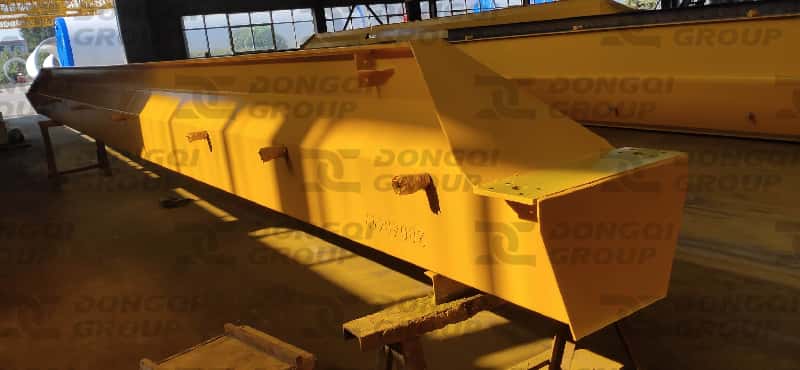
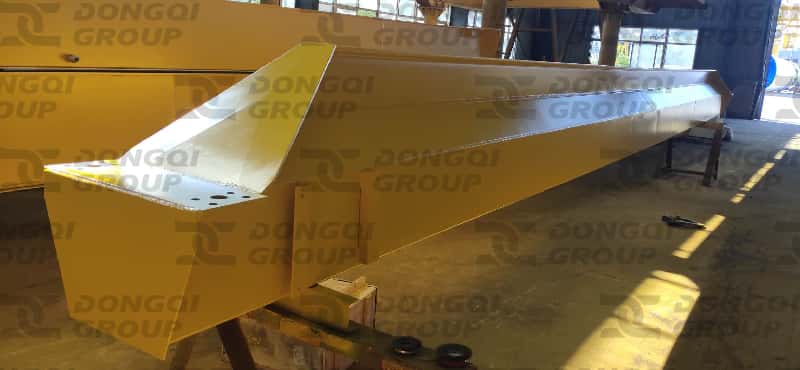
The first two photos in the collection focus on the main girder of the LD crane. For a procurement professional, the main girder is the backbone of your lifting operation. What should you be looking at here?
- Camber and Straightness: Observe the upward curve (camber) built into the beam. This is a critical quality control point for Dongqi production. The camber compensates for deflection when the hoist is loaded to its Safe Working Load (SWL). In these workshop images, you can clearly see the consistent profile of the I-beam and the reinforcement plates, ensuring that once installed in the Afghan workshop, the crane trolley moves effortlessly without “sloping” or drifting.
- Weld Seam Consistency: The close-up views (even within a wide-angle production floor shot) reveal the smooth, continuous fillet welds along the web-to-flange connection. This is not a box section merely tacked together; this is full-penetration welding suitable for the dynamic loads of an automotive repair bay—constant lifting of engines, transmissions, and armored vehicle components.
- Surface Preparation: The steel shows a uniform blasted finish, ready for the heavy-duty industrial paint system. For a customer in a landlocked, high-dust environment like Afghanistan, this pre-paint preparation is the difference between a 2-year and a 15-year service life.
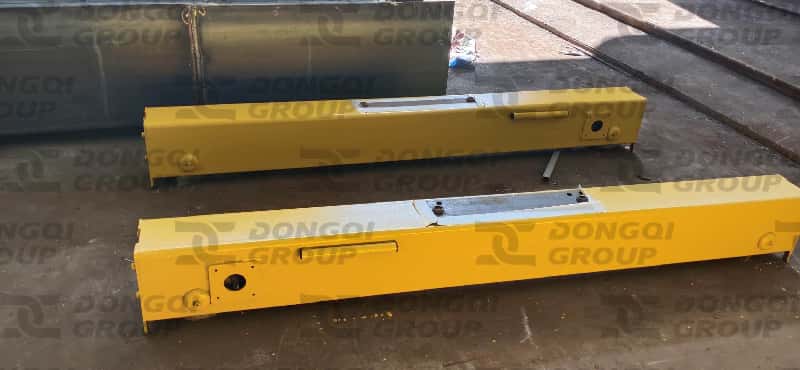
The third image is a detailed shot of the end carriage (or end beam) . Many purchasers focus only on the span and capacity of the girder, but the end carriage determines the long-term reliability of crane travel.
- Precision Alignment: Notice the bolt pattern and the machined surfaces where the main girder connects. This is a modular LD design, meaning the crane was partially disassembled for container shipping to Afghanistan. The precision visible here ensures that during reassembly on-site in Kabul (or the surrounding region), the crane tracks perfectly square to the runway rails—no skewing, no flange wear.
- Driven Wheel Assembly: You can see the direct-drive motor coupling. This is a standard Dongqi configuration for LD cranes, providing smooth acceleration and deceleration. For a vehicle workshop, jerky crane movement is a safety hazard when maneuvering a suspended V8 engine block over a chassis. The photo confirms the use of a robust, hard-wearing wheel profile designed for the A-series rail commonly found in industrial sheds.
- Buffer and Sweeping Plate: The end stops and rail sweepers are pre-installed. This demonstrates Dongqi’s “Complete Assembly Test” philosophy—we don’t just ship steel; we ship a system that has been mechanically aligned in our factory.
Why This Case Matters for Procurement Managers
If you are currently sourcing an LD-type or similar light-to-medium duty overhead crane for a workshop, hangar, or warehouse, these 2020 photos offer three tangible takeaways:
- Visibility Before Freight: Dongqi provides documented production evidence. You see your crane before it leaves the manufacturing floor. This mitigates the risk of shipping non-conforming goods to remote or challenging locations like Afghanistan.
- LD Modular Efficiency: The split between the main girder photos and the end carriage photo highlights why the LD series is the global workhorse for maintenance bays. It is optimized for containerized export. It fits in a standard 20ft or 40ft container, reducing your shipping costs significantly compared to a welded box girder crane.
- Proven Durability: This particular crane entered service in a dusty, heavy-use vehicle maintenance environment in 2020. The structural quality visible in these “birth photos” is the reason it is still operating reliably today.
Looking for a Similar LD Crane Solution?
Whether your next project is in the Middle East, Africa, Southeast Asia, or North America, the manufacturing standards remain the same. If you are preparing an RFQ for a single girder overhead crane, our team can provide you with a tailored technical proposal, including drawings, motor power specs, and lead time for dispatch.
Contact Dongqi Crane’s Export Department to discuss your lifting capacity (1t–20t) and span requirements. We provide the same photographic inspection service seen here for every unit we build.
