
5 Critical Questions Every Factory Must Answer Before Buying an Overhead Crane
Purchasing an overhead crane is a significant capital investment for any factory, warehouse, or manufacturing facility. Whether you’re setting up a new production line, expanding an existing plant, or replacing aging equipment, the decisions you make during the planning phase will impact your operational efficiency, maintenance costs, and workplace safety for the next 10 to 20 years.
Too often, buyers rush into requesting quotes with only one piece of information: “I need a 10-ton crane.”
While lifting capacity is important, it’s just the starting point. To get an accurate quote, a crane that fits your actual workflow, and a system that won’t become a maintenance headache, you need to dig a little deeper.
As a crane manufacturer with decades of global project experience, we’ve identified five non-negotiable questions you should answer before you send out your first request for quotation (RFQ). Answering these will not only speed up the procurement process but will also ensure you buy the right crane at the right cost.
Let’s dive in.
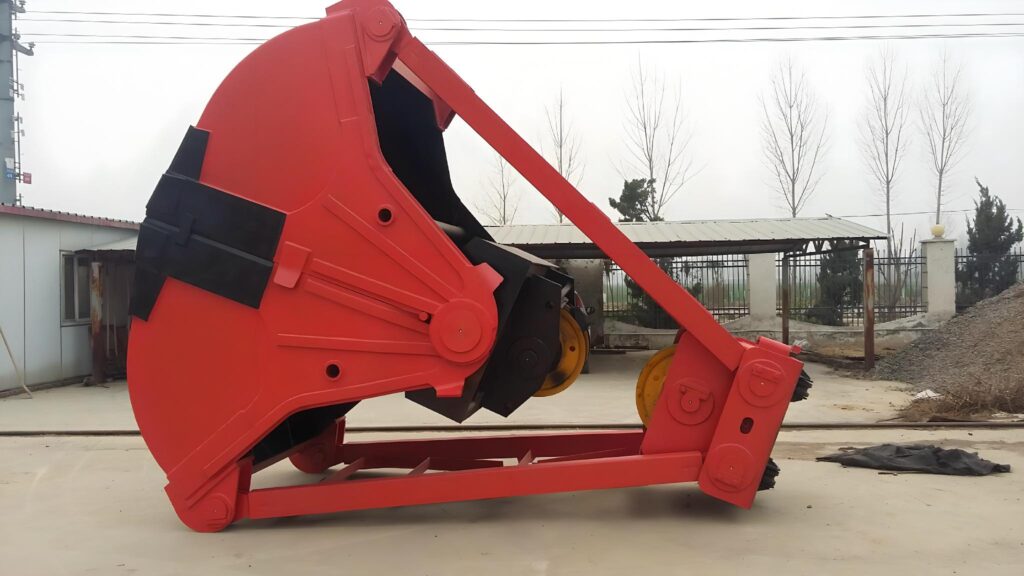
Question 1: What is the Actual Maximum Load and What Are You Really Lifting?
This sounds obvious, but it’s the most common source of crane mismatch.
The Pitfall:
Many buyers look at the heaviest single item they ever lift and use that number as the crane capacity. For example, they say “We need 20 tons” because the heaviest die or coil is 20 tons. But they forget to account for the weight of the lifting attachments—the spreader beam, the C-hook, or the magnet. If those attachments weigh 2 tons, a 20-ton crane is instantly overloaded.
What You Need to Define:
- Net Load: The weight of the product/material.
- Gross Load: Net Load + Weight of Lifting Attachments.
- Future Proofing: Will your products or dies get heavier in 5 years? It’s often more cost-effective to buy a slightly higher capacity now than to replace the entire crane structure later.
Pro Tip for Buyers:
Don’t just guess the weight. Check the engineering drawings or weigh the product. Also, distinguish between occasional lifts and routine lifts. If you only lift the 20-ton die once a month, a standard capacity crane works fine. If you’re lifting 20 tons every 10 minutes, 24 hours a day, you need a heavier-duty classification (which we cover next).
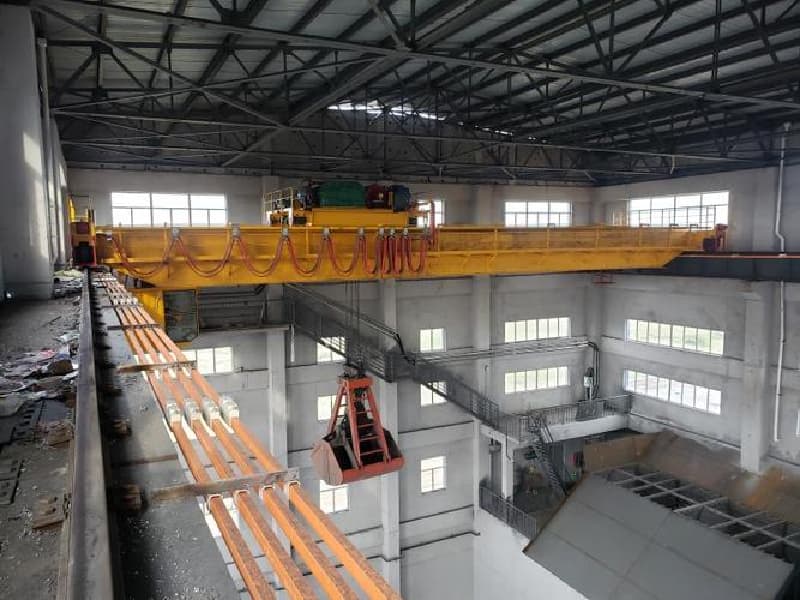
Question 2: What is Your Factory’s Work Duty Classification?
This is the most overlooked yet most expensive mistake in crane procurement. Two cranes can both be rated for “10 tons,” but one might cost twice as much and last three times longer. Why? Duty Cycle.
The Key Concept: FEM / ISO / CMAA Service Class
Crane classifications range from Class A (Standby/Infrequent) to Class F (Continuous Severe) . Here is the simple translation for factory owners:
| Class | Common Factory Scenario | What It Means for You |
|---|---|---|
| A3 / M3 (Light) | Maintenance bay, light assembly, occasional lifting. Average use: <2 hours/day, slow speeds. | You can save money on a lighter girder and hoist. |
| A5 / M5 (Medium) | Most common factory need. Machine shop, fabrication, warehouse loading. Regular use, moderate speeds. | This is the standard workhorse. Balanced cost and durability. |
| A7 / M7 (Heavy) | Steel mill, heavy stamping plant, bulk material handling. 24/7 operation, high speeds, shock loads. | You must invest in heavier structural steel, better bearings, and Class F insulation motors. |
The Buyer’s Mistake:
If you operate a steel processing facility with a 10-ton load lifted 20 times per hour, but you buy a Class A3 crane because the price was lower, the following will happen:
- Motors will burn out within 6 months.
- Gearboxes will leak or fail.
- The steel structure will develop fatigue cracks.
Actionable Question: “On my busiest day, how many lifts per hour do I make, and what percentage of the crane’s max capacity is that lift?” If the answer is “more than 50% capacity, more than 10 times per hour,” you need a higher class.
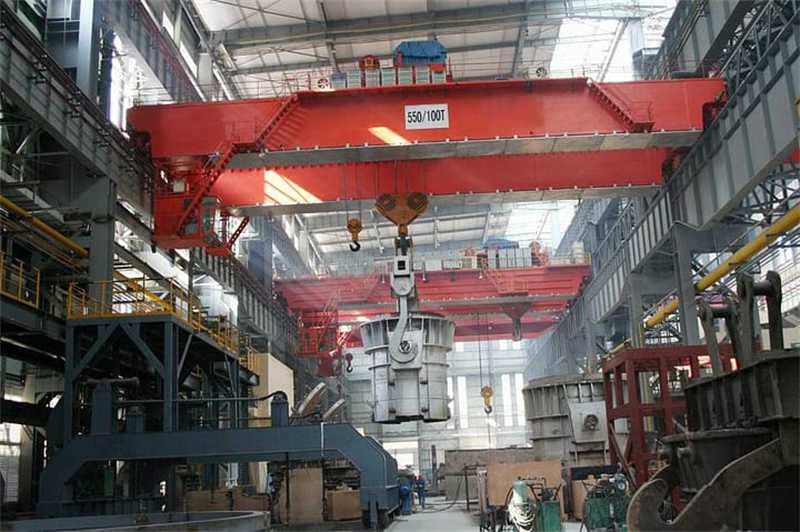
Question 3: What Are the Exact Dimensions of Your Building Envelope?
This is where “standard” cranes often fail to fit, leading to expensive civil works or disappointing performance.
Dimension 1: Headroom (Available Height)
- Hook Height (Lift): How high does the hook need to go? Example: Lifting a 3m tall mold over a 2m tall machine.
- Building Clearance: The distance from the floor to the lowest roof obstruction (truss, lights, sprinklers).
- The Reality Check: If you have low headroom, a standard single-girder crane with a top-running hoist might not fit. You may need a Low Headroom (LHR) Hoist or a Double-Girder Crane with a side-mounted trolley. Ignoring this means your hook won’t go high enough, or worse, the crane won’t fit in the building at all.
Dimension 2: Runway Span and Approach
- Span: The distance between the runway rails. This dictates the structural strength of the main girder.
- Hook Approaches: This is the distance the hook can reach toward the wall.
- Critical Check: If you have a workstation against the far wall, can the crane hook reach it? A standard crane might stop 1 meter short of the wall. If you need to service that area, you need an Extended Hook Approach design.
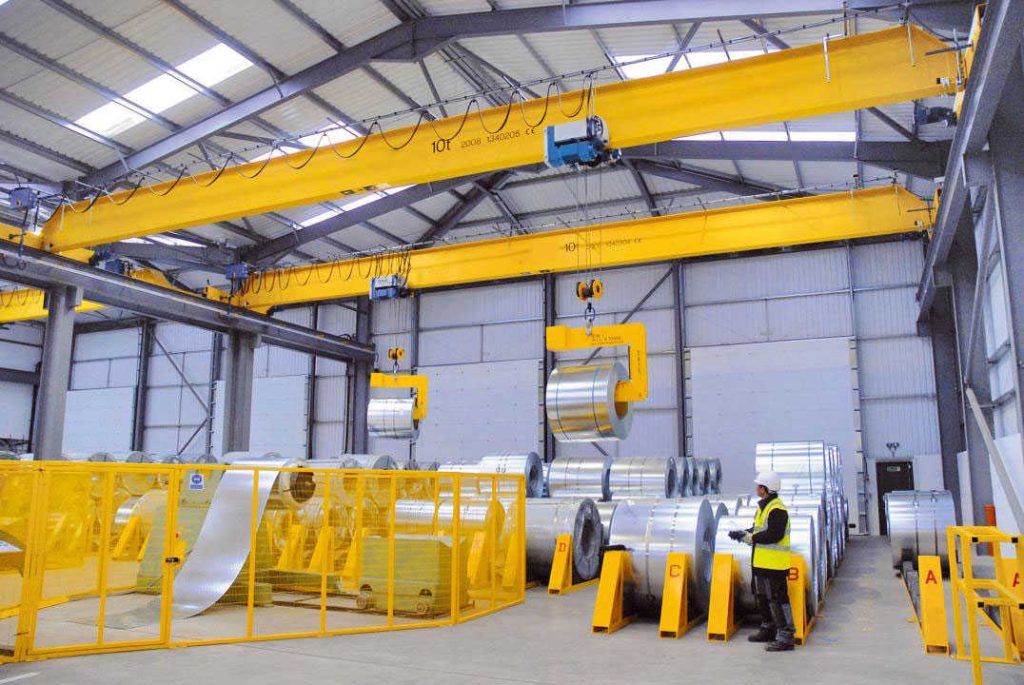
Table: Common Dimensional Constraints and Solutions
| Constraint | Problem | Solution |
|---|---|---|
| Low Ceiling (<6m) | Top-running hoist steals lift height. | Use Low Headroom Hoist or Underhung Crane. |
| Wide Columns / Obstructions | Crane cannot pass through building supports. | Use a Double-Girder Crane with walkways for clearance. |
| Wall-to-Wall Coverage Needed | Standard crane leaves dead space. | Specify “Minimum Hook Approach” in RFQ. |
Question 4: What Are Your Power Supply and Environmental Conditions?
The global supply chain means a crane built in one country might run on different power than the factory it ships to. Additionally, the factory environment dictates the protection level (IP Rating) of the components.
Electrical Requirements:
- Voltage & Phase: 230V/3Ph/60Hz (common in Americas), 400V/3Ph/50Hz (common in Europe/Asia), 415V/3Ph/50Hz (Australia), 480V/3Ph/60Hz (North America).
- Control Voltage: Ensure the control pendant or remote is safe (usually 24V or 48V).
- Buyer Advice: Always specify your local voltage standard in the RFQ. While VFDs (Variable Frequency Drives) can adjust speed, running a 50Hz motor on 60Hz power changes the motor life and speed curve.
Environmental Conditions:
Is your factory dusty? Wet? Hot? Corrosive?
| Environment | Required Protection | Example Scenario |
|---|---|---|
| Indoor Clean | IP20 – IP54 (Basic dust protection) | Assembly line, electronics plant. |
| Indoor Dusty/Gritty | IP55 (Dust protected, water jets) | Concrete plant, woodworking shop. |
| Outdoor / Coastal | IP65 (Dust tight, powerful jets) + C5M Corrosion Paint | Shipyards, ports, chemical plants. |
| Explosive (Gas/Dust) | ATEX / IECEx Certified (Flameproof) | Paint booths, grain silos, oil & gas. |
Important Note: If you are near the sea in a humid climate, do not skip the C5-M (Marine) paint specification. A standard industrial enamel will show rust bubbles within 12-18 months.
Question 5: How Will the Crane Be Installed and Maintained?
The cost of the crane hardware is only part of the total cost of ownership (TCO). Two critical logistics questions often derail budgets at the final stage.
A. Installation Access
- New Construction: If you are building a new factory, you can use a mobile crane to lift the bridge girders onto the runway from above. This is fast and cheap.
- Existing Factory: If you are replacing a crane in a live, operating factory, you may not be able to get a mobile crane inside. You might need to Build the Crane from Below (piece-by-piece lifting using chain blocks). This takes longer and requires more labor hours. Let your supplier know this upfront.
B. Future Maintenance Strategy
How will your team inspect the crane?
- Single Girder Cranes: Often maintained from a ladder or scissor lift.
- Double Girder Cranes: For larger cranes or busy factories, we strongly recommend a Walkway with Handrail on one side of the bridge. This allows maintenance staff to walk safely along the length of the crane to inspect wire ropes, gearboxes, and collectors. This is not a standard feature—it must be requested.
Summary: The Smart Buyer’s Checklist
Before you hit “send” on that email inquiry, run through this quick self-audit. Having these answers ready will instantly position you as a knowledgeable buyer and ensure you receive a technically accurate, apples-to-apples quotation.
- [ ] Load: Max Gross Weight (Product + Rigging) = _ Tons.
- [ ] Usage: I lift approximately _ times per hour/day.
- [ ] Building: Hook Height Needed = ft/m. Span = ft/m. Ceiling Clearance = _ ft/m.
- [ ] Power: My facility voltage is V / Ph / _ Hz.
- [ ] Environment: My facility is (Select one): Clean / Dusty / Wet / Corrosive / Outdoor.
- [ ] Installation: Is this a New Build or Retrofit in an Existing Building?
Ready to Get a Precise, Lifecycle-Optimized Quote?
Taking 10 minutes to clarify these five points saves weeks of back-and-forth engineering questions and protects you from buying the wrong equipment.
At Dongqi crane , we specialize in matching global factories with overhead crane solutions that fit their specific workflow, not just their tonnage. Whether you need a light-duty workstation crane or a high-capacity process crane for a steel mill, we help you navigate the selection process from the first sketch to the final lift.
