
Customized Type 30t Double Beam EOT Overhead Crane
Introduction
The 30-ton capacity marks a definitive frontier in industrial lifting, where operations are characterized not only by immense weight but by the profound strategic importance of each handled component. At this scale, the lifted assets are often the heart of a production line or a multi-million-dollar capital project—a generator stator, a ship’s propulsion unit, or a chemical reactor. A generic crane at this capacity is a liability; a Customized Type 30t Double Beam EOT Overhead Crane is engineered as a high-availability, precision-engineered production platform. This guide details how a fully bespoke 30-ton solution is architected to deliver uncompromising reliability and surgical control, transforming the most formidable material handling challenges into seamless, predictable, and safe processes at the core of heavy industry.
The Design Philosophy: Mastering the Critical Mass with Intelligent Force
Managing a 30-ton load transcends simple strength; it demands the mastery of physics on an industrial scale. The kinetic energy, structural deflections, and dynamic forces involved require a holistic engineering approach where safety, precision, and durability are designed in from the first calculation, not added on.
The philosophy for a 30-ton crane is rooted in achieving dynamic equilibrium. It must possess a structural architecture with significant performance headroom, engineered to absorb peak dynamic loads and operational stresses over a decades-long service life without degradation. Simultaneously, its drive and control systems must exhibit a level of sophistication that allows operators to command this immense potential energy with the finesse of a precision instrument. Customization is the rigorous process of defining this equilibrium point for your specific operational envelope, ensuring the crane is an enabler of efficiency, not a constraint governed by its own limitations.
Critical Engineering Domains for 30-Ton Performance
1. Advanced Structural Dynamics & Fabrication Integrity
The superstructure is a feat of applied mechanical engineering, designed for exceptional stiffness and longevity.
- Performance-Optimized Girder Systems: Utilizing non-linear Finite Element Analysis (FEA) and dynamic load modeling, we design girders that prioritize minimal deflection and high torsional rigidity. For long spans or high-speed applications, a patented, internally-reinforced box girder or a hybrid steel-aluminum design may be employed to achieve an optimal strength-to-weight ratio, thereby minimizing deadweight and maximizing payload efficiency relative to building structure limits.
- Engineered Drive & Bogie Systems: The end trucks evolve into robust bogie assemblies. These may feature eight or more wheels per end truck, distributing extreme wheel loads across the runway. Forced steering mechanisms or electronically synchronized independent drives are standard considerations to eliminate bridge skew, ensure perfect rail alignment, and prevent damaging scrubbing forces on long travel paths.
2. High-Torque, Redundant Motion & Drive Systems
Power delivery is engineered for both immense capability and flawless control.
- Redundant Hoist Drive Systems: The primary hoist is designed as a multi-redundant system. Configurations can include dual-motor drives with torque sharing, or a main hoist coupled with a fully independent auxiliary hoist for critical tandem lifts or maintenance backup. Components such as forged alloy steel shafts, precision-cut helical gears, and machined drums are specified for maximum service life under A6/A7 duty cycles.
- Regenerative AC Vector Drive Systems with Active Front Ends (AFE): State-of-the-art AFE drives provide not only regenerative braking but also near-unity power factor and minimal harmonic distortion to the plant grid. This technology allows for sensorless vector control, providing the highest possible torque accuracy and speed regulation for smooth, responsive handling of the 30-ton mass, even in unstable load conditions.
3. Enterprise-Level Control, Diagnostics, and Automation
The control system is the intelligent core, enabling both manual expertise and automated efficiency.
- Distributed Control Architecture with Safety Network: A primary industrial PLC manages operational logic, while critical safety functions are handled by a dedicated, certified Safety PLC (up to SIL3/PL e) communicating via a failsafe network. All I/O is distributed, reducing wiring complexity and improving diagnostics.
- Comprehensive IoT & Predictive Analytics Platform: The crane is equipped as a node on the Industrial Internet of Things (IIoT). An array of sensors feeds data on load cycles, motor performance, structural strain, and component health into a cloud or on-premise analytics platform. This enables true predictive maintenance, lifetime load history tracking, and performance optimization through data-driven insights.
4. Systemic Safety, Prognostics, and Functional Resilience
Safety is an architecturally embedded, multi-layered, and self-monitoring feature.
- Integrated Smart Load Management System: This goes beyond overload protection to include dynamic load weighing, center-of-gravity monitoring, and automatic configuration of speed/torque limits based on the selected lifting attachment and actual load moment.
- Prognostic Health Management (PHM) Network: Vibration analysis, oil condition monitoring (for gearboxes), thermal imaging of electrical panels, and acoustic emission sensors create a comprehensive health picture. The PHM system predicts remaining useful life of components, scheduling maintenance proactively to maximize uptime and prevent unscheduled stoppages.
Technical Specifications: The Blueprint for 30-Ton Industrial Mastery
The following table details the engineered framework for a Customized Type 30t Double Beam EOT Crane. Each parameter is a result of a deliberate design choice to meet your specific performance criteria.

| Parameter | Engineering Baseline | Customization Imperative for 30t |
|---|---|---|
| Capacity | 30 Tons (60,000 lbs) | Design per global standards (FEM 1.001, ISO 8686, CMAA Class F). Requires full documentation package including FEA reports, weld procedures, and certification (e.g., ABS, DNV for marine). |
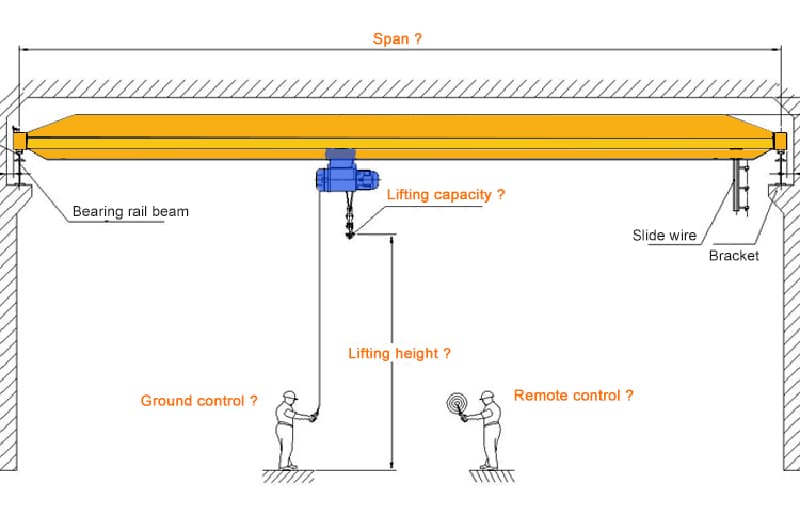
| Span | Fully Custom (Up to 60m+) | Critical engineering decision. May involve custom girder profiles, consideration of lattice/truss design for extreme spans, or integration of tie-bars for enhanced stiffness. Dynamic analysis for deflection is mandatory. |
| Lifting Height | Fully Custom | Typically features a two-speed or infinitely variable-speed hoist with a dedicated micro-speed range for precision placement. Rope reeving is engineered for optimal fleet angle and longevity. |
| Duty Class | A6/A7 (Continuous Severe / Very Heavy Duty) | Standard for primary industries. All mechanical and electrical components are rated for high thermal class and extreme mechanical endurance. |
| Control Power | 480V / 690V / 1kV, 3 Phase, 50/60Hz | Complete power distribution design, including harmonic mitigation (AFE drives), power factor correction, and may require a dedicated substation. Emphasis on voltage stability and protection. |
| Control System | Distributed PLC + SIL3 Safety PLC + AFE Drive Technology | Enables complex automation sequences, highest safety integrity, superior power quality, and full system diagnostics. |
| Speeds (Engineered Range) | Optimized for overall productivity with supreme focus on controlled acceleration/deceleration and load stability. | |
| – Hoisting | 1.8 ~ 5.5 m/min | |
| – Trolley Traverse | 10 ~ 15 m/min | |
| – Bridge Travel | 12 ~ 20 m/min | |
| Girder Configuration | Engineered Heavy-Duty Double Girder (Advanced Box, Truss, or Hybrid) | Selection is a core project phase, based on a detailed trade-off study of stiffness, weight, cost, and manufacturability. |
| Safety & Monitoring | SIL3 / PLe Compliant Architecture with Integrated PHM | Focus on highest functional safety, cybersecurity for networked systems, and data-driven predictive maintenance. |
| Environmental Specification | Up to IP66, Corrosion Class C5-M | Comprehensive packages for extreme environments: foundries (heat shields), chemical plants (air purged panels), offshore (splash zone protection). |
| Protective Coating | Long-Term Corrosion Protection (e.g., thermal spray metallization with sealed multi-coat paint system) | Designed for minimal total cost of ownership over a 25+ year lifespan in aggressive industrial settings. |
Ideal Applications: The Core of Ultra-Heavy Industry
This crane is the definitive solution for industries where 30-ton lifts are routine and operational excellence is non-negotiable.
- Heavy Casting & Forging Operations: Handling massive steel ingots, large forging dies, and finished castings like turbine housings or press frames. Customization focuses on extreme duty cycles (A7/A8), heat-resistant components, and specialized lifting beams for hot material.
- Shipbuilding & Offshore Construction: Moving and positioning large prefabricated hull blocks, offshore platform modules, and main propulsion engines. Demands very high lifting heights, wide spans, outdoor durability with high wind rating (e.g., SEVERE), and often compliance with marine classification society rules.
- Power Generation (Nuclear & Large Thermal): Installing and maintaining critical components like steam turbines, generators, heat exchangers, and reactor pressure vessels. Requires exceptional precision, documented quality assurance (N-stamp welding), seismic qualification, and unparalleled reliability.
- Large-Diameter Pipeline & Heavy Fabrication: Manipulating mega-sections of pipe, heavy pressure vessels, and mining truck frames. The crane must provide exceptional stability for welding, often with motorized load rotation and anti-sway systems.
- Aerospace: Assembly of Large Aircraft: Positioning wing assemblies, fuselage sections, and complete airframes. Emphasizes cleanroom-compatible operation (low particulate generation), vibration isolation, and sub-millimeter positioning repeatability.
Your Project Foundation: The Technical Specification Dialogue
To initiate the engineering of your 30-ton solution, a comprehensive and collaborative technical foundation is required:
- Total Load & Operational Spectrum Analysis: Detailed dossier on all loads (weights, dimensions, CGs, frequencies). A statistical analysis of the duty cycle (load spectrum, starts per hour, annual operating hours).
- Comprehensive Facility & Infrastructure Audit: Certified structural drawings of the building and runway supports with precise load capacity data. Complete details of the electrical infrastructure (available short-circuit current, transformer capacity, harmonic distortion limits).
- Process Integration & Automation Blueprint: Detailed sequence of operations (SOP) for the crane’s role. Specification of required interfaces with other plant systems (MES, ERP), communication protocols (Profinet, EtherCAT), and desired level of autonomy.
- Performance, Environmental & Compliance KPI’s: Defined targets for availability (>99.5%), positioning accuracy, noise levels, and a full environmental profile. All applicable regulatory and insurance requirements must be documented.
- Lifecycle & Support Requirements: Expectations for documentation (3D models, as-built drawings), training, spare part strategy, and remote support capabilities.
Conclusion: The Strategic Capital Asset for Industrial Leadership
Procuring a Customized Type 30t Double Beam EOT Overhead Crane is a capital decision that defines the ceiling of your plant’s heavy-lift capability. It is the acquisition of a high-intelligence, ultra-reliable industrial partner engineered to handle your most critical and heaviest assets with a degree of precision and confidence that defines world-class manufacturing and construction. This crane is not an expense; it is a strategic asset that safeguards project timelines, protects invaluable equipment, and underpins a reputation for executing the most demanding industrial tasks.
Initiate Your Ultra-Heavy Engineering Partnership
The path to your definitive 30-ton system begins with a joint technical exploration. Contact our advanced projects engineering team to schedule a detailed site assessment and a collaborative specification workshop. Let us demonstrate how a purpose-built 30-ton crane can be engineered as the cornerstone of your facility’s most ambitious operations.
Navigate Our Ultra-Heavy Lifting Portfolio:
- For demanding heavy industrial applications, explore the engineered performance of our [Customized Type 25t Double Beam EOT Crane].
- To step into the domain of mega-lifting for primary industries, investigate the capabilities of our [Customized Type 40t Double Beam EOT Cranes].
