
Customized Type 20t Double Beam EOT Overhead Crane
Introduction
The 20-ton capacity represents a definitive entry into the realm of heavy industrial lifting. At this scale, operations are no longer merely about moving objects; they are about orchestrating the flow of core production assets—massive machinery, industrial modules, and dense material batches—where precision, safety, and uptime are inextricably linked to profitability. A standard overhead crane may offer the nominal strength, but a Customized Type 20t Double Beam EOT Overhead Crane is engineered as a mission-critical production system. This guide details how a fully tailored 20-ton solution transforms into the operational backbone of facilities where lifting is the pivotal link in the value chain, demanding an uncompromising blend of brute strength and sophisticated control.
The Design Philosophy: Where Structural Integrity Enables Operational Finesse
Handling 20-ton loads introduces profound engineering challenges: immense structural stresses, significant kinetic energy, and the absolute imperative of controlled movement. Off-the-shelf solutions often force a trade-off, but customization synthesizes these demands into a cohesive, high-performance unit.
The philosophy for a 20-ton crane is built on a paradox it must resolve: being powerfully robust enough to withstand relentless heavy-duty cycles with unwavering reliability, while simultaneously being precisely responsive enough to place a load with millimeter accuracy. This is achieved through a holistic, application-driven design process where every component—from the metallurgy of the girders to the algorithm in the drive—is purpose-selected to ensure the crane operates not as a blunt instrument, but as a seamless, predictable, and intelligent extension of the industrial process it serves.
Critical Domains of Custom Engineering
1. Uncompromising Structural Dynamics
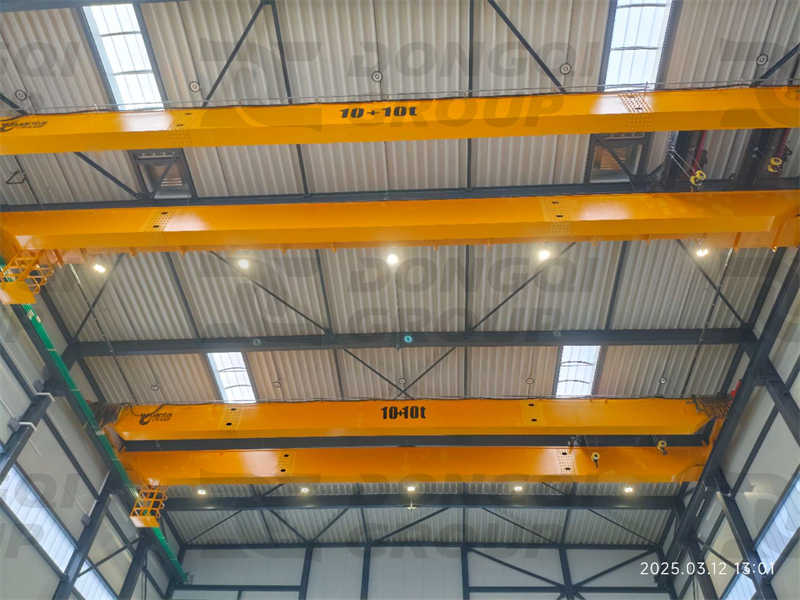
The double girder structure is the crane’s skeleton, designed for maximum stiffness and fatigue life under severe loading spectra.
- Ultra-Stiff Girder Design: Utilizing high-tensile steel, our girders are engineered using advanced computational modeling to achieve optimal section modulus. The goal is to minimize long-span deflection and ensure torsional rigidity, which is critical for maintaining alignment and smooth travel when handling long, heavy loads like steel beams or concrete forms.
- Heavy-Duty End Truck & Drive Assemblies: End trucks are fabricated with reinforced diaphragms and house large-diameter, forged steel wheels running on high-capacity precision bearings. Customization often includes dual-motor four-wheel drive configurations on the bridge for superior traction, balanced power distribution, and elimination of skewing across wide spans.
2. High-Torque, Precision Motion Systems
The drive systems must master the inertia of massive loads.
- Industrial-Grade Hoisting Unit: The hoist is engineered as a dedicated powerhouse. It features a high-torque, duty-rated motor, a hard-geared, high-integrity gearbox, and a drum designed for perfect rope spooling under full load. Options include two-speed or variable-frequency micro-speed control for flawless final positioning.
- Advanced Vector Drive Technology: Regenerative AC Vector VFDs on all motions are essential. They provide full torque at zero speed for holding loads steady, precise speed regulation across the entire range, and the ability to convert braking energy back into the power system, enhancing efficiency and control.
3. Integrated Control & Automation Hub
Control evolves into comprehensive process management.
- Centralized Intelligent Control Panel: A PLC-based system acts as the crane’s brain, managing all motions, safety interlocks, and diagnostic functions. It provides interfaces for Profibus, Ethernet/IP, or Modbus TCP integration with wider factory automation systems.
- Advanced Operator Interfaces: Ergonomic, multi-function radio remote controls with OLED displays showing real-time parameters (load, height, diagnostics), or fully equipped, climate-controlled operator cabs with panoramic visibility, are tailored to the operating environment and duty cycle.
4. Proactive, Multi-Tiered Safety & Health Monitoring
Safety transcends basic interlocks to become a predictive, systemic feature.
- Layered Protective Systems: In addition to mandatory overload protection and limit switches, systems like absolute encoder-based position control, load sway prevention (active or passive), and infrared zone protection create a safe operational envelope.
- Condition & Performance Monitoring: Integrated sensors continuously monitor key health indicators: motor winding temperature, gearbox oil temperature and vibration, brake lining wear, and structural stress points. Data can be fed into a predictive maintenance platform, enabling proactive servicing and preventing catastrophic failures.
Technical Specifications: The Blueprint for 20-Ton Performance
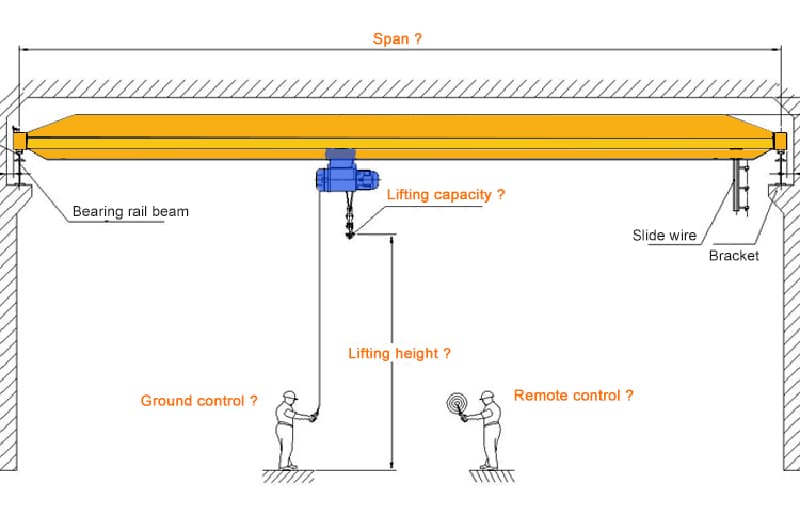
The following table outlines the engineered parameters of a Customized Type 20t Double Beam EOT Crane. Each specification is a variable to be optimized for your unique operational equation.
| Parameter | Standard Baseline | Engineering Focus for 20t Customization |
|---|---|---|
| Capacity | 20 Tons (40,000 lbs) | Emphasis on rigorous design codes (FEM 1.001, CMAA), and documented load testing (e.g., 125% static, 110% dynamic). |
| Span | Fully Custom (Up to 50m+) | Structural design is critical. May involve reinforced box girders, truss girders, or patented designs to achieve required stiffness with optimal weight. |
| Lifting Height | Fully Custom | Dual-speed hoisting (main/auxiliary or micro-speed) is standard for precision. Multi-fall reeving may be used for very high lifts. |
| Duty Class | A5/A6 (Severe / Continuous Severe) | Standard for steel mills, foundries, and heavy fabrication. Components are selected for high thermal and mechanical stress endurance. |
| Control Power | 480V/690V, 3 Phase, 50/60Hz | Electrical design includes power factor correction, harmonic mitigation, and robust short-circuit protection. |
| Control System | Industrial PLC + Regenerative Vector VFDs | Enables speed/torque precision, anti-sway algorithms, and seamless automation integration. |
| Speeds (Typical Range) | Optimized for cycle time while prioritizing control and stability of heavy loads. | |
| – Hoisting | 2.5 ~ 7.0 m/min | |
| – Trolley Traverse | 15 ~ 20 m/min | |
| – Bridge Travel | 20 ~ 30 m/min | |
| Girder Type | Heavy-Section Box-Type or Truss-Type Double Girder | Selected based on span, speed, and deflection criteria. Focus on dynamic stability. |
| Safety Architecture | Fault-Tolerant, Redundant Systems | Includes redundant braking paths, dual-channel safety PLCs, and collision avoidance systems for multi-crane bays. |
| Environmental Class | Up to IP55/IP65, Corrosion-Resistant | Specific sealing, coatings (e.g., thermal spray aluminum), and component choices for mills, foundries, or coastal sites. |
| Surface Treatment | High-Performance Protective Coating System | Typically involves blast cleaning, zinc-rich epoxy primer, and polyurethane topcoat for durability. |
Ideal Applications: The Domain of Industrial Heavyweights
This crane is the definitive solution for core heavy industries where its capacity is a daily driver of production.
- Steel Service Centers & Rolling Mills: Handling 20-ton coils of steel, slabs, and bundles of structural beams. Customizations focus on C-hook or motorized coil lifter integration, high-duty cycle (A6) components, and exceptional travel stability to prevent load oscillation.
- Heavy Fabrication & Wind Tower Manufacturing: Positioning and turning large weldments for wind turbine sections, mining truck frames, or pressure vessels. Requires high precision, large spans, and often outdoor capabilities with wind-load ratings.
- Power Generation (Thermal & Hydro): Installing and maintaining giant turbines, generators, transformers, and penstocks. Demands exceptional reliability, often in congested spaces, with features like rotational trolleys or special lifting attachments.
- Large-Scale Precast Concrete Production: Handling massive concrete elements like bridge girders, tunnel segments, and architectural panels. Crane design prioritizes gentle, controlled handling to prevent cracking, and adaptive spreader beams for various product shapes.
- Port Machinery & Shipyard Logistics: Serving as a primary handling tool in dry docks or component yards for moving ship sections, engines, and large machinery. Customization addresses robustness for outdoor marine environments, high winds, and integration with transport systems.
Defining Your Specification: The Foundation for Success
To engineer your optimal solution, a detailed operational profile is essential:
- Comprehensive Load Spectrum: Data on maximum load, typical loads, their physical dimensions, centers of gravity, and required lifting attachments (spreader beams, magnets, etc.).
- Facility Infrastructure Audit: Detailed runway drawings (including beam type, rail specification, and support column locations), available power supply characteristics, and all spatial constraints.
- Process Integration Map: Detailed workflow showing how the crane interacts with other equipment (furnaces, presses, CNCs), required cycle times, and desired level of automation (manual, semi-auto, full-auto).
- Performance & Environmental Specifications: Required positioning accuracy, priority speeds, and a full description of the ambient environment (temperature, humidity, particulates, corrosives).
- Regulatory & Compliance Requirements: Any specific industry standards or safety regulations that must be met (e.g., nuclear, military, special seismic zones).
Conclusion: The Strategic Asset for Heavy Industrial Dominance
Investing in a Customized Type 20t Double Beam EOT Overhead Crane is a strategic declaration to build unmatched capability and resilience into your production foundation. It transcends being equipment; it becomes a high-availability, high-precision production partner that directly safeguards your throughput, capital assets, and workforce safety. This crane empowers you to handle your most critical and massive components not just with strength, but with confidence, control, and intelligent efficiency.
Initiate Your Heavy-Duty Engineering Partnership
The path to your definitive 20-ton solution begins with a deep-dive analysis. Contact our heavy-equipment engineering team to schedule a detailed site assessment and a collaborative technical specification workshop. Let us demonstrate how a purpose-built 20-ton crane can become the most reliable and productive force multiplier in your facility.
Explore Our Heavy-Lifting Range:
- For robust precision in critical applications, review our [Customized Type 15t Double Beam EOT Crane] solutions.
- To step into the league of ultra-heavy industry, investigate the engineered capabilities of our [Customized Type 25t Double Beam EOT Cranes].
