
2025 Indoor Crane Market Insights: Understanding Key Choices and Applications
Ever found yourself standing in your facility, wondering which indoor crane is the right fit for the job? You’re not alone. Choosing between an indoor overhead crane for fixed paths or a flexible indoor gantry crane can be tricky, especially when every space and task seems to have its own demands.
Looking at what businesses actually chose in 2025 can give us some helpful clues. The trends from last year’s selections show clear patterns—not necessarily about the “best” crane, but about the right crane for specific needs. For instance, compact indoor crane systems like the HD-type European design were frequently selected for efficient, day-to-day handling, while portable options dominated when mobility was a priority.
Let’s break down what these choices mean and how they might help you in your own decision-making process.
Market Trends and Product Performance: Insights from Dongqi Crane’s 2025 Data
The indoor crane market in 2025 has been shaped by a clear industrial imperative: maximizing efficiency within existing footprints. Businesses across manufacturing, warehousing, and assembly are prioritizing solutions that offer not just lifting power, but also space optimization, energy savings, and operational flexibility. This trend is vividly reflected in the annual sales data from Dongqi Crane, a prominent Chinese manufacturer known for its European-standard crane technology. Their product performance serves as a reliable barometer for what practical features and configurations are resonating most with customers today.
Dongqi Crane’s 2025 sales figures reveal a decisive preference for specific types of equipment, highlighting two dominant themes in customer choice:
| Product Category | Top-Performing Model | 2025 Sales Performance at Dongqi Crane | Primary Market Driver |
|---|---|---|---|
| Overhead Cranes | HD-Type European Single-Girder Crane | Accounted for over 50% of total sales revenue. | Space and Energy Efficiency: Compact design maximizes usable vertical workspace and reduces building load. |
| QDX-Type Double-Girder Crane | Ranked second in overall sales. | Robust Performance for Demanding Applications: Preferred for stability with heavier loads and longer spans. | |
| Gantry Cranes | Portable Indoor Gantry Crane | Dominated its category, representing over 80% of all gantry units sold. | Operational Flexibility & Mobility: Meets the need for adaptable, movable lifting without permanent installation. |
Interpreting the Trends: Why These Products Led
The overwhelming popularity of the HD-Type European Single-Girder Crane aligns perfectly with the industry-wide shift towards smarter space utilization. As a company focused on European-standard designs that emphasize being “energy-saving, lightweight, and compact”, Dongqi’s HD-type model addresses key pain points. It allows facilities, especially those with height restrictions or older structures, to gain greater hook height without costly building modifications. Its lower wheel load also minimizes stress on existing building structures, making it a cost-effective and efficient indoor overhead crane solution for a vast range of general material handling tasks.

The strong showing of the Portable Indoor Gantry Crane underscores a growing need for agility in workshops and warehouses. Unlike fixed systems, these cranes can be deployed exactly where needed, adapting to changing workflows, maintenance schedules, or project-based work. Their dominance in Dongqi’s gantry sales indicates that customers highly value this “plug-and-play” versatility, often using them as a complementary small indoor crane or a primary indoor mobile crane solution for dynamic environments. This reflects a move away from fixed, single-point solutions towards more adaptable material handling strategies.
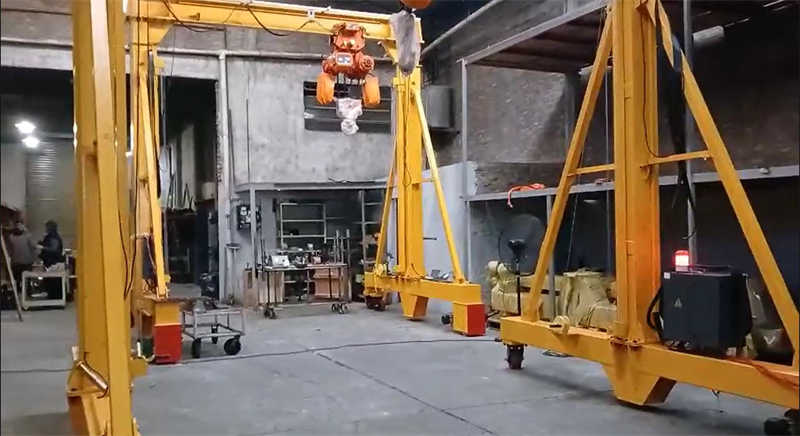
Dongqi Crane’s position as a recognized player in segments like electric wire rope hoist single-girder cranes and its commitment to technological partnerships provide context for this product success. Their sales data suggests that customers are not just buying cranes; they are investing in integrated indoor crane systems that offer long-term value through durability, lower total cost of ownership, and alignment with modern industrial design principles focused on efficiency and flexibility.
Analysis of Key Indoor Crane Types and Their Uses: The Dongqi Crane Portfolio
Selecting the right indoor crane is about matching specific technical features to your operational challenges. Based on Dongqi Crane’s 2025 sales data and market feedback, customer choices clearly map to distinct application needs. The following analysis expands on the previously mentioned bestsellers and details other key models in Dongqi’s portfolio, providing a comprehensive guide to their design purpose and ideal use cases.
| Product Category | Dongqi Model | Key Design & Engineering Purpose | Primary Application Scenarios |
|---|---|---|---|
| Overhead Cranes | HD-Type European Single-Girder | Maximizes space and energy efficiency with a compact, lightweight design, low headroom, and reduced wheel load. | General manufacturing, assembly lines, workshops with height restrictions; the go-to for efficient, daily material handling. |
| LD-Type Single-Girder | An economical and reliable standard-duty indoor overhead crane solution with a simple structure for straightforward lifting tasks. | Workshops, warehouses, and stations requiring cost-effective, periodic lifting of light to medium loads. | |
| QDX/LH-Type Double-Girder | Provides superior stability, higher lift height, and robust construction for heavy-duty, high-cycle operations over larger spans. | Steel yards, machining centers, pulp & paper plants, and applications involving heavy or lengthy loads. | |
| LB-Type Explosion-Proof | Engineered with special motors, electrical components, and enclosures to prevent ignition in hazardous atmospheres. | Chemical plants, paint shops, grain silos, oil & gas facilities, and any area with flammable dust, vapors, or gases. | |
| Gantry Cranes | Portable Indoor Gantry | Offers ultimate flexibility with a mobile, modular design requiring no permanent installation; an indoor mobile crane for variable points. | Maintenance areas, loading docks, temporary work cells, and facilities with frequently changing workflow layouts. |
| MH Single-Girder Gantry | A cost-effective, fixed or semi-permanent indoor gantry crane solution where overhead runways are not available or practical. | Fabrication shops, warehouse loading bays, and outdoor storage areas under a canopy for dedicated lifting stations. | |
| MG Double-Girder Gantry | Delivers high capacity and stability for heavy-duty outdoor or large-span indoor applications at a fixed location. | Shipyards, heavy equipment assembly halls, and lumber yards requiring powerful, stationary lifting over a wide area. |
Connecting Features to Function: A Practical Guide
The popularity of Dongqi’s HD-Type European Crane and Portable Gantry Cranes underscores two major market demands: spatial efficiency and operational flexibility. Facilities constrained by existing building dimensions find immense value in the HD-Type’s ability to provide maximum hook height without structural modifications. Conversely, dynamic workshops prioritize the mobility of a portable indoor gantry crane, which can be deployed as needed, turning any floor space into a temporary lifting station.
For specialized industrial environments, the LB-Type Explosion-Proof Crane is not merely an option but a mandatory safety investment. Its design addresses the critical need for safe indoor crane systems in hazardous locations, a niche yet essential segment of the market. Meanwhile, the classic LD/LH and MH/MG models represent the reliable workhorses for standard and heavy-duty applications, respectively, where duty cycle and load capacity are the primary drivers over extreme space-saving or mobility.
Actionable Insights for Your Selection:
- For Maximizing Existing Space: Prioritize European-design cranes (like the HD-Type) or low-headroom models.
- For Dynamic, Multi-Point Lifting: Explore portable indoor gantry cranes or indoor mobile crane solutions.
- For Repetitive, Heavy-Duty Cycles: Consider double-girder structures (QDX, LH, MG) for their durability and stability.
- For Hazardous Environments: An explosion-proof certified crane (LB-Type) is the only compliant and safe choice.
- For Cost-Effective, Standard Needs: Standard single-girder models (LD, MH) often provide the best value for predictable, periodic tasks.
This analysis illustrates that “popularity” in Dongqi’s 2025 data is a direct reflection of how well a product’s engineered purpose solves a common industrial challenge. By aligning your facility’s specific constraints (space, process flow, load, environment) with the design intent of these crane types, you can effectively narrow down the optimal indoor crane for sale for your operation.
What Influenced These Choices in 2025?
Several practical factors drove these selection trends. For many facilities, especially older buildings or those with dense layouts, space optimization is critical. Cranes with lower headroom, like the European-style designs, allow for greater hook height without requiring costly building modifications. This makes an efficient indoor overhead crane a strategic investment for maximizing usable cubic space.
Furthermore, the need for adaptability in production and maintenance workflows has grown. The strong preference for portable indoor crane solutions reflects this. Businesses value equipment that can be easily moved to where the work is, whether for servicing machinery, handling materials in multiple locations, or adapting to changing project layouts. This makes a versatile indoor mobile crane or portable indoor gantry crane an essential tool for dynamic operational environments.
Finally, considerations of total cost of ownership extend beyond the initial price. Buyers increasingly evaluate installation expenses, energy consumption, and long-term maintenance. Equipment that offers easier integration into existing facilities or lower operational costs often presents a more compelling long-term value, influencing purchase decisions.
Guidance for Selecting Your Indoor Crane
To navigate the available options for an indoor crane for sale, consider these steps based on observed 2025 trends:
- Define Your Core Need: Is the lifting path fixed or variable? For repetitive, fixed-path movement along a runway, an indoor overhead crane system is likely optimal. For tasks that move across different floor areas, a mobile indoor gantry crane offers the necessary flexibility.
- Audit Your Facility Constraints: Precisely measure available headroom, floor space, and floor load capacity. Space-constrained facilities often benefit from the compact design of European-style cranes, while open areas with heavy loads may require a double-girder or fixed gantry solution.
- Consider Operational Workflow: Evaluate how the crane integrates into your process. For dedicated production lines, a fixed crane provides efficiency. For maintenance, repair, and multi-use areas, the mobility of a small indoor crane or portable gantry is a key advantage.
- Plan for the Future: Consider how your needs might change. Modular or adjustable systems can offer better adaptability over time.
Common Questions (FAQs)
- Q: I need a crane for general use in my workshop. What is a common starting point?
- A: Many operations begin with evaluating a single-girder indoor overhead crane, such as the European-style models. They provide a good balance of capacity, space efficiency, and cost for general material handling.
- Q: When should I consider a portable gantry crane over an overhead crane?
- A: Choose a portable indoor gantry crane for sale if your lifting points change, if you have no overhead runway structure, or if you need a temporary or mobile solution. It is ideal for flexibility without permanent installation.
- Q: What does “double-girder” offer that “single-girder” does not?
- A: A double-girder indoor crane system, like the QDX-type, typically offers higher lift heights (as the hoist sits between girders), greater stability for heavier or longer loads, and durability for more intensive duty cycles.
Conclusion: Finding Your Perfect Fit in the Indoor Crane World
So, what does all this data and detail mean for you? At its heart, the 2025 trends tell a simple story: there’s no single “best” indoor crane, only the one that’s right for your specific job.
The runaway success of Dongqi’s HD-type European overhead crane and their portable indoor gantry crane points to two universal priorities in modern facilities: saving space and staying flexible. If your building feels tight or your processes are fixed, the compact design of an indoor overhead crane system is likely your ally. If your work moves around or changes often, the freedom of a mobile indoor gantry crane might be the game-changer.
Making Your Choice Simpler
Here are a few down-to-earth questions to ask yourself as you start looking for an indoor crane for sale:
- Where’s the pinch point? Is it your building’s low ceiling, the need to lift across a wide bay, or a cluttered floor plan? Your biggest constraint often points to the solution type.
- Does the work move, or does the crane? A fixed indoor overhead crane is like a dedicated highway—incredibly efficient for a set route. A portable indoor crane or indoor mobile crane is like an all-terrain vehicle—it goes wherever the job is.
- Think beyond the price tag. Consider the full picture: installation costs, potential building modifications, and long-term energy use. The most budget-friendly option upfront isn’t always the most cost-effective over ten years.
- Don’t forget tomorrow. Could your needs change? A slightly more adaptable system now might save you from a costly replacement later.
The goal isn’t to buy the most popular crane, but the one that will become a seamless, productive part of your team. By understanding what drove other businesses’ choices last year, you’re better equipped to make a confident decision for your own.
Ready to narrow it down? Reviewing the specific uses for models like the heavy-duty LH-type or the safety-critical LB-type explosion-proof crane from our detailed table is a great next step to match Dongqi’s engineering to your workshop’s reality.
