
Mastering Heavy-Lift Logistics: The Dongqi ME Model Double Trolley Shipyard Engineering Gantry Crane
In the high-stakes world of shipbuilding, where the scale of components is monumental and the margin for error is zero, the choice of lifting equipment is not merely an operational decision—it is a strategic one. The construction of a vessel, from its massive hull blocks to its intricate superstructure, is a complex ballet of moving, rotating, and positioning colossal, often irregularly shaped, loads. Standard cranes often become a bottleneck in this process, lacking the precision, flexibility, and sheer intelligence required for modern, efficient shipyard operations.
Dongqi Crane, a global leader in advanced lifting solutions, has engineered a machine to meet these exacting demands: the ME Model Double Trolley Shipyard Engineering Gantry Crane. This is not just a crane; it is a sophisticated material handling system designed to revolutionize workflow, enhance safety, and accelerate production timelines in the most demanding marine engineering environments.
Part 1: The Shipyard Challenge & The Dongqi Solution
Shipyards face a unique set of challenges that standard overhead cranes cannot adequately address:
- Handling Massive, Unwieldy Loads: Ship hull segments and other large components are not only heavy (often ranging from 50 to 500 tons) but also long, wide, and prone to swinging.
- The Need for Precision Maneuvering: The mating of hull blocks requires millimeter-level precision. A misalignment of a few centimeters can lead to costly rework and delays.
- Complex Assembly Operations: Many components require rotation or “flipping” for welding and assembly on multiple sides. Traditionally, this requires multiple cranes or complex, risky ground-based methods.
- Optimizing Limited Space: Shipyards are crowded places. A crane must offer extensive coverage and the ability to work in confined areas without interfering with other operations.
The Dongqi ME Model Double Trolley Gantry Crane is the direct answer to these challenges. Its defining feature—the dual hoist system—transforms a single crane from a simple lifting device into a versatile, intelligent partner in the shipbuilding process.
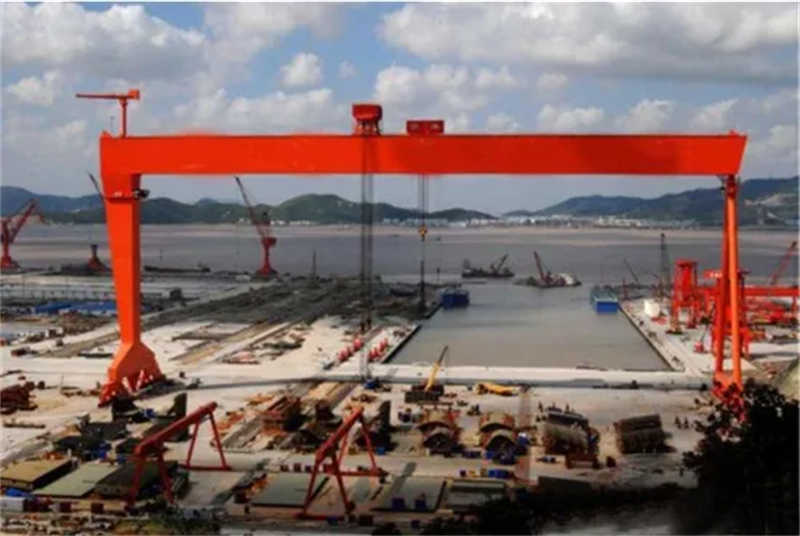
Part 2: Deconstructing the Engineering Marvel: Core Systems of the ME Model
2.1 The Double Girder Structure: A Foundation of Unyielding Strength
At the heart of the ME Model is its robust double girder design. Constructed from high-tensile, low-alloy steel, the main beams are engineered using Finite Element Analysis (FEA) to simulate and withstand the extreme stresses of heavy-duty, cyclic loading. This design ensures minimal deflection under full capacity, providing the stability required for handling high-value, sensitive loads. The entire structure is treated with a multi-stage anti-corrosion coating system, specifically formulated to resist the harsh, saline-laden air of coastal shipyards.
2.2 The Revolutionary Dual Trolley System: The Brain and Brawn
This is the crane’s most significant innovation. Instead of a single trolley, the ME Model features two independent trolleys that can travel along the same girders.
- Independent and Synchronized Control: Each trolley is equipped with its own hoisting mechanism and can be operated independently for separate tasks. However, their true power is revealed in synchronized mode, where a centralized Programmable Logic Controller (PLC) orchestrates their movements to act as a single, unified lifting unit.
- Load Balancing and Distribution: The PLC system automatically manages the load distribution between the two trolleys, preventing overloading on either side and ensuring the structural integrity of the load and the crane itself.
- Versatile Lifting Configurations: This system allows for a wide range of lifting configurations, adapting to the specific geometry of each load.
2.3 Precision Motion Control with Full AC Variable Frequency Drive (VFD)
Every motion of the ME Model—hoisting, trolley travel, and gantry long-travel—is governed by state-of-the-art AC Variable Frequency Drive technology.
- Smooth Operation: VFDs enable soft starts and stops, eliminating the jerky movements that cause dangerous load swing and potential damage to both the cargo and the crane’s structure.
- Micro-Speed Control: Operators can engage a micro-speed function for precise, inch-perfect positioning, which is absolutely critical during the final mating of large hull blocks.
- Energy Efficiency: By controlling motor speed and torque, VFDs significantly reduce power consumption compared to traditional contactor-based systems, leading to lower operating costs.
2.4 Comprehensive, Multi-Layered Safety Systems
Safety is non-negotiable in heavy industry. The Dongqi ME Model is built as a “Fail-Safe” fortress.
- Redundant Load Safety: Dual-load limiting devices (mechanical and electronic) prevent overloads. For each hoist, upper and lower limit switches provide redundant protection against over-travel.
- Anti-Collision Systems: The two trolleys are equipped with automatic anti-collision sensors to maintain a safe distance from each other. For shipyards with multiple gantry cranes, a yard-wide anti-collision system can be integrated.
- Fail-Safe Braking: Electrically released, spring-applied brakes engage automatically in the event of a power failure, securely holding the load.
- Environmental Resilience: The crane is rated for severe duty, with motors and electrical panels designed to withstand high humidity, wide temperature variations, and salt spray. All critical components are sealed to at least IP65 standards, protecting against dust and water jets.
Part 3: Real-World Applications: Transforming Shipyard Operations
The theoretical advantages of the ME Model are best understood through its practical, transformative applications on the shipyard floor.
- Application 1: The Aerial Flip (Load Rotation)
- Challenge: A large, curved hull plate needs to be flipped 180 degrees for welding on its other side. Using two separate cranes is logistically complex and risky due to potential communication errors between operators.
- Dongqi Solution: The two trolleys of the ME Model attach to opposite ends of the plate. Through coordinated lifting and lowering—with one trolley hoisting while the other remains static or descends—the crane performs a controlled, aerial flip of the entire load. This is done by a single operator using the pre-programmed synchronized mode, drastically reducing risk and time.
- Application 2: Long, Irregular Load Handling
- Challenge: A 40-meter-long ship hull section needs to be transported and positioned. A single lifting point would cause excessive bending stress (sagging).
- Dongqi Solution: The two trolleys are positioned at the optimal points along the girders to distribute the load’s weight evenly. They then lift and travel in perfect synchronization, keeping the hull section level and stress-free throughout the entire move.
- Application 3: Staggered Lifting for Complex Assembly
- Challenge: Installing a ship’s superstructure (the command bridge) requires one end to be lifted higher than the other to clear obstructions before being set down.
- Dongqi Solution: The independent control of the two trolleys allows operators to lift one end of the superstructure higher than the other, navigating it into place with unparalleled flexibility that a single-trolley crane cannot offer.
Part 4: Technical Specifications at a Glance
The following table outlines the standard configuration for the Dongqi ME Model series. All parameters are fully customizable to your project’s specific requirements.
| Parameter | Specification Range (Standard Models) | Notes |
|---|---|---|
| Lifting Capacity | Main Hoist: 5 – 500 Tons | Capacity split between the two trolleys as required. |
| Span | 18m – 50m+ | Custom-designed to your yard’s rail span. |
| Lifting Height | 10m – 30m+ | Adjustable based on your facility’s requirements. |
| Duty Class | A6 / A7 (FEM/ISO) | Suitable for heavy-duty shipyard applications. |
| Control Mode | Air-Conditioned Cabin + IP65 Rated Wireless Remote Control | Provides operator flexibility and optimal visibility. |
| Hoisting Speed | 0.5 – 5.0 m/min (VFD Controlled) | Fully variable with precision micro-speeds. |
| Trolley Travel Speed | 5 – 20 m/min (VFD Controlled) | Smooth and precise positioning along the girder. |
| Gantry Travel Speed | 10 – 30 m/min (VFD Controlled) | Efficient transit across the yard. |
| Power Supply | 3-Phase, 380V/480V, 50/60Hz | Configurable to regional standards. |
| Environmental Class | F2 (For high humidity) / Corrosion Protection | Essential for marine environments. |
Part 5: Beyond Shipbuilding: Versatility in Heavy Industry
While designed for shipyards, the ME Model’s capabilities make it an ideal solution for other sectors:
- Heavy Fabrication Shops: For handling and rotating large pressure vessels, wind turbine components, and mining machinery.
- Large-Scale Precast Concrete: For moving and positioning massive concrete elements for bridges and buildings.
- Ports and Terminals: For specialized heavy-lift operations beyond the scope of standard container cranes.
Conclusion: Partnering for a More Efficient and Safer Future
The Dongqi ME Model Double Trolley Shipyard Engineering Gantry Crane represents a paradigm shift in heavy-lift technology. It replaces brute force with intelligent power, replacing risk with calculated control. By investing in this advanced system, you are not just purchasing a piece of equipment; you are investing in a strategic asset that will pay dividends through:
- Accelerated Production Cycles
- Enhanced Worksite Safety
- Reduced Product Damage
- Optimized Yard Space and Workflow
- Lower Lifetime Operational Costs
At Dongqi Crane, we partner with our clients to deliver not just a product, but a complete solution. Our process includes in-depth consultation, custom engineering, professional installation, and a global service and support network.
Ready to elevate your shipyard’s capabilities? Contact our engineering team today for a free, no-obligation consultation and a customized proposal for the ME Model Double Trolley Gantry Crane, designed to meet the unique demands of your operation.
