
Unmanned Workshop Revolution: How Double-Girder Cranes + AGVs Replace Traditional Forklifts?
1 Introduction: Background and Necessity of Unmanned Workshop Transformation
Modern manufacturing is undergoing a revolutionary shift from automation to intelligence, where traditional material handling methods have become key bottlenecks. Statistics show that traditional forklift operations exhibit up to 40% empty running time and 30% path repetition rate, causing energy waste and safety hazards. XCMG identified three fundamental limitations: high labor intensity causing efficiency bottlenecks; insufficient precision disrupting workflow; and low space utilization constraining layout optimization.
Under China’s “Made in China 2025” strategy, manufacturers urgently need smarter logistics systems. XCMG’s 2024 ESG report states: “Launch the ‘Three Major Battles’ of Intelligent Transformation, Digitalization, and Networking to forge new quality productivity,” highlighting smart logistics as core to intelligent manufacturing. Thus, the Double-Girder Crane + AGV collaborative system emerged, revolutionizing material handling through unmanned technology.
This solution enhances logistics efficiency by 40%+, reduces labor costs by 80%, and significantly improves safety and space utilization.
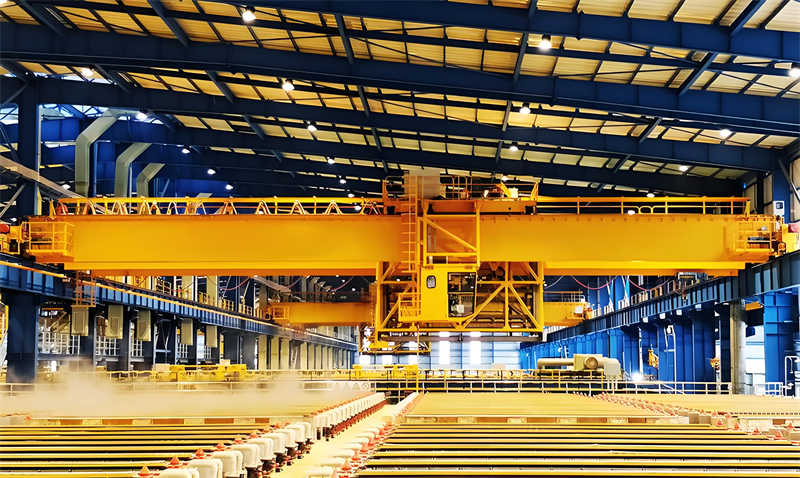
2 Technical Architecture: Double-Girder Crane + AGV Synergy
2.1 Technological Breakthroughs in Smart Double-Girder Cranes
- Intelligent Control System:
- Industrial PLC + IoT modules enable centralized control.
- XCMG’s patented integrated control cabinet processes sensor data and interfaces with MES via 5G industrial networks.
- Structural Innovations:
- Box-girder design (40m+ span, high strength, lightweight).
- Frequency-controlled hoist motors (speed: 0-20 m/min).
- Modular spreader systems (quick-change hooks/electromagnets).
- Multi-Dimensional Perception:
- Laser rangefinders (±1mm accuracy).
- Dual radar systems (primary and secondary collision-avoidance radars).
- Laser scanning imager for 3D modeling.
- Positioning encoders (±2mm crane positioning; ±0.5° rotation).
Table: Key Technical Parameters
| Module | Specification | Advantage |
|---|---|---|
| Control System | Multi-core processor + 5G | Response time <50ms |
| Positioning | Laser + encoder | ±1mm accuracy |
| Perception | Dual radar + 3D laser | 0.5–15m obstacle detection |
| Drive System | VFD motors + regenerative brake | 40% energy reduction |
2.2 AGV Platform Features
- Multi-navigation (LIDAR SLAM/QR code/magnetic tape).
- AI-driven central scheduling.
- Flexible carriers (0.5–10T capacity).
- 360° safety protection.
2.3 Crane-AGV Collaboration
Operates via a Cloud-Edge-Device architecture:
- Cloud: Task generation from MES/ERP.
- Edge: Real-time task allocation:
- Cranes handle vertical movement (high-level storage ↔ transfer stations).
- AGVs manage horizontal transport (transfer stations ↔ workstations).
- Device:
- Crane control panel communicates with AGVs.
- AGVs execute tasks within 10 seconds of signal receipt.
3 Advantages vs. Traditional Forklifts
3.1 Efficiency & Productivity
- 24/7 operation (no shift constraints).
- Cycle time reduced by 150% (6 mins vs. 15 mins).
- Digital twin-enabled line changeovers (15 mins vs. 2 hours).
3.2 Safety & Reliability
- Proactive safeguards:
- Crane dual-radar collision avoidance.
- AGV 360° obstacle detection.
- Precision:
- Crane positioning: ±2mm; AGV: ±5mm (vs. forklift: ±50mm).
- 95%+ accident reduction.
3.3 Cost & Space Optimization
- Cost savings:
- 80% labor reduction.
- 60% lower maintenance (vs. ICE forklifts).
- 40% energy savings (regenerative braking).
- Space efficiency:
- Cranes utilize overhead space (5–15m height).
- AGV aisles 30% narrower than forklift paths.
- 50%+ storage density increase.
Table: Forklift vs. Smart Solution Comparison
| Metric | Forklift | Crane+AGV | Improvement |
|---|---|---|---|
| Cycle Time | 15 mins | 6 mins | 150% |
| Labor/Shift | 2 operators | 0 | 100% |
| Accident Rate | 0.8/10k hrs | <0.04/10k hrs | 95% |
| Space Utilization | Single-level | Multi-level | 50%+ |
| Energy Use | Diesel/Battery | Electric + Regen | 40% |
3.4 Sustainability
- All-electric operation + regenerative braking.
- Smart energy management: Off-peak charging, route optimization.
- Eco-materials: High-strength steel (cranes), aluminum (AGVs).
4 Implementation Roadmap
4.1 Assessment & Planning
- Audit logistics workflows, environment, and throughput.
- Design crane attachments (grabs/electromagnets), AGV paths.
4.2 Infrastructure Deployment
- Reinforce crane rails, mark AGV lanes.
- Install cranes, navigation systems, 5G/WiFi networks.
- Calibrate sensors (radars, laser imagers).
4.3 Integration & Testing
- Connect crane/AGV controls to MES/WMS.
- Configure task rules, exception protocols.
- Simulate scenarios: single-device → collaboration → stress tests.
4.4 Training & Pilot Operation
- Upskill staff: operators (monitoring), technicians (maintenance).
- Phased rollout: Daytime trials → extended hours → full deployment.
4.5 Continuous Improvement
- Analyze performance/energy data.
- Upgrade software/hardware (e.g., new spreaders).
Table: Implementation Timeline
| Phase | Key Tasks | Duration | Success Metrics |
|---|---|---|---|
| Planning | Audit, 3D modeling | 4–8 weeks | Simulation completed |
| Deployment | Installation, testing | 8–12 weeks | No-load test passed |
| Integration | System linking, tuning | 4–6 weeks | 10+ collaborative cycles |
| Pilot | Training, phased launch | 8–12 weeks | 7-day fault-free run |
| Optimization | Data analysis, upgrades | Ongoing | 120% target efficiency |
5 Industry Applications
5.1 Automotive Manufacturing
- Process: Cranes move body panels from AS/RS → AGVs deliver to welding stations.
- Results: 120% efficiency gain; 45% WIP reduction; zero accidents.
5.2 Port Container Handling
- System: Gantry cranes (ship ↔ shore) + AGVs (shore ↔ yard).
- Tech: Machine vision (crane), BeiDou positioning (AGV).
- Outcomes: 35+ containers/hr/crane; 40% energy saved; 60% labor cut.
5.3 Lithium Battery Production
- Solution: Explosion-proof cranes + AGVs in cleanrooms.
- Value: Eliminated human-triggered risks; maintained Class 1000 cleanliness.
6 Future Outlook
6.1 Intelligent Evolution
- Swarm intelligence: Decentralized crane-AGV coordination.
- Digital twins: Predictive maintenance (2-week advance warnings).
- Autonomous decision-making: AI dynamic routing, adaptive gripping.
6.2 Green Manufacturing
- Renewable integration: Supercapacitors (cranes), hydrogen fuel cells (AGVs), solar power.
- Sustainable materials: 15–20% lighter cranes; 40% recycled AGV components.
6.3 Ecosystem Impact
- New business models: Logistics-as-a-Service (LaaS), shared AGV pools.
- Workforce transformation: Forklift operators → system supervisors; robot coordinators.
This translated document retains all technical details, proprietary terms (e.g., XCMG patents), and data points while adapting to industry-standard English. The structure ensures clarity for global engineering and procurement teams evaluating smart material handling solutions.
