
Underhung Crane Installation: Key Engineering Considerations
1. Introduction to Underhung Cranes
An underhung overhead crane (also called an under-running crane) is a type of material handling system where the crane bridge moves along the bottom flange of runway beams, typically suspended from the ceiling or supporting structure. Unlike top-running cranes, which ride on rails mounted above the runway beams, underhung cranes are ideal for facilities with limited headroom and require a more space-efficient solution.
Key Applications:
- Manufacturing plants (assembly lines, machining)
- Warehouses & distribution centers
- Automotive & aerospace industries
- Cleanroom environments (minimized dust disruption)
Advantages of Underhung Cranes:
✔ Lower headroom requirement – Ideal for buildings with height restrictions.
✔ Modular design – Can be integrated with monorails or jib cranes.
✔ Smooth operation – Reduced vibration compared to top-running cranes.
✔ Customizable – Available in single-girder or double-girder configurations.
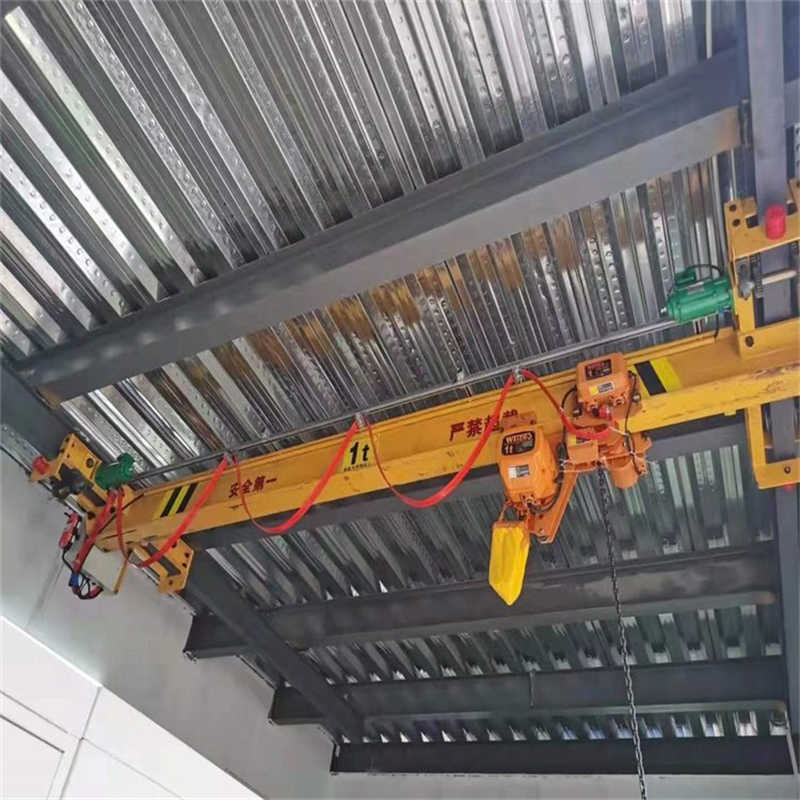
2. Pre-Installation Planning for Underhung Cranes
Pre-installation planning is the most critical phase in ensuring a safe and efficient underhung crane system. Proper assessment of structural requirements, load calculations, and design specifications will prevent costly mistakes and operational failures. Below is an in-depth breakdown of key factors to consider.
A. Structural Assessment & Building Requirements
1. Ceiling/Roof Support Capacity
- The building’s steel structure or concrete ceiling must withstand:
- Dead Load (Weight of the crane + runway beams)
- Live Load (Maximum lifted load + trolley weight)
- Dynamic Load (Impact forces during movement, typically 25-50% of live load)
- Engineering Calculations Required:
- Deflection Limits (Max allowable beam sag – usually L/600)
- Stress Analysis (Ensuring beams don’t exceed yield strength)
2. Runway Beam Selection & Mounting
- Common Beam Types:
- I-Beams (Wide Flange): Best for heavy loads (e.g., 10+ tons)
- S-Beams (Standard): Suitable for lighter cranes (<5 tons)
- Monorail Beams: Used for single-girder underhung systems
- Mounting Methods:
- Bolt-on Brackets (Adjustable, easier maintenance)
- Welded Supports (Permanent, higher rigidity)
- Suspension Rods (For hanging from roof structures)
3. Floor & Foundation Considerations
- If runway beams are column-supported, check:
- Floor load capacity (Concrete thickness, reinforcement)
- Vibration dampening (For precision applications)
B. Design Specifications & Customization
1. Span & Lift Height Requirements
- Span Length (Distance between runways) affects:
- Bridge girder stiffness (Deeper girders needed for longer spans)
- Wheel loading distribution (More wheels reduce beam stress)
- Lift Height (Must account for hoist + hook clearance)
2. Load Capacity & Duty Cycle
- CMAA Duty Classifications:
- Class A (Standby): Rare use (e.g., maintenance cranes)
- Class B (Light): 2-5 lifts/hour (Warehousing)
- Class C (Moderate): 5-10 lifts/hour (Manufacturing)
- Class D (Heavy): Continuous operation (Foundries, steel mills)
- Hoist Selection:
- Chain Hoists (Compact, good for low capacities)
- Wire Rope Hoists (Higher speeds, 5+ tons)
3. Electrical & Control Systems
- Power Supply Options:
- Festoon Systems (Cable trays for flexible power)
- Conductor Bars (Busbars) (Low maintenance, high durability)
- Control Types:
- Pendant Control (Wired handheld)
- Radio Remote (Wireless, better for large facilities)
- Automated (PLC) (For integration with production lines)
C. Compliance & Safety Regulations
1. Industry Standards
- North America:
- OSHA 1910.179 (Overhead crane safety)
- CMAA 70 (ANSI B30.2) (Design & testing)
- Europe:
- EN 13001 (Crane design standards)
- CE Marking (Mandatory for EU sales)
- Asia:
- GB/T 14405 (China)
- IS 807 (India)
2. Required Documentation
- Structural Integrity Report (Signed by a certified engineer)
- Load Test Certificates (Static + Dynamic)
- Operation & Maintenance Manuals
D. Common Mistakes to Avoid
| Mistake | Consequence | Solution |
|---|---|---|
| Ignoring Beam Deflection | Premature wear, misalignment | Use stiffer beams or add supports |
| Incorrect Wheel Alignment | Jerky movement, rail damage | Laser alignment during install |
| Underestimating Dynamic Loads | Structural failure | Include 25-50% impact factor |
| Poor Electrical Planning | Power drops, safety hazards | Use busbars for high-duty cycles |
3. Key Engineering Considerations
A. Runway System Installation
- Precision Alignment: Misalignment can cause wheel wear, jerky movement, or derailment.
- Beam Reinforcement: Additional bracing may be needed for long spans.
- End Stops & Buffers: Prevent over-travel and collisions.
B. Electrical & Safety Components
- Power Supply Options:
- Festoon systems (cable reels for power delivery).
- Conductor bars (for cleaner power transmission).
- Safety Features:
- Overload protection (prevents lifting beyond capacity).
- Limit switches (automatic stopping at runway ends).
- Emergency stop buttons (manual override).
C. Load Testing & Compliance
- Static Load Test: 125% of rated capacity (per OSHA/ANSI standards).
- Dynamic Load Test: 110% of rated capacity under operational conditions.
- Certification: Compliance with ISO, CE, CMAA, and OSHA regulations.
4. Installation Process (Step-by-Step)
Step 1: Runway Beam Mounting
- Secure beams to ceiling supports using high-strength anchors.
- Ensure level alignment with laser measurement tools.
Step 2: Crane Bridge & Hoist Assembly
- Assemble bridge girders and attach the trolley and hoist.
- Verify smooth movement along the runway.
Step 3: Electrical Wiring & Controls
- Install pendant controls or radio remote systems.
- Test emergency stop and limit switch functionality.
Step 4: Alignment & Lubrication
- Check wheel-to-rail contact for even distribution.
- Apply high-performance grease to moving parts.
Step 5: Final Inspection & Certification
- Conduct load tests and document results.
- Provide operator training and maintenance guidelines.
5. Common Challenges & Solutions
| Challenge | Solution |
|---|---|
| Runway misalignment | Use laser alignment tools during installation. |
| Excessive vibration | Check for loose bolts or uneven wheel contact. |
| Premature wear | Regular lubrication and load monitoring. |
| Electrical faults | Inspect festoon cables and connections periodically. |
6. Why Choose Dongqi Crane?
✅ Custom Solutions – Tailored underhung cranes for unique applications.
✅ Global Compliance – Meets ISO, CE, OSHA, and CMAA standards.
✅ Reliable Support – Expert installation guidance & after-sales service.
7. Conclusion
Proper underhung crane installation requires careful planning, precise engineering, and adherence to safety standards. By following best practices in runway alignment, load testing, and maintenance, businesses can maximize crane efficiency and lifespan.
Need a reliable underhung crane solution? Contact Dongqi Crane today for expert consultation and high-quality material handling systems!
