
Underhung Cranes for Light-Duty Lifting: Cost-Effective & Space-Saving Solutions
Introduction
In industries where precision, efficiency, and space optimization matter, underhung cranes (also called under-running cranes) offer a smart solution for light-duty material handling. Designed to operate on the bottom flange of overhead runway beams, these cranes are ideal for workshops, assembly lines, and warehouses needing 1-10 ton lifting capacity.
Compared to traditional top-running cranes, underhung systems provide lower costs, easier installation, and better space utilization—making them a preferred choice for light-load applications. In this guide, we’ll explore how underhung cranes work, their key benefits, and why Dongqi Crane’s solutions stand out in reliability and performance.
How Underhung Cranes Work
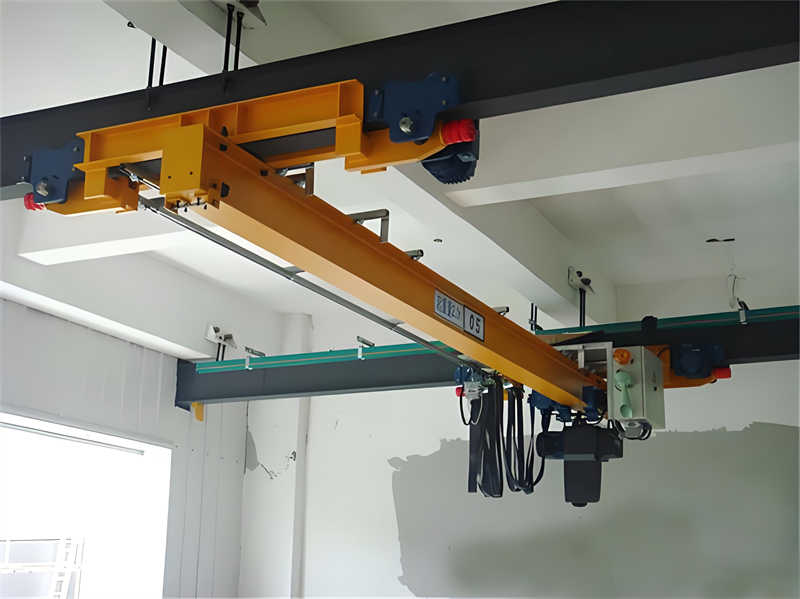
Underhung cranes (also called under-running cranes) operate differently from traditional overhead cranes, offering unique advantages for light-duty applications. Below is a detailed technical and operational explanation of how these cranes function.
1. Structural Components of an Underhung Crane
An underhung crane system consists of several key parts:
① Runway Beams (Support Structure)
- Made of steel I-beams attached to the building’s ceiling or support structure.
- The crane runs along the bottom flange of these beams (unlike top-running cranes, which ride on top).
- Can be single-girder (for lighter loads) or double-girder (for wider spans).
② Bridge Girder (Main Horizontal Beam)
- Moves perpendicular to the runway beams.
- Supports the hoist and trolley, which carry the load.
- Constructed from welded steel for durability and lightweight efficiency.
③ End Trucks (Wheel Assemblies)
- Located at each end of the bridge girder.
- Equipped with steel wheels that roll along the bottom flange of the runway beams.
- Can be motorized (for electric cranes) or manual (for push-operated models).
④ Hoist & Trolley (Lifting Mechanism)
- The hoist (electric chain hoist or wire rope) lifts and lowers the load.
- The trolley moves the hoist horizontally along the bridge girder.
- Options: Manual chain hoist (for low-frequency use) or electric hoist (for automation).
2. Movement & Operation Mechanism
① Longitudinal Travel (Along the Runway Beams)
- The entire crane (bridge girder + hoist) moves parallel to the runway beams via motorized or manual end trucks.
- Allows the crane to cover the entire length of the workspace.
② Cross Travel (Along the Bridge Girder)
- The trolley moves side-to-side across the bridge girder.
- Enables precise positioning of the load.
③ Vertical Lifting (Hoist Operation)
- The hoist raises/lowers the load via chain or wire rope.
- Electric hoists offer variable speed control for smooth handling.
3. Power & Control Systems
① Power Supply Options
- Electric Underhung Cranes:
- Powered by conductor bars, festoon systems, or cable reels.
- Ideal for frequent use in workshops or production lines.
- Manual Underhung Cranes:
- Operated by hand-pushing the bridge and using a chain hoist.
- Best for low-budget, low-frequency lifting needs.
② Control Methods
- Pendant Control: Handheld remote for floor-operated cranes.
- Radio Remote Control: Wireless operation for improved safety & flexibility.
- Cab Control: Rare in underhung cranes (more common in large top-running cranes).
4. Load Distribution & Stability
- Unlike top-running cranes, underhung cranes do not require additional support columns because they hang from the ceiling.
- The runway beams must be structurally sound to handle:
- The weight of the crane + load.
- Dynamic forces (e.g., movement, acceleration, braking).
- Proper wheel alignment prevents derailment and ensures smooth operation.
5. Safety Features
Underhung cranes include several safety mechanisms:
✔ Overload Protection – Prevents lifting beyond capacity.
✔ Limit Switches – Stops the crane at runway ends to avoid collisions.
✔ Emergency Stop Button – Allows immediate shutdown.
✔ Anti-Sway Technology (Optional) – Minimizes load swinging for precision tasks.
6. Why This Design Is Ideal for Light-Duty Use
- Space Efficiency: No need for floor-mounted supports.
- Lower Costs: Uses existing building structures.
- Smooth Handling: Precise movement for assembly, packaging, and maintenance.
Key Advantages of Underhung Cranes for Light-Duty Use
Underhung cranes offer distinct benefits that make them particularly suitable for light-duty material handling applications (typically 1-10 tons). Here’s an in-depth look at their advantages:
1. Space Optimization & Facility Layout Flexibility
- Ceiling-Mounted Design: Utilizes overhead space that would otherwise go unused, keeping floor areas completely clear
- No Support Columns Required: Unlike top-running cranes, doesn’t require additional floor supports that disrupt workflow
- Low Headroom Operation: Ideal for facilities with height restrictions (minimum clearance as low as 6 inches possible)
- Modular Configuration: Can be designed around existing equipment and building obstructions
2. Cost Efficiency Across the Equipment Lifecycle
- Lower Initial Investment: Typically 20-30% less expensive than equivalent top-running cranes
- Reduced Installation Costs: Utilizes existing building structure (saves on support steel requirements)
- Energy Savings: Smaller motors consume less power for light loads (up to 40% less than heavy-duty systems)
- Maintenance Savings: Simplified design with fewer wear components reduces upkeep costs
3. Enhanced Operational Performance
- Precision Handling: Smooth movement ideal for delicate assembly operations (positioning accuracy within ±1/16″)
- Quieter Operation: Produces less noise than top-running models – important for work environments
- Variable Speed Control: Available options allow perfect speed matching to application requirements
- Improved Ergonomics: Reduces worker fatigue by eliminating manual material movement
4. Safety & Compliance Benefits
- Built-in Safety Features: Standard includes overload protection, limit switches, and emergency stops
- Reduced Swing: Stable load movement minimizes dangerous load oscillations
- Clear Floor Visibility: Open design gives operators unobstructed views of lifting operations
- Compliance Ready: Meets all relevant ISO, ANSI, and OSHA standards for overhead lifting
5. Application-Specific Advantages
- For Manufacturing:
- Enables just-in-time part delivery to workstations
- Supports lean manufacturing initiatives
- Facilitates quick changeovers between products
- For Warehousing:
- Maximizes storage density by eliminating floor-based equipment
- Allows direct transfer between storage and loading areas
- Supports first-in/first-out inventory management
- For Maintenance Shops:
- Provides full coverage of work areas
- Enables single-operator handling of heavy components
- Reduces equipment damage during repairs
6. Future-Proofing Your Operation
- Scalable Capacity: Systems can be designed for easy capacity upgrades
- Technology Integration: Compatible with automation and smart factory systems
- Reconfigurable Layouts: Can be modified as production needs change
- Sustainable Design: Energy-efficient operation supports green initiatives
Real-World Impact Example:
A mid-sized auto parts manufacturer replaced their floor-based jib cranes with an underhung system, achieving:
- 35% increase in production area utilization
- 28% reduction in material handling time
- ROI in just 14 months through productivity gains
Common Light-Duty Applications
Underhung cranes are widely used in industries where small to medium loads require frequent movement:
- Manufacturing: Assembly lines, part handling, and machine servicing.
- Warehousing: Transporting lightweight materials and packaged goods.
- Automotive & Aerospace: Handling small components with precision.
- Maintenance Workshops: Lifting tools, motors, and equipment safely.
Underhung Cranes vs. Top-Running Cranes: Which is Better?
| Feature | Underhung Crane | Top-Running Crane |
|---|---|---|
| Installation | Uses building structure | Requires extra support |
| Cost | Lower initial investment | Higher upfront cost |
| Load Capacity | Best for 1-10 tons | Designed for 10+ tons |
| Space Efficiency | Compact, ideal for low headroom | Needs more vertical clearance |
→ Best Choice for Light-Duty? Underhung cranes win for cost, space savings, and flexibility in light-load environments.
Why Choose Dongqi Underhung Cranes?
Dongqi Crane specializes in high-quality, customizable underhung cranes for light-duty industries. Our solutions offer:
- Durable Construction: Corrosion-resistant steel for long-term reliability.
- Safety Compliance: Meets ISO, CE, and OSHA standards.
- Custom Options: Adjustable spans, hoist types (electric/manual), and load capacities.
- Expert Support: From design to installation and maintenance.
Conclusion
For businesses needing efficient, budget-friendly lifting solutions, underhung cranes provide the perfect balance of performance, space savings, and cost efficiency. Whether in manufacturing, warehousing, or maintenance, these cranes optimize workflow without heavy infrastructure investments.
Ready to explore underhung crane solutions?
📞 Contact Dongqi Crane today for a free consultation or quote!
