
Top Running vs Under Running Crane: Which Is Right for Your Needs?
Introduction
When selecting an overhead crane for industrial or warehouse applications, two primary options are Top Running Cranes and Under Running Cranes (also called Underhung Cranes). Each type has distinct advantages in terms of space utilization, load capacity, cost, and installation requirements.
This guide compares Top Running vs Under Running Cranes across key factors to help you determine the best fit for your operations.
1. What Are Top Running and Under Running Cranes?
When selecting an overhead crane system, understanding the fundamental differences between top running cranes and under running cranes (also called underhung cranes) is crucial. These two designs serve distinct purposes and are engineered for different operational environments. Below, we explore each type in detail, including their structural configurations, working mechanisms, and typical applications.
Top Running Cranes: Heavy-Duty Overhead Lifting

Structural Design:
A top running crane is characterized by its bridge beam running on top of elevated runway rails, which are supported by either freestanding columns or the building’s structural framework. The crane’s end trucks (wheel assemblies) move along these rails, allowing the hoist and trolley to traverse the length of the runway.
Key Components:
- Runway Beams: Heavy-duty steel beams that support the crane’s movement.
- End Trucks: Wheeled mechanisms that facilitate horizontal motion.
- Hoist & Trolley: The lifting mechanism that travels across the bridge.
Why Choose a Top Running Crane?
This design is optimized for heavy loads, typically ranging from 5 tons to over 500 tons, making it ideal for industries such as:
- Steel manufacturing (handling molten metal, coils, and large structural components).
- Power generation (lifting turbines, generators, and heavy machinery).
- Shipbuilding & aerospace (moving massive assemblies with precision).
Advantages:
✔ Higher load capacity – Built for extreme weights.
✔ Greater span capabilities – Can cover wider work areas.
✔ Minimal deflection – More stable under heavy loads.
Limitations:
✖ Requires reinforced support structures – May need additional column bracing.
✖ Higher initial cost – Due to structural modifications.
Under Running (Underhung) Cranes: Space-Efficient Material Handling
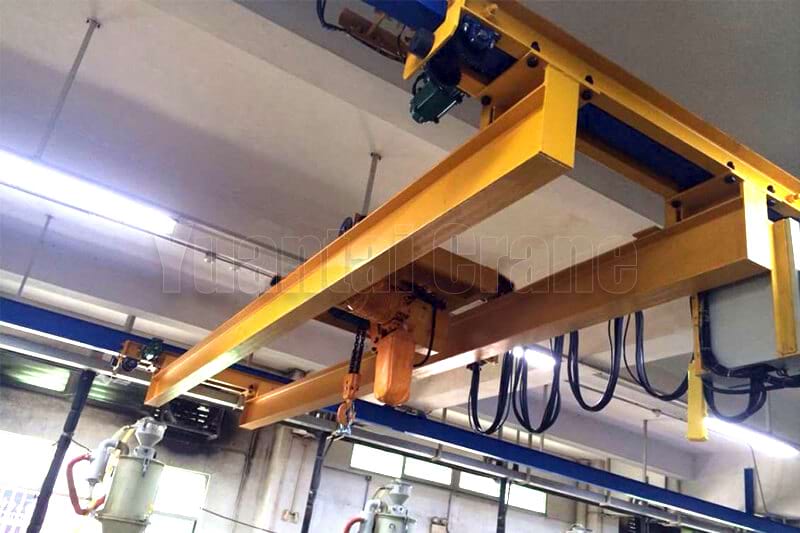
Structural Design:
Unlike top running cranes, under running cranes are suspended from the bottom flange of overhead runway beams, which are typically attached to the ceiling or roof support structure. The entire crane system—bridge, hoist, and trolley—hangs beneath the runway, making it a space-saving solution for facilities with height restrictions.
Key Components:
- Runway Beams: Mounted to the ceiling structure rather than standalone columns.
- Suspended Bridge: Moves along the underside of the runway.
- Compact Hoist & Trolley: Designed for lighter loads.
Why Choose an Under Running Crane?
This type is best suited for light to medium-duty lifting (0.5 to 20 tons), commonly used in:
- Warehousing & logistics (moving pallets, boxes, and packaged goods).
- Automotive assembly lines (transporting vehicle parts).
- Food processing & packaging (handling lightweight products).
Advantages:
✔ Saves vertical space – Ideal for low-clearance buildings.
✔ Lower installation cost – Uses existing roof support structures.
✔ Modular & adaptable – Easier to reconfigure for layout changes.
Limitations:
✖ Limited load capacity – Not suitable for extremely heavy materials.
✖ Potential for more wear – Hanging design may increase maintenance needs.
2. Key Comparison Factors
A. Space Utilization
| Factor | Top Running Crane | Under Running Crane |
|---|---|---|
| Headroom Requirement | Needs significant vertical clearance | Requires less headroom |
| Floor Space Usage | No interference with floor operations. | Maximizes vertical space, ideal for low-ceiling facilities. |
| Best For | High-bay facilities (e.g., steel plants, shipyards). | Warehouses, workshops with height restrictions. |
Takeaway:
- Top Running is better for tall buildings needing heavy lifting.
- Under Running is more space-efficient in low-clearance environments.
B. Load Capacity
| Factor | Top Running Crane | Under Running Crane |
|---|---|---|
| Typical Capacity | 5 tons – 500+ tons. | 0.5 tons – 20 tons. |
| Structural Support | Requires reinforced runway beams. | Relies on ceiling/roof structure strength. |
| Best For | Heavy manufacturing, steel, construction. | Light assembly, packaging, maintenance. |
Takeaway:
- Top Running cranes handle much higher loads due to their robust design.
- Under Running cranes are limited by the ceiling’s load-bearing capacity.
C. Cost Comparison
| Factor | Top Running Crane | Under Running Crane |
|---|---|---|
| Initial Cost | Higher (requires reinforced support structure). | Lower (uses existing ceiling structure). |
| Installation Complexity | More complex (needs structural modifications). | Simpler (bolted to existing beams). |
| Maintenance Cost | Lower (rails endure less wear). | Higher (more frequent wheel and rail wear). |
Takeaway:
- Under Running cranes are cheaper upfront but may cost more in maintenance.
- Top Running cranes have a higher initial investment but better longevity for heavy use.
D. Installation & Flexibility
| Factor | Top Running Crane | Under Running Crane |
|---|---|---|
| Structural Modifications | Requires reinforced columns/runway beams. | Minimal changes (attaches to ceiling). |
| Mobility & Expansion | Fixed, harder to modify. | Easier to relocate or expand. |
| Best For | Permanent, high-capacity setups. | Flexible, adaptable layouts. |
Takeaway:
- Under Running cranes are better for dynamic layouts (e.g., modular factories).
- Top Running cranes are ideal for permanent, high-load installations.
3. Which One Should You Choose?
Choose a Top Running Crane If:
✔ You need heavy lifting (20+ tons).
✔ Your facility has high ceilings and strong structural support.
✔ You prioritize durability and long-term use.
Choose an Under Running Crane If:
✔ You have limited headroom (low ceilings).
✔ Your lifting needs are light to medium-duty (<20 tons).
✔ You want a cost-effective, flexible solution.
Industry Applications: Where Top Running and Under Running Cranes Excel
Top Running Crane Applications: Powering Heavy Industries
Top running cranes dominate industries where extreme load capacities and rugged durability are non-negotiable. These workhorses of material handling excel in environments that demand:
A. Steel Production & Metal Fabrication
- Molten metal handling: Specialized ladle cranes with 200-500t capacity move scorching steel in foundries
- Coil transportation: Massive 50-100t cranes with C-hooks efficiently maneuver heavy steel coils
- Plate handling: Magnet-equipped cranes lift and position large steel plates with millimeter precision
B. Power Generation Facilities
- Turbine installation: 300-800t capacity cranes carefully lower multi-ton turbines into position
- Generator maintenance: Precision cranes with micro-movement capabilities for delicate component alignment
- Nuclear plant refueling: Radiation-resistant cranes handle radioactive materials in containment buildings
C. Heavy Manufacturing & Shipbuilding
- Press line servicing: 50-150t cranes maintain massive stamping presses in automotive plants
- Ship block assembly: Goliath cranes with 50m+ spans assemble prefabricated ship sections
- Mining equipment assembly: Cranes position enormous dragline buckets and mining truck frames
D. Specialized Heavy Applications
- Aerospace: Custom-engineered cranes handle delicate but enormous aircraft components
- Concrete production: Abrasion-resistant cranes service precast concrete plants
- Railcar manufacturing: Dual-hoist systems lift entire railcar bodies for assembly
Under Running Crane Applications: Maximizing Efficiency in Light/Medium Duty
Under running cranes shine in operations where space optimization and flexible material flow are paramount:
A. Manufacturing & Assembly Operations
- Automotive production: 1-10t cranes feed parts to assembly lines with precise positioning
- Machining centers: Jib crane combinations service CNC machine tools in job shops
- Electronics manufacturing: Clean room-compatible cranes handle sensitive components
B. Warehousing & Distribution
- Package handling: 0.5-5t cranes with vacuum lifters streamline box and pallet movement
- Cold storage: Low-temperature rated cranes operate in freezer warehouses
- Cross-docking: Modular systems adapt to changing warehouse layouts
C. Food & Beverage Processing
- Bottling lines: Sanitary stainless steel cranes meet FDA hygiene requirements
- Ingredient handling: Explosion-proof models service flour and sugar processing
- Packaging areas: Quick-disconnect hoists facilitate changeovers
D. Special Light-Duty Applications
- Maintenance bays: Versatile cranes service equipment in repair facilities
- Laboratories: Precision cranes with sensitive controls for delicate instruments
- Art studios: Custom-finished cranes handle valuable sculptures and displays
Hybrid Applications: When Both Types Work Together
Many facilities employ a strategic mix of both crane types:
- Automotive megaplants: Top running cranes handle press lines while under running systems service assembly
- Aerospace facilities: Massive top running cranes move wing assemblies while under running cranes feed components
- Food processing: Under running cranes handle packaging while top running cranes service processing equipment
Emerging Application Trends
- Automated top running cranes: AI-guided systems in smart factories
- Modular under running systems: Reconfigurable cranes for agile manufacturing
- Hybrid energy cranes: Regenerative power systems in both crane types
This detailed breakdown shows how each crane type serves distinct yet complementary roles across industries. The right choice depends on your specific operational requirements, facility constraints, and growth plans. Would you like me to elaborate on any particular industry application?
5. Frequently Asked Questions (FAQs)
Q1. Can I use both crane types in the same facility?
Yes! Some facilities combine them—Top Running for heavy-duty areas and Under Running for lighter tasks.
Q2. How do I know if my building supports a Top Running crane?
A structural engineer must assess roof/column load capacity before installation.
Q3. Which is more energy-efficient?
Under Running cranes typically use less power due to lighter loads.
6. Conclusion
The choice between Top Running and Under Running Cranes depends on:
- Load requirements (heavy vs. light).
- Space constraints (high vs. low ceilings).
- Budget (initial vs. long-term costs).
For heavy industrial use, Top Running is the best choice.
For light-duty, space-limited applications, Under Running is more practical.
Need help deciding? Consult a crane specialist to evaluate your facility’s needs!
Would you like additional details on customization options (e.g., motorized vs. manual cranes)? Let me know!
